Friday, February 29, 2008

At Maple Bridge

Source: Abebooks

I was heartened on the Underground the other day to see a Gary Snyder poem in the carriage among the adverts: 'On Maple Bridge' (1984) paired with his translation of 'Maple Bridge Night Mooring' (c.765) by Chang Chi. Back in 765, the temple bell could be heard by Chang Chi in his boat; Gary Snyder noted that its sound had now travelled far across the sea. I think it was possible to hear it faintly down in the Victoria Line amid the crush of morning commuters.


I was even more pleased to spot on YouTube recently some great footage of a Gary Snyder reading. Here are the links: Part 1, Part 2, Part 3, Part 4.


This is the 300th post on Some Landscapes, and I think it's sometimes a little hard to see coherent patterns and themes emerging here. I've been looking again at Gary Snyder: Dimensions of a Life, a festschrift published back in 1991 by the Sierra Club. It includes an essay by Peter Coyote describing a cross-referenced library card index system Snyder has evolved, to organise his quotes, thoughts and ideas. There is, of course, a big step between this simple academic kind of organisation and the ability to organise one's perceptions of the world. Coyote writes that Snyder does this and then goes a step further again, by actually 'identifying with the patterns he perceives... he might, for instance, feel that the back of his head opens onto the Sierra mountain range, and that that range is his spine.' It's natural to identify Snyder with the Sierra landscape. Flicking back to a poem in the same book, 'September Ridge' by Will Peterson, there's a quote from Snyder, writing in Japan more than fifty years ago, that 'the best wandering mountains in the world may be the high sierra - no bugs, no rain, no people, clear cool sunshine & hundreds of square miles of alpine terrain...'

Monday, February 25, 2008

The Artist on the Seashore at Palavas


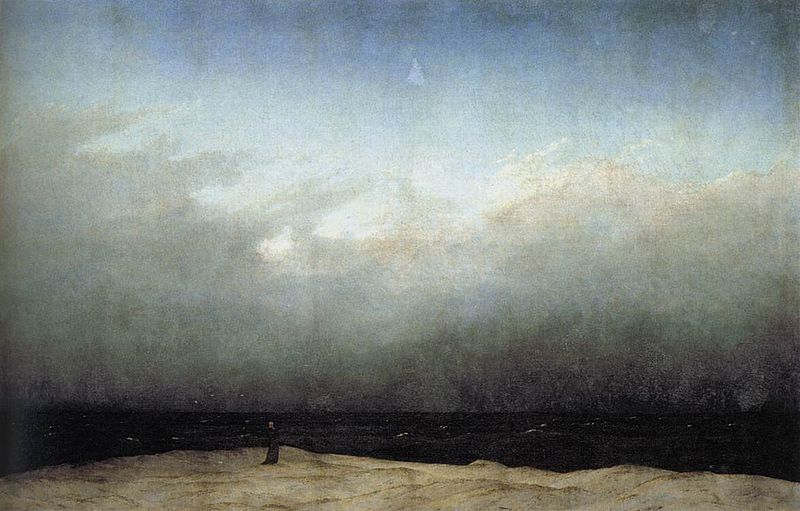
Caspar David Friedrich, Monk by the Sea, 1809
Source: Wikimedia Commons

Robert Rosenblum’s book Modern Painting and the Northern Romantic Tradition: From Friedrich to Rothko traces a lineage from Monk by the Sea (1809) to Green on Blue (1956) by way of ‘Romantic’ paintings by Blake, Runge, Van Gogh, Munch, Kandinsky, Ernst, Mondrian... Rosenblum’s thesis was first elaborated in a set of lectures delivered in 1972. It is interesting to think of some of the ‘Northern’ artists from the last fifty years that a revised version of the book written today might include. Andreas Gursky perhaps? Olafur Eliasson? Peter Doig? A look through the index to this site suggests quite a few other possible names.

And what of the other kind of non-Northern, non-Romantic artist? Rosenblum provides a couple of interesting contrasts with the aesthetic of Monk by the Sea. Gustave Courbet’s The Artist on the Seashore at Palavas (1854) combines the same basic elements as Friedrich’s painting. ‘Yet far from suggesting silent absorption into some spiritual beyond, the figure appears strangely earthy and self-assertive. It is no surprise to read Courbet’s comments on this self-portrait: “Oh sea! your voice is tremendous, but it will never succeed in drowning out the voice of fame as it shouts my name to the whole world!”’ Great stuff! For more on Courbet’s ego, see the article by John Golding in a recent New York Review of Books (the same issue has an article about blogs: “Blog writing is id writing—grandiose, dreamy, private, free-associative, infantile, sexy, petty, dirty” - hmm... I’m not sure how many of these adjectives I recognise. But it makes me think Courbet would have written an entertaining blog.)

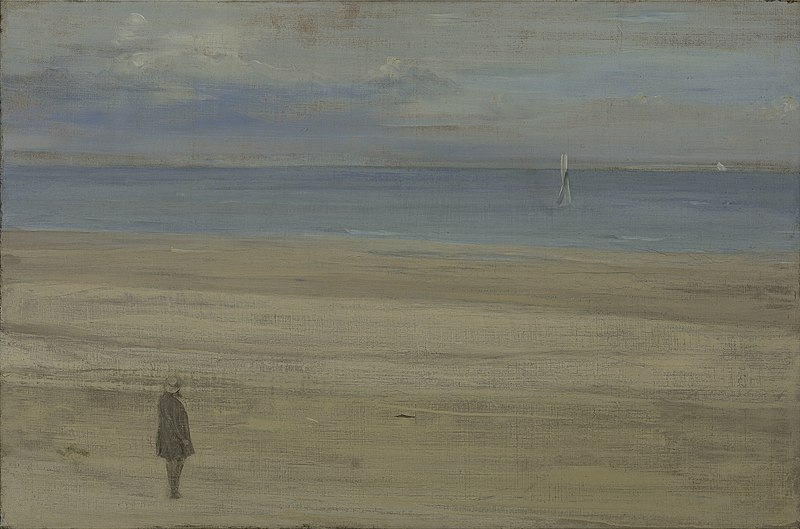
‘Eleven years later,’ Rosenblum continues, ‘in 1865, Whistler, by then thoroughly steeped in the art pour l’art ambience of Paris, also painted a picture of Courbet, who now stands on the beach at Trouville, once more turned to the unbroken stretch of sand and sea. This time, Courbet’s swollen ego has vanished in favour of a ghost of a figure, hardly discernible as anyone at all. Yet if the presence of this lone figure as the only human element on a deserted beach can evoke some whisper of mood, the painting nevertheless imposes itself primarily as an exquisite tour de force of muted tonalities arranged in horizontal tiers.’ Whistler originally called the painting Harmony in Blue and Silver, thus emphasising its abstract qualities over any sense of sublime mystery. And so both Courbet and Whistler, working in France, represent for Rosenblum a different way of painting landscapes to the Northern Romantic tradition.


James Abbott McNeill Whistler, Harmony in blue and silver: Trouville (1865)
Source: Wikimedia Commons

In contemporary art it is no doubt possible, though perhaps not easy, to find similar comparisons. How about Francis Alÿs versus Richard Long for example? Any others? It’s appealing to think that the ‘Northern Romantic tradition’ might still be possible to trace, partly because the whole idea seems so old-fashioned, partly because it is so easy to imagine that today’s global art world would make even such broad generalisations seem, in reality, quite implausible.

Friday, February 22, 2008

Klausen Pass

According to Fiona Bradley, when Andreas Gursky 'photographed the scene that became Klausen Pass (1984), he did not notice the people scattered at the base of the mountain. Looking at the photograph later, he identified the people as the reason for the success of the image: dispersed throughout the field of vision, the people direct and animate it' (Andreas Gursky: Images 1995). This account seems rather unlikely even for an amateur photographer - who photographs a landscape without instinctively noting where other people are and how it will affect the image? In other works from the early eighties, Andreas Gursky was finding interesting groups of people to photograph, like Sunday Walkers, Dusseldorf (1984)... the scatter of figures on the sunny mountainside in Klausen Pass seem too interesting to have been overlooked in the work's composition.

It is true, however, that in Klausen Pass the individuality of the adults and children standing and walking through the image can be ignored - as part of the composition they are an irregular sequence of coloured forms leading the eye up a path to the mountain. They provide some scale like the small foreground figures in traditional picturesque painting. And yet because the photographic medium means we are looking at real people, rather than, say, anonymous pastoral shepherds, they remain intriguing. Why is that woman walking off the path? Who is that bare-chested man waiting for? Which of these people know each other and which are strangers?

In later works by Andreas Gursky, individual people may be absent, but the traces of human activity - rows of windows, cars, containers - continue to provoke questions about what we are looking at. In general his landscapes are given structure and pattern by groups of figures and the accumulation of human artifacts. This gives them their distinctive formal beauty whilst simultaneously drawing attention to some of the ways in which we now work, travel and spend our leisure time.

Saturday, February 16, 2008

A morbid melancholy

"The works of Caspar David Friedrich, hitherto almost totally unknown in this country, will be a revelation for the British Art public..." When was this written? 1822? 1872? 1922? It is actually on the back of the Tate Gallery's 1972 Friedrich exhibition catalogue, "the only full-scale publication on Friedrich in English". Well there must have been a lot of books on Friedrich since then, but this catalogue would have set a high standard, with its excellent long essay by William Vaughan and catalogue entries by Helmut Borsch-Supan. Near the end of the catalogue there are an interesting set of 'Reminiscences of Friedrich and his Art', translated by Vaughan with George and Elizabeth Katkov. Here's an extract from one of these, by a younger contemporary, the Dresden landscape painter Adrian Ludwig Richter. His criticism of Friedrich may resonate for those who think Friedrich's art can sometimes feel a little forced:
'... it seems to me that Friedrich's method of conception leads in a false direction, that could be highly epidemic in our time; the majority of his pictures exhale that morbid melancholy, that feverishness that grips every sensitive observer so forcefully, but which always produces a disconsolate feeling - this is not the seriousness, not the character, nor the spirit and importance of nature, this has been imposed onto it. Friedrich chains us to an abstract idea, making use of the forms of nature in a purely allegorical manner, as signs and hieroglyphs - they are made to mean that and that. In nature however, every thing expresses itself; her spirit, her language lies in every shape and colour. A beautiful scene in nature, it is true, also awakes only one feeling (not a thought), but this is so all-embracing, so grand, powerful and intense, that every allegory seems in comparison dried out and shrivelled up. The liberation of the spirit, the feeling of freedom in a broad, beautiful, enlivening space, this is principally what nature can affect us with so beneficially...' (Diary entry, 30 January 1824)

Abbey in an Oak Forest, Caspar David Friedrich, 1809-10
Source: CGFA

Friday, February 15, 2008

A Bull in a Storm on a Moor


It was exactly five years ago today that millions of us marched through London to protest about the impending war on Iraq. One of my abiding memories is the extraordinarily slow progress we made, such was the weight of numbers. As we inched down Piccadilly I remember looking up at some figures carved on a building and realising suddenly I was seeing a sculpture of Thomas Girtin, one of my favourite landscape watercolourists. The building was designed for the Royal Institute of Painters in Water Colour (now located at the Mall Galleries) and along with Girtin it has busts of Sandby, Cozens, Girtin, Turner, Cox, De Wint, Barret and Hunt.

There is a description of the building at British History Online: 'Nos. 190–195 Piccadilly were rebuilt between 1881 and 1883 for the Royal Institute of Painters in Water Colours, which had been founded in 1831 as the New Society of Painters in Water Colours... The new galleries with shops and a public hall beneath were built from the designs of E. R. Robson... The galleries of the Royal Institute were damaged by enemy action in 1940, and were reopened on 1 July 1948. Three bays of the ground-floor façade have now been extensively altered by Pan American Airways, and the remainder of the lower parts of the building, with Nos. 36–40 Jermyn Street, is occupied by shops, restaurants and offices. The building in its present state is no more than a sad relic of Robson's original design, its ground and second storeys, and indeed its whole proportions, having been ruthlessly sacrificed to commercial interests. A photograph of 1896 in the possession of the National Buildings Record shows a three-storeyed stone façade arranged in two stages, the two-storeyed upper stage being twice the height of the lower and almost completely devoid of windows, expressing the exhibition galleries within. The ground storey was divided into nine bays by pilasters supporting a simple but well-proportioned entablature, and in the middle and outer bays were three splendid Baroque doorways, each having a swan-neck pediment enclosed within a broken segmental pediment...'

The Royal Institute of Painters in Water Colour, photographed in 2008

It seemed inappropriate to be protesting against the possibility of war and thinking about the gentile art of watercolour. However, I remembered that Paul Sandby, who stands at the beginning of the British tradition of watercolour painting, actually worked for the army: making maps to help avert another Jacobite rebellion. And subsequent watercolourists were not always in the business of creating serene classical idylls. Here, for example, is a painting by another of the watercolourists honoured by the Royal Institute building, David Cox. The V&A site says of it "he often depicted scenes of rain and strong winds. In this watercolour Cox attacks the sheet with his brush to achieve an aggressive and threatening effect." The threat and uncertainty felt very real five years ago; the storm came hasn't blown over yet.

The Challenge: A Bull in a Storm on a Moor by David Cox
Souce: V&A

Saturday, February 09, 2008

Freed from the old perspective

In The Spectacle of Flight: Aviation and the Western Imagination, 1920-1950, Robert Wohl describes how writers experiencing flight for the first time started to see landscape differently - both in terms of viewpoint and speed. Paul Morand, for example, in Flèche d’orient (1932) noticed the absence of familiar sites: ‘the blue bottoms of leaves, the stratified facades of mountains, the colonnade formed by a forest, the dark pockets of valleys, and human beings...’ Instead the, world looked ‘like a painting that has been freed from the old perspective and yesterday’s colours.’

The analogy with abstract painting occurred to other writers. Ernest Hemingway flew from Paris to Strasbourg in 1922 and saw below ‘brown squares, yellow squares, and big flat blotches of green where there was a forest. I began to understand cubist painting.’ Gertrude Stein looked down at the American landscape and saw “all the lines of cubism made at a time when not a painter had ever gone up in an airplane. I saw three on the earth the mingling lines of Picasso, coming and going, developing and destroying themselves. I saw the simple solutions of Braque, I saw the wondering lines of Masson...’ Stein concluded that ‘as the twentieth century is a century which sees the earth as none has ever seen it, the earth has a splendour that it never has had...’

Friday, February 08, 2008

The Description of Cooke-ham

I was recently flicking through Kenneth Baker's anthology The Faber Book of Landscape Poetry (2000), which, as you would expect from the editor of The Faber Book of Conservatism, is a solidly conservative selection. It's not exactly Earth Shattering, even if it does acknowledge that ‘Man has a lot to answer for when it comes to spoiling the environment.’ He certainly does! Baker provides an example in the Introduction of the way politicians like himself can promote policies to help the environment: ‘as a result of positive government intervention and tax incentives more trees are planted each year than are felled.’ He has a whole section on trees, which includes an extract from an interesting early landscape poem, 'The Description of Cooke-ham' by Aemelia Lanyer. Here are a few lines:
Now let me come vnto that stately Tree,
Wherein such goodly Prospects you did see;
That Oake that did in height his fellowes passe,
As much as lofty trees, low growing grasse:
Much like a comely Cedar streight and tall,
Whose beauteous stature farre exceeded all...

A biographical note by Kari Boyd McBride explains that ''The Description of Cooke-ham' must have been written between February 25, 1609 (when Anne Clifford married and took the name "Dorset," by which she is called in the poem), and October 2, 1610 (when the poem was entered in the Stationers' Register).... [It] is the first country house poem to be published in English (predating Ben Jonson's "To Penshurst" [1616]). Drawing on classical generic features, Lanyer figures the virtue of the "Lady" of the poem, Margaret, Countess of Cumberland, in the homage accorded her by the estate's flora and fauna.' "Dorset", Anne Clifford, was Margaret's daughter.

Here is another extract in which Lanyer describes the effect of Lady Margaret's departure:

But your occasions call'd you so away,
That nothing there had power to make you stay:
Yet did I see a noble gratefull minde,
Requiting each according to their kind,
Forgetting not to turne and take your leaue
Of these sad creatures, powrelesse to receiue
Your fauour, when with griefe you did depart,
Placing their former pleasures in your heart;
Giuing great charge to noble Memory,
There to preserue their loue continually:
But specially the loue of that faire tree,
That first and last you did vouchsafe to see:
In which it pleas'd you oft to take the ayre,
With noble Dorset, then a virgin faire:
Where many a learned Booke was read and skand
To this faire tree, taking me by the hand,
You did repeat the pleasures which had past,
Seeming to grieue they could no longer last.

Saturday, February 02, 2008

North Country Sketches

Publisher and poet Jonathan Williams has often written about music. There is A Celestial Centennial Reverie for Charles Edward Ives, for example, which draws on Emerson and Thoreau ('the poet's flute / is heard / out over / the pond'). There are his epitaphs for composers like Ives, Elgar, Poulenc, Satie, Charlie Parker... some of these connect music to landscape, e.g. Jean Sibelius: 'the drone of overtones in / a rye field by / a river'. And in 1978 came The Delian Seasons, a sound poem inspired by Frederick Delius's North Country Sketches (1913-14).

Williams explains in a note to The Delian Seasons that ‘North Country Sketches is Delius’s only composition evoked by the Pennine Dales of the West Riding of Yorkshire, the landscape of his growing up... Following Delius’s passion for wordless choruses, I have restricted my words (except for three in ‘The March of Spring’) to place names found on four Ordnance Survey maps… Nouns are made to work harder than merely be places. The way they are sounded and placed in the poems owes ‘something’ to incessant listening to North Country Sketches.’ To give you a limited idea of the result, the first one, ‘Autumn: the wind soughs in the trees’ starts as follows 'whins end / whins end / arrant lattera carlin / whins end...'

I suppose this doesn't make a great deal of sense... you really need to see the original poem in its visual arrangement and read the entire thing. I have noticed that Williams has tended to suffer a bit from having his poems republished away from the original settings. For example, Blues & Roots, Rue and Bluets: A Garland from the Appalachians, in its original 1971 edition, had photographs by Nicholas Dean on almost every page and some of Williams' found poems were literally photographs of road signs etc. A 1985 reprint dropped the images and, I think, lost a lot of the impact.

Incidentally, did you know that Frederick Delius has a MySpace site? And that he numbers Beethoven and Schubert among his friends? He doesn't seem to be posting a blog though...

Friday, February 01, 2008

The South Downs

It is interesting to consider how far you can get from a direct representation of a landscape and still provide a space that can elicit some kind of idea or memory of that place. There are various distancing effects like abstraction or surrealism that can be used in any of the arts. There is obviously the degree to which any representation is personal or universal, precise and objective or rather generalised. And of course there is the art form itself: in terms of representational detail one might expect, ceteris paribus, photography > painting > poetry > music.

I was listening to a musical evocation of landscape yesterday and thinking how difficult it was to associate it with my idea of the place (particularly, to be honest, as I was listening to an iPod amid the traffic of St Paul's Road, Islington). The piece was Gavin Bryars' 'The South Downs' and its dominant sound is a mournful cello. It seemed to me to evoke a colder, more rugged place than the soft green hills of Sussex. I actually had in mind 'The North Shore', a similar composition that precedes 'The South Downs' on Bryars' album A Man in a Room, Gambling, and I was thinking that 'The South Downs' sounded, for me, like the sea. Then I remembered reading that Bryars actually based it on the view from Birling Gap, where the sea is very present as you stand on the edge of the South Downs, looking down at the waves, hearing the wind and feeling the space around you. So I felt more of a connection, even though the music still feels too mournful and poignant for me: perhaps I've only been there on beautiful days...


The sea near Birling Gap - photographed by me in 2003

There is a good description of 'The South Downs' on this site in which various adjectives suggest possible correspondences between the music and the place:

"The piece is somewhat episodic in form, its 15-minute duration being separated by pauses and fermatas into a string of short scenes. These begin quite lucidly, with arpeggiated figures in the viola and simple tones in the piano. With each successive tableau, however, the viola's music becomes more urgent and dynamic, while the piano becomes more involved. Eventually, the instruments trade places: the viola indulges in long, relaxed tones and trills while the piano takes up the softly undulating arpeggios and broken chords. This slowing of motion in the cello corresponds to its descent into its lower ranges, alternately sliding further and further down to subterranean pedal tones and taking lyrical melodic ascents on the upper strings; the piano, in the meantime, maintains its humble task of pulsing away on rich minor mode harmonies. Bryars' chord progressions sometimes take unexpected turns, but his focused consistency of sonority and texture make them an almost secondary aspect of the piece. Still, one of the most dramatic moments in the piece occurs about ten minutes in when, as the piano sets the somber mood, the violin undertakes an unexpectedly poignant tremolando melody on double stops. The gesture and chords are so lush as to suggest irony in any other context, but in this piece Bryars has set the scene so convincingly as to leave little doubt about his expressive sincerity."

The last sentence is interesting and is a reminder of the difficulty artists have today in dealing with the genuinely moving feelings we still have in a place as picturesque as Birling Gap. Interestingly the description here refers to 'successive tableau', as if Bryars is reproducing a series of photographs. Which suggests another distancing effect: the representation of a representation, something I've mentioned here in relation to Gerhard Richter and (a reminder that this has always been a possibility) in connection with Domenichino's frescoes for the Villa Aldobrandini.

Friday, January 25, 2008

Denbigh castle ruins


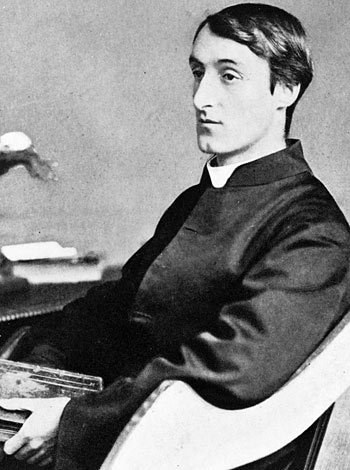
How does inscape relate to landscape?  For Gerard Manley Hopkins, inscape was that which gives something its own special identity.  We come to feel and perceive these qualities through what he called instress.  J.R. Watson: ‘the inscape of an elm tree is the property by which we recognize it: but it is not just its shape or ‘scape’: it is its ‘inscape’, its inner being or self-hood, the thing itself in its own special nature.’

However, inscape is not necessarily about the qualities of a particular tree.   For example, on May 18 1870, Hopkins noted in his diary “great brilliancy and projection: the eye seemed to fall perpendicular from level to level along our trees, the nearer and further Park; all things hitting the sense with double but direct instress.”  Here the instress is a force from within the trees which gives this landscape its particular intensity.

W. H. Gardner describes instress as ‘the sensation of inscape – a quasi-mystical illumination, a sudden perception of the deeper pattern, order and unity which gives meaning to external forms.’ Hopkins experienced instress as he walked in the landscape, studying bluebells and horned violets, looking at the moon and the sky or the waves of the sea, even, as here, in encountering an old stone pointed arch:
'The day was bright, the sun sparkling through a frostfog which made the distance dim and the stack of Denbigh hill, as we came near, dead mealy grey against the light: the castle ruins, which crown the hill, were punched out in arches and half arches by bright breaks and eyelets of daylight. We went up to the castle but not in: standing before the gateway I had an instress which only the true old work gives from the strong and noble inscape of the pointed arch...'
- from Gerard Manley Hopkins’ diary, February 4th 1875

Saturday, January 19, 2008

An aerial view of the Val de Bièvre


Before photographs could be taken from aeroplanes, aerial landscapes had to be captured by other means:

  • The first aerial photograph from a balloon was Nadar’s image of the Val de Bièvre near Paris, taken in December 1858. (as depicted in the Daumier cartoon above). However, the result was not a great success. Soon, however, clear images were being taken, like the aerial view of Boston taken in 1860 by James W. Black using the balloon, Queen of the Air.
  • In 1869 John A. Scott invented the Ophthalmos, where a camera was sent up in an unmanned balloon on the end of rope. Inspired by this, Arthur Batut in France devised a kite from which aerial photographs could be taken, publishing them in La photographie aérienne par cerf-volant (1890).
  • Finally, in 1903 Julius Neubronner devised a lightweight camera which could be attached to a carrier pigeon, the shutter being released every sixty seconds, thus enabling birds to create landscape images... A Nature Conservancy site refers to the photographs taken by the Bavarian Pigeon Corps: “while their images (that sometimes included wingtips in the frame) were of limited use, the birds looked great in uniforms”. They do indeed look very smart and I rather like their photographs too.

Sunday, January 13, 2008

Figure in a Mountain Landscape

Peter Doig is coming to Tate Britain for a talk next month. I was told the tickets all went within 30 minutes of going on sale, so sadly I won't be able to report on what he says, but I'll try to get to the exhibition. Doig tends to re-work his themes, one of which is Figure in a Mountain Landscape, examples of which are here, here and here (this last one is subtitled, for no clear reason, 'I Love You Big Dummy', which is presumably a Captain Beefheart reference..?) The original for Doig's cowled figure en plein air is a 1935 photograph of Franklin Carmichael, one of the Canadian Group of Seven painters, sketching at Great Lake Nortern Ontario. Rather than paint and repaint a landscape from nature, Doig paints and repaints a photograph of someone painting a landscape from nature.

There is a short article about Doig in the latest issue of Tate etc. by the Brooklyn-based critic Lyle Rexer (great name!) He says that Doig benefits from "a certain Richter effect, that is from anti-Platonist critiques, when it came to be understood that he, too, often preferred two-dimensional images as models to the common reality of the breathing world." When I said in a previous post of Gerhard Richter's landscapes "there is little comfort to be had in these highly artificial paintings, based on photographs or picture postcards" I was of course referring to those who would seek spiritual solace in Nature or desire a painting that transmits the artist's feeling for a particular place. But of course many contemporary viewers will want precisely to be reassured that this is not what is happening. Rexer says that one of Doig's curators, for example, "went so far as to assure us that there is no nature painting here, no plein air, only good studio conceptualism." However, in a sense Peter Doig simply approaches painting in a traditional way. It's just that instead of painting, say, Cadmus and a snake in a landscape, like Poussin, Doig paints Berry Oakley and a canoe in a landscape.

Friday, January 11, 2008

Gone – the narrow copse


Earth Shattering: Eco Poems is the latest anthology from Bloodaxe editor Neil Astley, following recent successes like Staying Alive, Being Alive, and Pleased to See Me: 69 Very Sexy Poems. It is full of interest and I’m sure I’ll draw from it in future postings, but here I’m going to concentrate on the introduction where Astley sets his collection in context, discussing recent anthologies and critical writing on ecopoetics. Here are some of the chief sources for Earth Shattering:


  • J. Scott Bryson’s Ecopoetry: A Critical Introduction (2002) defines ecopoetry as a subset of nature poetry with three main characteristics. These are (1) an awareness of interdependence and connectiveness (as in Denise Levertov’s poem ‘Web’); (2) humility in the face of nature; (3) scepticism of hyper-rationality which is usually linked to concern about ecological catastrophe.
  • I have talked here before about Terry Gifford’s definition of post-pastoral, which has similar attributes to Bryson’s ecopoetry. Astley describes Gifford’s 1995 study Green Voices: Understanding contemporary nature poetry as the first comprehensive British study of ecopoetry (the essays in Bryson focus on US poets).
  • I've also referred to John Elder’s Imagining the Earth: Poetry and the Vision of Nature (1985) before here, e.g. in relation to William Everson, and Astley notes its importance as a relatively early study in the field.
  • Then of course there is Jonathan Bate’s The Song of the Earth (1990), which Astley praises for presenting ‘ecology and poetry together as one body of thought and feeling.’ I’ve only used this book once here so far, but it's worth saying in passing that The Song of the Earth is one of the best books on landscape in the arts I have read. Jonathan Bate writes so well that you almost feel disappointed when you turn from himto consult the actual books he discusses: a case in point would be William Henry Hudson’s Green Mansions, which was less interesting to me as a novel than the extracts Bate used in The Song of the Earth
The majority of the poetry in Earth Shattering is modern, even though the anthology starts with some of David Hinton’s ‘wilderness poets of ancient China’. But I’ll end this posting with an 'ecopoem' that will be out of copyright, and which provides a link to the previous posting: ‘First Known When Lost’ by Edward Thomas:
I never had noticed it until
‘Twas gone, - the narrow copse
Where now the woodman lops
The last of the willows with his bill
It was not more than a hedge overgrown.
One meadow's breadth away
I passed it day by day.
Now the soil is bare as bone,
And black betwixt two meadows green,
Though fresh-cut faggot ends
Of hazel made some amends
With a gleam as if flowers they had been.
Strange it could have hidden so near!
And now I see as I look
That the small winding brook,
A tributary's tributary, rises there.

Sunday, January 06, 2008

Roads shining like river up hill after rain

The final entry in the war diary of landscape poet Edward Thomas is dated 8 April 1917 – he was killed the next day at 7.36 am by a shell blast:


'8. A bright warm Easter day but Achicourt shelled at 12.39 and then at 2.15 so that we all retired to the cellar. I had to go over to battery at 3 for a practice barrage, skirting the danger zone, but we were twice interrupted. A 5.9 fell 2 yards from me as I stood by the f/c post. One burst down the back of the office and piece of dust scratched my neck. No firing from 2-4. Rubin left for a course.'
The Faber ‘Collected Poems’ also reproduces these brief notes Thomas made on the last pages of the diary:
'The light of the new moon and every star

And no more singing for the bird...

I never understood quite what was meant by God

The morning chill and clear hurts my skin while it delights my mind Neuville in early morning with its flat straight crest with trees and houses – the beauty of this silent empty scene of no inhabitants and hid troops, but don’t know why I could have cried and didn’t'
Loose inside the diary there was a photograph and a slip of paper with several addresses and these words:
'Where any turn may lead to Heaven

Or any corner may hide Hell

Roads shining like river up hill after rain.'

Tuesday, January 01, 2008

This is Lagos


This is Lagos (2002) by Olu Amoda - welded scrap steel.

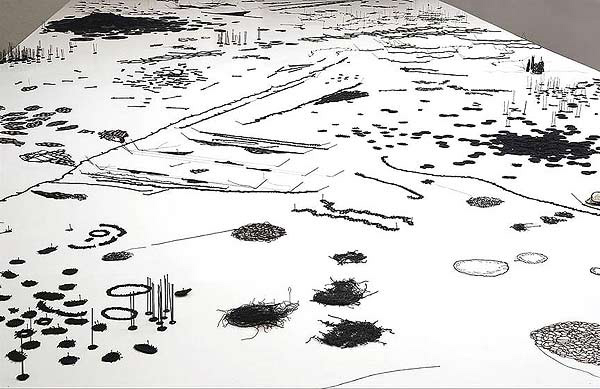
One of my New Year's resolutions is to include a few more images in 'Some Landscapes'. The one above is, I have to admit, a rather inauspicious start: a murky snapshot of some metal on a table, framed by lumps of coal. It was taken at the V&A's 'Out of the Ordinary: Spectacular Craft' exhibition yesterday. Normally I don't have images of contemporary art works for copyright reasons but nobody seemed to mind photographs being taken at the V&A. This is Lagos is a metal cityscape seen from above, where it is impossible to discern what is signified by each of the individual scraps of metal, or what they originally were before the artist found them. I thought the way Amoda creates a semi-abstract topography was reminiscent of Anne Wilson's piece earlier in the exhibition, which can be seen in another poor quality photo below. Some of her arrangements of lace and pins look like winter trees in a snowy landscape, whilst other features are more mysterious. There is a better photograph of a 2002 version of Topologies here.


Topologies (2007) by Anne Wilson - lace, thread, cloth, pins, painted wood support.

Of course craft is by definition skillful, but it can still be surprising to encounter really intricate beauty or objects you would not have thought possible. Annie Cattrell's Conditions for example, (see third and least-bad photo below) seem to imprison real clouds in blocks of glass. I wonder what John Constable, some of whose cloud studies are owned by the V&A, would have made of them? I suppose one difference is that he wanted to capture the whole sky rather than an individual cloud, as in a 5 September 1822 sketch: "looking S.E. noon. Wind very brisk. & effect bright & fresh. Clouds. moving very fast. With occasional very bright openings to the blue."


Conditions (2006) by Annie Cattrell - subsurface etching in glass

So, as I said, I will try to put some more images into this blog in 2008, and maybe add a few retrospectively to earlier postings. I'll also try to provide more labels to help navigate certain themes and find quickly the entries on some key figures (like Constable - see label below). And at some point I'll get round to adding links and a decent blog roll...

Thursday, December 27, 2007

Sunset Landscape

I have mentioned the Southern Song landscape painter Ma Yuan here before in connection with a Wallace Stevens poem. I’ve just been reading about the Ma family in Richard M. Barnhart’s chapter of Yale’s Three Thousand Years of Chinese Painting. They served Chinese emperors for five generations, starting with Ma Ben (Fen) in the early twelfth century and ending with Ma Lin, who was active in the early to mid thirteenth century. Ma Lin’s ‘touching Sunset Landscape seems almost to be an elegy for his dynasty, so preoccupied is it with the end of light and vision.’ It is a minimal landscape set beneath two lines by Wang Wei, “Mountains hold the autumn colour near / Swallows cross the evening slowly.” Barnhart notes that many scholars have detected a melancholy mood in Ma Lin’s paintings, but, since it was the emperor that commissioned these works, their poignancy cannot solely be attributed to the artist. In Ma Lin, the doomed Song dynasty court ‘found the perfect voice to sing their sad songs for them as they presided over the end of a great empire.’

Ma Lin, Sunset Landscape, 1254

Sunday, December 23, 2007

Things seen at Mabillon Junction

An alternative to soundwalks is to stay in one place and record the sounds heard over a period of time. Or, one could enumerate things seen... Georges Perec's Tentative de description de choses vues au carrefour Mabillon le 19 mai 1978 was a two-hour edited condensation of a day in which the writer used a mobile recording studio at Place Mabillon in Paris to describe everything he saw over the course of a day. I've never heard this, but David Bellos describes the finished product, broadcast on French radio in February 1979, as 'a hallucinatory audio experience' where repetition turns into rhythm: 'no one but Perec could have had the combination of self-restraint (he never comments on what he sees, he just says, another 68 bus, three red cars, a lady with a dog...), modesty, and sheer gall to carry on for hours on end, to the end.' (Georges Perec: A Life in Words p640).

While on the subject of Perec, I can't resist noting on a landscape theme that the main character in his magnum opus, Life A User's Manual, spent twenty years travelling the world painting watercolours of sea ports. Having completed each one in to an identical format, the artist, Percival Bartlebooth, sent them to a craftsman, Gaspard Winckler, to have them made into increasingly complex jigsaws. For another twenty years, Bartlebooth would complete these jigsaws at the same rate at which he had painted the original seascapes, one a fortnight. As he went along, each painting was removed from its backing, returned to the original spot at which it had been painted twenty years earlier, and then erased so that the final product was a fresh sheet of watercolour paper. However, Bartlebooth died (on the night the novel is set) before he could complete the great project. The puzzle he was working on at the end depicted 'a little port in the Dardenelles, at the mouth of the river which the Ancient Greeks called Maiandros, Meander.' As David Bellos remarks, 'the story of Meander figures both the tortuousness of attempts to defer the moment of dying and the impossibility of doing so forever.'

Friday, December 21, 2007

Soundwalk, Queen Elizabeth Park, Vancouver

Writing the last entry made me dig out the excellent survey of acoustic ecology in The Wire 226, which describes the original World Soundscape Project at Simon Fraser University (SFU). Their work varied from activities that might be considered broadly as a kind of landscape art, recording soundcapes across Canada and in five European villages, to more practical work on noise abatement, reviewing legislation and mounting an international car-horn count. Phil England interviewed Hildegard Westercamp for the article, an original member of the SFU team, assistant to R. Murray Schafer, and the person responsible for re-launching the soundscape movement in 1991 with the first Soundscape Newsletter. Asked why she thought the movement arose in Vancouver, Westercamp pointed to the experimental cultural environment in Canada in the early seventies, but also to the influence of the Canadian wilderness. "There's a huge silence out there. And when you experience that silence against what urban environments are like, there's a major difference. I was walking through London today and I thought, my god, how far away the Earth is at King's Cross."

As someone who waits for a bus at Kings Cross several times a week, I can only agree... But then, as noted in the last entry here, the sounds of the city have their own beauty and emotional charge. Peter Cusack is quoted in the same Wire article describing his CD Your Favourite London Sounds, which includes a list encompassing traffic, trains, aeroplanes, buskers, people chatting, even the sound of breaking glass. Cusack goes on to suggest that the use of sounds recorded in a landscape for music or sound art is diverging from the more direct approach where soundscapes are recorded to investigate or dramatise social or ecological issues. Here, I am more interested in the former approach, typified by someone like Chris Watson.

There is a whole dissertation by Andra McCartney on Hildegard Westercamp available online here. The site also includes a soundwalk McCartney took with Westercamp in Queen Elizabeth Park, 'Vancouver's Oasis'. You can listen, for example, to a recording of a creek, described by McCartney as follows: "We spent more time at the creek than anywhere else. Westercamp is fascinated by the endless variety of water voices, and her approach to close-up recording articulates them well. She shifted from one stepping-stone to another, moving the stereo microphone to highlight how the water found its way through crevices, over boulders, around branches in its path, illustrating the architecture of the creek bed, and the dance of the water through its sculptural forms..."

Sunday, December 16, 2007

Baorittaolegainuoer - Natural Booming

I've been listening to the environmental recordings compiled on a CD for Uovo 14 by David Toop. In his notes, Toop says that the origins of this kind of modern sound art lie in 'a complex network of specialist and esoteric activities: scientific research into animal communication and bioacoustics; oral history and radio drama; birdwatching, trainspotting and similar ocular pursuits; documental filmmaking; exotic sonic backgrounds; post-Cageian environments; and the soundscape studies pioneered in Vancouver in the early 1970s by R. Murray Schafer and the World Soundscape project. Because of these origins, many of them located in looking as much as listening, and an uneasy relationship to landscape as visual spectacle, in the past, field recording as an art practice has tended towards the picturesque, benign and static.'

I've observed in various entries here how visual art and poetry have shifted over time from traditional views of 'landscape' to more complex ideas about 'place'. In the same way, Toop suggests that field recording suffered from an 'unspoken anti-urbanism which would exclude people, motor vehicles, industry, and all other interventions that could be considered the audio equivalent of telegraph poles in a beautiful landscape. Sounds have been recorded for specific human purposes, such as the melodic beauty of a particular birdsong that somehow reflects the structure of human music. This has been changing for some time, however, with more concentration given to sound environments that Murray Schafer might once have described as an 'earsore', and more focus on the sonic ecology in which we actually live.' Typical of this modern approach would be Lee Patterson's 'Ox Bow Pool & Airliners', or unpromising sounding soundscapes like Jeph Jerman's 'Clarkdale Slag Heap', recorded in Arizona, or Peter Cusack's 'Oil Field Soundwalk', recorded in Azerbaijan.

Clive Bell's review of the Uovo compilation in The Wire notes that the hypnotic song of Chris Watson's tree frogs triggers 'thoughts about human tribal music, just as the deep-throated humming of Rob Mullender and Isobel Clouter's Mongolian sound mountain inevitably recalls the local overtone singing.' Far fetched I suppose, but there's an appeal to the idea that natural sounds have embedded themselves in local musical forms.

Incidentally, the Mullender / Clouter piece,'Baorittaolegainuoer - Natural Booming', is an example of the way artists have been recording singing sands, as discussed here before. In a paper here, Clouter writes about the importance of preserving the sounds of these sands, which have always provoked stories, as in the account she quotes by the monk Hiuen Tsang from 629: 'At times sad and plaintive notes are heard and piteous cries, so that between the sights and sounds of the deserts, men get confused and know not whither they go. Hence there are so many who perish in the journey. But it is all the work of demons and evil spirits.'

Friday, December 14, 2007

The Dead Sea

Last night some friends were showing me photographs of Bonneville Salt Flats. I immediately dredged from childhood memory the name of Gary Gabelich, who set the land speed record there in 1970. Bonneville was in fact the site for all the land speed records from 1935 (Malcolm Campbell) to 1970: most of the earlier record breaking attempts took place on beaches like Daytona Beach (which has always sounded highly glamorous to me) and Pendine Sands in Wales (which doesn't). The most recent records have been set in Black Rock desert, which may look less spectacular than Bonneville, but which is still a fairly extreme landscape. Water speed records have also taken place in spectacular places of maximum flatness: Malcolm Campbell, for example, sped across the Romantic settings of Lake Maggiore (1937) and Coniston Water (1939).

The Bonneville photographs also reminded me of a trip I once made to the Dead Sea where I convinced our host to keep driving and driving in the hope of finding some spectacular salt landforms (no luck). I had in mind the kind of thing Michel Tournier describes towards the end of his novel Four Wise Men (1982): 'the blue surface of the water was sprinkled with white dots... they were great mushrooms of white salt, rooted in the bottom and emerging at the top like reefs.' Tournier goes on to tell of elephants spraying each other with the salt water and inadvertently crystallising themselves (the kind of thing that makes you question where, in a landscape like The Dead Sea, realism ends and magical realism begins). Salt's tendency to encrust and transform has always lent itself to metaphor (Stendhal's description of love, for example). The transformation of Lot's wife in the Bible seems like a story straight out of Ovid's Metamorphoses, except that the mention is all too brief: "But his wife looked back from behind him, and she became a pillar of salt."


Geological formation overlooking the Dead Sea, called Lot's Wife (from Wikimedia Commons)

The growth of salt deposits has continued to affect the appearance of Robert Smithson's Spiral Jetty. Smithson chose to work at the Great Salk Lake partly for the blood-red colour of the water. However, it wasn't his first artwork based on a salt landscape: Mono Lake Nonsite (Cinders Near Black Point) brought some rocks collected at "The Dead Sea of the West" into the gallery. There is a film of the 1968 trip Smithson made to the lake with Nancy Holt and Michael Heizer, described by Lennie Bennett here as "guileless and optimistic, a self-portrait of three young artists on the brink of fame, scrambling around the ancient landscape with voiceovers by Smithson and Heizer reading passages from books about the lake. Smithson picks up handfuls of rocks that he later incorporated into an installation, along with his famous mirrors. At the end, they set fire to a map of the area; Smithson also used the cinders as part of that installation."

In one of his conversations with Denis Wheeler, Smithson talked about Mono Lake and pointed Wheeler to Mark Twain's Roughing It (1872). There Twain says "This solemn, silent, sailless sea—this lonely tenant of the loneliest spot on earth—is little graced with the picturesque. It is an unpretending expanse of grayish water, about a hundred miles in circumference, with two islands in its centre, mere upheavals of rent and scorched and blistered lava, snowed over with gray banks and drifts of pumice stone and ashes, the winding sheet of the dead volcano, whose vast crater the lake has seized upon and occupied." But Twain does find something of the picturesque in the some landforms that recall Tournier's description of the Dead Sea: "all around its shores stand picturesque turret-looking masses and clusters of a whitish, coarse-grained rock that resembles inferior mortar dried hard; and if one breaks off fragments of this rock he will find perfectly shaped and thoroughly petrified gulls' eggs deeply imbedded in the mass. How did they get there? I simply state the fact—for it is a fact—and leave the geological reader to crack the nut at his leisure and solve the problem after his own fashion."