Saturday, February 24, 2007

Landscape on a Chinese fan

I'm rather busy at the moment (having this week become a father for the second time) so here's just a brief landscape thought to ponder from Fernando Pessoa's The Book of Disquietude (trans. Richard Zenith):

'Useless landscapes like those that circumscribe Chinese teacups, starting out from the handle and abruptly ending at the handle. The cups are always too small... Where would the landscape continue and with what (...) of porcelain, if it could continue past the teacup handle?
Certain souls are able to feel a profound sorrow because the painted landscape on a Chinese fan isn't three dimensional.'

19th century Mi-style Landscape Fan Painting

Friday, February 16, 2007

Two-Way Mirror Hedge Labyrinth

To Tate Modern last night for a talk by Dan Graham. He mainly discussed his various pavilions and architectural structures, including recent projects like the Hayward Gallery refurbishment. He has a strangely nervy delivery and it is quite hard to imagine him among the hipsters of the New York art world. He sometimes gives a strange impression of insecurity for such a renowned artist, referring to "my friend Steve Reich", "my friend Sol Le Witt", "my former girlfriend Laurie Anderson", as if we'd only value his work by association with others. He complained about bad experiences with the Dia Foundation (who wouldn't let Thurston Moore perform in Graham's Two-Way Mirror Cylinder Inside Cube) and now with the Hayward who have said his installation 'doesn't work'. He had some amusingly critical things to say about Bill Viola.

Graham talked quite a lot about his influences, among whom he mentioned John Constable (especially with reference to the cloud paintings) and the Hudson River School. He has written an article for Tate magazine which explains his interest in the apocalytic landscapes of John Martin. In an interesting recent interview with Graham, Pietro Valle observed: "You seem to be more and more interested in landscapes. However, there's a difference between landscaping, i.e. the production of specialized areas in the suburban culture (often segregating buffer zones), and the landscape that you try to unveil with your pavilions." Graham's response: "In my Two-Way Mirror Hedge Labyrinth I combine the hedges that are typical of Baroque garden labyrinths with the glass that is typically used for corporate buildings. That specific pavilion was built for the home of a collector and the hedge is the extension of the fence of the existing garden. Hedges have become a means to mark the boundary between public and private in the single-family residential culture. I try to mix urban greenery elements with elements taken from the corporate areas but in a different way compared with the halls in skyscrapers where the greenery is imprisoned inside the building."

Monday, February 12, 2007

Water falling, drop by drop

My copy of the New York Review of Books arrived today and I whiled away a dismal bus journey reading an article about James Laughlin, whose enviable life combined the roles of rich playboy, ace skier and founder of New Directions, publisher of many of the most interesting twentieth century writers. A complete list of these would be lengthy, but would include: Pound, cummings, Bishop, H.D., Zukofsky, Levertov, Snyder, Dylan Thomas, Henry Miller, Lorca, Neruda, Borges, Rilke, Ungaretti, Nabokov and Sebald. As many of these had other publishers in England, I don't have many New Directions books on my shelves, but looking just now I realised those I do have are particularly choice items it would be hard to imagine appearing from a publishing house not bankrolled by someone like Laughlin (or benefitting from the profits New Directions earned on Hermann Hesse's Siddhartha). I think my favourite is Henri Michaux's Ideograms in China, a slim volume originally written in 1971 that shares many of the preoccupations of Ernest Fenollosa's The Chinese Written Character as a Medium for Poetry (a seminal text for Ezra Pound and some post-Poundian poets).


Michaux, like Fenollosa and Pound, sees in the origins of Chinese script a direct response to nature. The idea of natural signs (which of course also figures in Western thought, e.g. Plato's Cratylus) seems to offer the possibility of presenting and combining actual elements of landscape, rather than simply evoking a scene in a succession of abstract signs. Michaux (translated by Gustaf Sobin) describes the recovery of ancient Chinese writing (c. 120 CE) by scholars who compiled a 'dictionary of orginal signs', so that a written page could be full of 'everything to be found in the world': 'full of water falling, drop by drop, out of clouds / of ferryboats crossing from one side to another / full of earth embankments / of furnaces... scenes that lend themselves to reflection / scenes of all sorts... clustered that they might end in ideas / or unravel as poetry.'

Despite these efforts, the subsequent development of Chinese writing led further and further from nature, towards abstraction. However, as Richard Sieburth says in his afterword: 'if calligraphy enables the material body of the sign to be transfigured into pure spirit, the very activity of this scriptura scribens nonetheless plunges us back (by a kind of dialectical reversal) into the immanent energies of a natura naturans. Freed from imitating nature, signs may now signify it...' And so writing itself can become a kind of habitable landscape. Michaux ends his poetic essay with a final observation on Chinese writing: 'Calligraphy around which - quite simply - one might abide as next to a tree, or a rock, or a source.'

Tuesday, February 06, 2007

The fortress at Qalat-i Gird

The British Museum has an exhibition of Georg Gerster's aerial photographs of historical sites, The Past From Above. The images that struck me initially were those with an unexpected formal beauty, like the long oval of the Stadium of Aphrodisias in Turkey, or a burial mound in the Niger inland delta (with its superficial resemblance to Smithson's Spiral Jetty), or the contrast between the ancient ruins at Ebla in Syria and the intricate and beautifully coloured field pattern that now surrounds it. Some of the photographs show landscapes that would be spectacular even without a historical trace, particularly those associated with religious sites: tombs built onto the side of Cerro de los Metates, a volcanic chimney in Mexico; or the Dabra Damo monastery, built on a table mountain in Ethiopia; or the wave-battered island of Skellig Michael, site of another monastery.

Some of the most interesting photographs show natural processes at work, like the sand dunes threatening the ancient field system visible at Kharga Oasis, Egypt. Gerster photographed another dune landscape at Sistan, Iran, where the Wind of 120 Days seems to have obliterated everything beneath the sands, except for the circular shape of Qalat-i Gird fortress. According to Dietrich Huff, this 'much-feared' wind determines the angles of trees and buildings and creates 'bizarrely beautiful and distinctly shaped shifting dunes.' The fortress probably dates from the 13th century, after the composition of Firdausi's Shahnama in which the legendary hero Rustam was depicted as the saviour of Sistan, but early enough to have witnessed the conquest of Tamburlaine and his wounding at the siege there.

Sunday, February 04, 2007

Cannon River Eddies

Environmental sound artist Philip Blackburn has an interesting website called Music and Nature featuring various soundclips and interviews. For example, there is video footage of his own Cannon River Eddies, 'a performance installation in Northfield, Minnesota, to bring attention to the role of water and the presence of the river in the town center'. There is also a survey of wind music by Rene Van Peer and features on animal music, ranging from bird song to the performances of the Thai elephant orchestra.

Postscript: September 2015
This Music and Nature website still exists, although much has been written about music and nature in the ten years since it was created.  As the post above is a bit short I thought I would summarise that survey of wind music by listing his examples...
  • Chris Watson says that "Wind, wherever the sound recordist operates, is an obvious nuisance".  But in a recording made at Glen Cannich, he "could walk through the foci of these wind sounds within a few paces, as if being part of some great instrument..."
  • By contrast wind can be a gentle backdrop as in a forest recording by Jonathon Storm...
  • Wind in the trees sounds differently depending on the leaf cover. A Peter Cusack recording 'captures the spirit of late autumn, when most trees are bare, and leaves that are still clinging to the branches have a very distinctive brittleness.'
  • Gordon Hempton devoted a whole album to the winds of North America, which vary according to the local landscape
  • A Francisco López, 'Wind from Patagonia' demonstrates 'layers of sound, suggestiveness and a subtle musicality.'
  • Geoff Sample recorded a spring gale whistling around ta metal gate
  • 'In Guadalcanal, one of the Solomon Islands, people used to erect bamboo poles on the easternmost beaches of the island when someone had died. Holes and slits were cut out in the canes, which were played by the wind'
  • The Japanese sound artist Akio Suzuki recorded the wind blowing across his Analapos instrument
  • Scott Smallwood recorded the wind around a pile of scrap and refuse left at an abandoned airfield in the Utah desert.
  • Eric La Casa collects wind and wind-based recordings and adds a church organ to the mix

Thursday, February 01, 2007

When Faith Moves Mountains

Among the interesting works of landscape art in Tacita Dean and Jeremy Millar's book Place is one they describe as having 'great simplicity and poetic richness': When Faith Moves Mountains by Francis Alÿs. The artist was struck by the hardship of life on the edge of Lima, where seventy thousand people live in shanty towns without running water or electricity. Displaced from the city by social unrest and economic crises, they came to live on the Ventanilla dunes, slowly moving hills of sand that seem like metaphors for the forces acting on the people of Lima. On April 11 2002, Alÿs organised an action he describes as 'at once futile and heroic, absurd and urgent.' Five hundred volunteers formed a line at the foot of a dune and working only with shovels managed to mve it about four inches from its original position.

There is an Artforum article in which Alÿs discusses this work. "When Faith Moves Mountains is my attempt to deromanticize Land art. When Richard Long made his walks in the Peruvian desert, he was pursuing a contemplative practice that distanced him from the immediate social context. When Robert Smithson built the Spiral Jetty on the Salt Lake in Utah, he was turning civil engineering into sculpture and vice versa. Here, we have attempted to create a kind of Land art for the land-less, and, with the help of hundreds of people and shovels, we created a social allegory. This story is not validated by any physical trace or addition to the landscape. We shall now leave the care of our story to oral tradition, as Plato says in the Republic. Only in its repetition and transmission is the work actualized. In this respect, art can never free itself from myth. Indeed, in modem no less than premodern societies, art operates precisely within the space of myth."

Monday, January 29, 2007

Wittgenstein's cottage

There is an excellent new 'exhibition in a book' on the theme of Place put together by Tacita Dean and Jeremy Millar, published by Thames & Hudson. Their introduction doesn't try to place 'place' precisely, but among other things they remark that 'one might say that 'place' is to landscape as 'identity' is to portraiture'. For example, they mention Guy Moreton's photograph, Wittgenstein's Cottage (2002-4), taken as part of Alec Finlay's Wittgenstein project. Both the photograph and the site itself might be seen as beautiful landscapes, but the ruins of Wittgenstein's cottage give the landscape a particular identity.

The book discusses place under the headings 'urban', 'nature', 'fantastic', 'myth / history', 'politics / control', 'territories', 'itinerancy' and 'heterotopias and non-places.' There is also a postcript which gives a four way conversation on place and its relationship with space and landscape, involving the two authors and two art historians: Joseph L. Koerner and Simon Schama. Here are some points they make:
  • That we now tend to reject the framed view (even though it is hard to escape - the painting having been replaced by the TV screen), in favour of a wider sense of experience and possibility.
  • That limitless space, as in the ocean, remains frightening, but that grids of latitude and longitude have made this kind of abstract space knowable (Deleuze and Guattari).
  • That obviously historical change means that places mutate, and that people can value both the monumental and the transient, e.g. landscapes seen through the car window like the frames of a film (Walter Benjamin).
  • That society only has a sense of place when it is no longer rooted. Urban dwellers looking at rural society and feeling their own rootlessness start to value 'place'.
  • That in the modern world place can be fixed with linear perspective and abstract thinking, and yet do we really know that their was a different sense of place in the pre-modern world?
  • That places can be experienced and recalled through all the senses (e.g. smells and sounds), but space may be something that can only be imagined.
  • That the forces of globalisation may be destroying the specificity of places, and yet those forces may themselves result from the 'staggering boredom' of life in the countryside and the possibilities of the modern city.
  • That we understand place emotionally, through memory, and ultimately find it much more difficult to explain than space.

Friday, January 26, 2007

The Lake of Albano and Castel Gandolfo

When art historians read changes in style as reflecting broader political changes it is often possible to argue from both ‘sides’. For example, Ann Bermingham in her essay ‘English Landscape Drawing around 1795’ argues that the impact of the French Revolution was seen in a rejection of earlier forms of landscape composition, based on the idealised classical landscapes painted in seventeenth century Italy, in favour of more naturalistic drawings where the forms of nature took on a more individual character. From a liberal perspective, this would be consistent with an appreciation of the real qualities of the English countryside, rather than the kinds of views sought on the Grand Tour. However, from a conservative point of view, the change in landscape painting could equally be seen as a rejection of the systematic abstractions of theory and the open intellectual spaces of the prospect view, in favour of local scenes demonstrating the timeless qualities of the native landscape.

Thomas Hearn, A Brownian Landscape Garden and A Picturesque Landscape Garden
illustrations for Richard Payne Knight's 'Landscape'

These political differences reflect contemporary changes in picturesque theory. The conservative position was essentially that taken by Uvedale Price and Richard Payne Knight in their criticisms of the gardens of Capability Brown and the picturesque theories of William Gilpin. Both Brown and Gilpin had imposed the harmonious compositions of painters like Claude onto the real landscape. Thomas Hearne provided the illustrative etchings of Brownian and Picturesque gardens for Knight’s didactic poem 'The Landscape' (1795) - see above.  Ann Bermingham sees the new style embodied in Hearne’s art. She contrasts Hearn’s detailed view of Oak Trees (c. 1786) with a slightly earlier view of The Lake of Albano and Castel Gandolfo (c 1783-5) by John Robert Cozens. So Cozens’ older painting could be either a comforting conservative souvenir of an idealised Italy or a liberal artistic expression of the eighteenth century’s expanding horizons. Take your pick.

John Robert Cozens, The Lake of Albano and Castel Gandolfo, c. 1783-5

Thomas Hearne, Oak Trees, c. 1786

Saturday, January 20, 2007

Wind vortex on the ice cap

Landscape artist Chris Drury is currently working in Antarctica and writing a blog (which looks rather like this one... except that he has lots of nice photos!) However, as he says: "I expected to be out in the landscape most of the time. But in truth Antarctica is a dangerous and unpredictable place and I am here as part of a large organisation who have to ensure everyone’s safety... So for these first 3 weeks the experience has been primarily a social one." Furthermore, "the land itself and the experience of it is absolute. It is so stunningly beautiful, that in the face of it art has no place. As a result I am increasingly reluctant to do anything much in it, apart from make marks with my feet or a skidoo in the snow. I have no wish to use other resources to make a futile impression on what is absolute. I will be content to record on film and photograph what is here and to let the experience of place; land, weather, people and science, become embedd[ed] deep within me." However, in his most recent post he does say he has plans to "make a drawing of a wind vortex" on the ice cap, so we can look forward to some new land art as a result of the trip.

Friday, January 19, 2007

The Bridlepath is Filled with Clouds

Certain Trees was the title of an exhibition of 'the constructed book, poem and object 1964-2006' held at the Centre des livres d'artistes last year. It focused on a loosely connected group of artists and poets who have presented their own work through small presses and exhibition spaces: Simon Cutts, Stuart Mills, Brian Lane, Les Coleman, Thomas A. Clark and others. In his essay for the catalogue, John Bevis sees these artists as inhabiting the (relatively narrow) space between Robert Lax, the American minimalist poet (working in a line that runs from Emily Dickinson through William Carlos Williams and the Objectivists), and Ian Hamilton Finlay, maker of concrete poems.

It is interesting how often these artists work with landscape themes. Bevis himself is represented by works called Cloud Study (1981), The Foliage Society (1984), and An A-Z of Birdsong (1995). The catalogue describes Bevis as pursuing a 'dialogue between the natural world and its classification and presentation through the idiom of language'. This is a description that could be also applied to works by Thomas A. Clark, Ian Hamilton Finlay and other books and objects: Simon Cutts' After John Clare (2002-4), Stuart Mills' The Bridlepath is Filled with Clouds (1970), Fridjof Nansens's Fog Log (1978) by Brian Lane. Some of the names of the small presses also suggest an affinity with the natural world: Moschatel, Wild Hawthorn, Coracle.

The title 'Certain Trees', with its own hint of landscape, comes from a Roy Fisher poem 'Epitaph: Lorine Neidecker' (evoking her best known poem, 'My Friend Tree', which was published in Ian Hamilton Finlay's magazine 'Poor. Old. Tired. Horse', which was in turn named after a line in a Robert Creeley poem...) The lines by Roy Fisher are juxtaposed in the catalogue with a Simon Cutts poem from 1968, 'The Menagerie goes for a Walk': '.... shade from your tree / touch from my wood. A wood full of trees / a tree full of wood.'

Finlay, Fisher and Neidecker all feature in another exhibition, 'The possibility of poetry: from Migrant magazine to artists' books' currently on at the British Library, which celebrates Gael Turnbull's 1960s little magazine, Migrant.

Tuesday, January 16, 2007

Four Stones and Castle Tomen

There is an interesting Tate Paper by Stephen Daniels on the photographer, antiquarian and promoter of ley lines, Alfred Watkins. It notes a link with the work of land artists Richard Long and Hamish Fulton, but focuses mainly on Watkins' career and the way photography shaped his archaeological theories.

Watkins was a member of Hereford's Woolhope Club and wrote articles for them 'on various antiquarian subjects, chapels, wayside crosses, city walls and ancient pottery, accompanied on his excursions by the manager of the Meter Works, W.M. McKaig, who assisted with the field work including the photography. Nothing, it seems, prepared members for Watkins’s astonishing contribution to field archaeology, his systematic idea of ley-lines, at the Club’s autumn meeting on 29 September 1921. This was an afternoon excursion and evening lantern slide lecture in the Club’s rooms in Hereford Free Library and Museum, reported the following year in the Club’s transactions as a paper on ‘Early British Trackways, Moats, Mounds, Camps and Sites.' His book, Early British Trackways appeared in 1922 and, following further research and elaboration of his theories, a more substantial book, The Old Straight Track (1925) became a popular success.


Daniels reproduces some of Watkins' illustrations, including the frontispiece to Early British Trackways, showing the alignment of the Four Stones and Castle Tomen. 'This takes the form of a collage, with three photographs of the sites, one a telephoto shot of Castle Tomen, superimposed on a woodland glade marking a ley.' However, neither Watkins' ideas nor the illustrations had a strong impact on contemporary art. Instead painters like Paul Nash and John Piper were more influenced by Antiquity, a journal started in 1927 by O.G.S. Crawford, who considered Watkins a crank and refused to accept an advertisement for his book, The Old Straight Track.

Sunday, January 14, 2007

The fields of Ennor

Artists trying to find a new way of seeing the landscape may need to try something more unusual than standing and gazing at the view or walking and taking notes. I always think of Peter Lanyon, driving round Cornwall trying to find new angles and eventually taking to the sky in his glider. Roger Deakin's book Waterlog might also be seen in this way: he chose a cold, wet option - swimming in rivers, ponds, lakes and seas around Britain. Literally immersed in these places he not only got a different perspective, he was also sometimes able to see landscapes that would be otherwise inaccessible, like the submerged fields of Ennor...

Deakin's swimming journey started off the coast of Cornwall, where he swam between the Scilly Isles of Bryer and Tresco. He explains: 'The Scilly Isles are the last outcrop of a ridge of volcanic granite that forms the backbone of Cornwall and they were, until about 4000 years ago, the high points of a big island called Ennor. But the melting of the polar ice caps that began after the last Ice Age meant that Ennor’s lowland valleys and fields were gradually submerged. I donned the wetsuit, mask and snorkel, and swam out into the shallow sandy bay. It was high tide and about thirty yards off the shore I looked down at a pair of stone walls meeting at a right angle, and a circle of stones that must once have been a sheep pen. With seaweed hedges growing from the stones, these are the patterns and remains of the patchwork of old fields that once stretched all the way across the valley to Tresco. They are really just a continuation of the remaining field boundaries on shore. This may be why some stretches of water around the Scillies still have names from Before the Flood that are literally outlandish, like Garden of the Maiden Bower or Appletree Bay.'

There are many obituaries and memories of Deakin (who died last year) on line: see here for example. Ken Worpole pays tribute to Deakin on the Open Democracy site (one of several short pieces he has written there on Landscape and Identity). There are also various texts by Deakin, like this one about orchards on the Common Ground site. And the Radio 4 site has a programme Deakin made on a canoe journey from Redgrave Fen in Suffolk to Geldeston Lock in Norfolk, along with another about his garden.

Sunday, January 07, 2007

Boden Sea, Uttwil

There is a nice exhibition of Hiroshi Sugimoto photographs at the Hirshhorn Museum site. Here is how he introduces some of his seascapes: "One New York night in 1980, during another of my internal question-and-answer sessions, I asked myself, "Can someone today view a scene just as primitive man might have?" The images that came to mind were of Mount Fuji and the Nachi Waterfall in ages past. A hundred thousand or a million years ago would Mount Fuji have looked so very different than it does today? I pictured two great mountains; one, today's Mount Fuji, and the other, Mount Hakone in the days before its summit collapsed, creating the Ashinoko crater lake. When hiking up from the foothills of Hakone, one would see a second freestanding peak as tall as Mount Fuji. Two rivals in height—what a magnificent sight that must have been! Unfortunately, the topography has changed. Although the land is forever changing its form, the sea, I thought, is immutable. Thus began my travels back through time to the ancient seas of the world."

"Immutable", but never the same... as you look at the different seas you wonder if he has captured essential differences in them - the hazy shimmer of Boden Sea, Uttwil (1993), the firm horizon of Tyrrhenian Sea, Conca (1994) or whether in different atmospheric conditions these images could be reversed.

In an interview here Sugimoto says: "The first portfolio of seascapes I published was entitled 'Time Exposed' because time is revealed in the sea.... People have a lot of strange ideas about my seascapes - they think these photographs were done using very long exposures, but they are in fact very fast because I wanted to stop the motion of the waves, which are constantly moving. You heard I took some photographs using a camera speed of zero ASA? That's impossible."

Postscript 2015:
I was wondering if it might be possible to include a fair use / non-copyright image with this now and I see that since I wrote this post the photograph Boden Sea, Uttwil has been used for two album covers.  The first, below, was Specification.fifteen (2006) by Richard Chartier and Taylor Deupree.  Three years later U2 used the same image for No Line on the Horizon.

The Owl's Map


I have been listening to The Owl's Map, an album on Ghost Box by Belbury Poly. It is is based on the fictitious 'ancient market town of Belbury' which, according to the sleeve notes, 'is an uneasy mix of ancient and modern': Iron Age ramparts and a 'picturesque 11th century church', but also 'some notable modernist architecture', including the Polytechnic which gives its name to the group. The album is labelled 'Field Guides to British Towns and Villages Volume 7'. It contains murky photographs which, like the images in W.G. Sebald's books, invite you to peer at them trying to work out the boundary between truth and fiction. Most seem to have been taken in the 1970s (see here for example), a time when such towns were uneasily facing both backwards and forwards (before the homogenisation of identical chain stores and the re-branding of polytechnics as universities). The music itself sounds futuristic and pastoral at the same time, whilst the design is inspired by old school textbooks and Penguin paperbacks.

Simon Reynolds has investigated Ghost Box and other strands of 'haunted audio' in contemporary music for an article in Wire and his Blissblog features outtakes from this, including some thoughts on 'The Owl's Map' as a title: 'the owl: the perfect Ghost Box bird-mascot, where the wholesome (children's story books from Winnie the Pooh onwards, bird-watching guides, owl as symbol of wisdom etc) collides with the umheimlich (spooky creature with ultra-acute nightvision). Nature studies meets the supernatural... the map: likewise collides the scientific / precise / diagrammatic / official-bureaucratic-governmental-landsurveying (all those symbols indicating building types, gradients, terrain, natural features and man-made monuments) with the more magical evocations (parchment scrolls, the manuscript illuminating occult path-ways, routes to the treasure…)'

In his interview with Reynolds, Jim Jupp, the man behind Belbury Poly, says that The Owl's Map concept derived partly from old tourist guides ("you know the sort of thing, murky old photos of Chichester Cathedral") and that the colour scheme for the album was inspired by the "those brown road signs that point the way to Roman ruins, falconry centres or stately homes." Jupp's partner in Ghost Box, Julian House, plans to start making films about Belbury (which is named, incidentally, after the fictional town in C S Lewis's That Hideous Strength.)

Friday, January 05, 2007

Deluge

Leonardo da Vinci, Deluge over a City, 1517-18

The V&A exhibition Leonardo da Vinci: Experience, Experiment and Design brought together some of the most inspiring pages from his notebooks, and actually animated some of them. It included one of Leonardo's Deluge drawings from the Royal Collection, described thus: 'Spiral cataracts of air, spray and dust wrench water and even rocks into the air, while a tree (which gives scale to the cataclysm) bends to breaking point as the storm approaches.' The drawing is set in the context of his scientific studies of motion, flow and natural forces. It is so much about the properties of the storm that it feels perverse to try to make sense of the Deluge as a landscape, but the power of the wind and water seem particularly real if you imagine them transforming the view of an actual place.

 Leonardo da Vinci, Deluge, 1519

It made me think about where artists or writers have created landscapes of deluge. I recalled a Ray Bradbury story, 'The Long Rain' (1950), which is not about a storm but does describe perpetual heavy rain. It starts like this: 'The rain continued. It was a hard rain, a perpetual rain, a sweating and steaming rain; it was a mizzle, a downpour, a fountain, a whipping at the eyes, an undertow of the ankles; it was a rain to drown all the rains and the memory of rains. It came by the pound and ton, it hacked at the jungle and cut the trees like scissors and shaved the grass and tunnelled the soil and moulted the bushes...' Bradbury's science fiction story is set on 'the rain world of Venus', which by the time he wrote it was a poetic idea rather than a scientific possibility.

Sunday, December 31, 2006

Carrigskeewaun

Carrigskeewaun in County Mayo is a key landscape for the poet Michael Longley. There is a page on the Teachnet Ireland site that includes his poem 'Carrigskeewaun' and some teacher's notes explaining how it contrasts 'wild natural scenery and the domestic images of picnics, children at play by the sea and boiling kettles'. The site also has a long list of Michael Longley links and some quotes from the poet, including this justification for his landscape poetry: 'The most urgent political problems are ecological: how we share the planet with the plants and the other animals. My nature writing is my most political. In my Mayo poems I am not trying to escape from political violence. I want the light from Carrigskeewaun to irradiate the northern darkness. Describing the world in a meticulous way is a consecration and a stay against damaging dogmatism.'

There is another site for 'Carrigskeewaun' here and a further poem inspired by the landscape, 'Remembering Carrigskeewaun', is at the Poetry Archive.

Postscript: 2011

With the publication of his new collection, Kate Kellaway in The Guardian interviewed Michael Longley.  He told her "I don't go to Carrigskeewaun for escapist reasons. I want the beauty, the psychedelic wild flowers, the calls of the wild birds. I want all of that shimmering beauty to illuminate the northern darkness. We have peace of a kind, but no cultural resolution – the tensions which produced the Troubles are still there. It is important for me to see beautiful Carrigskeewaun as part of the same island as Belfast. I might be most a Belfast man when I am in Carrigskeewaun."  And then a bit later, in the same interview, he envisaged his own death.  "There is a headland as you approach Carrigskeewaun and that is where I want my ashes scattered. And I just want one little stone, with my name on it, to be blown around by the wind and to mingle with the sand grains."

Tuesday, December 26, 2006

The Monk by the Sea

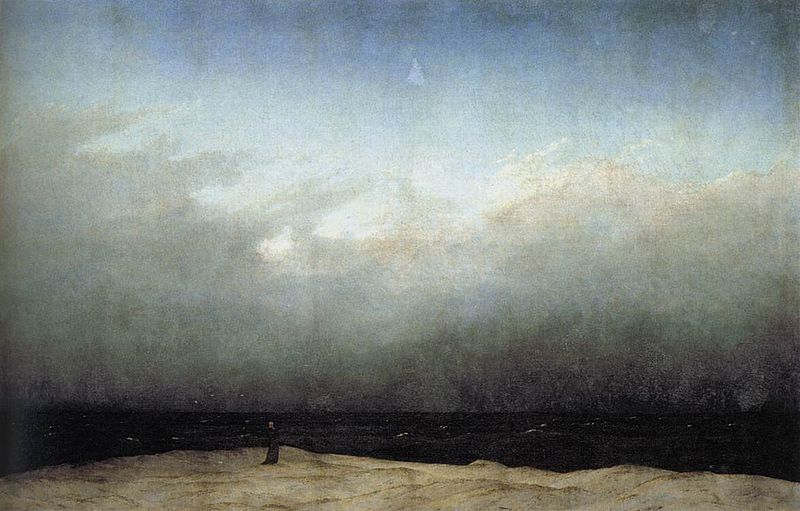
Among the many fascinating readings in Harrison, Wood & Geiger's Art in Theory 1648-1815 are two versions of a short article on the famous Friedrich painting, The Monk by the Sea, which was exhibited at the Berlin Royal Academy of Art in 1810. These texts clearly show the style of two (possibly three) of the great German Romantic writers. The first is by Clemens Brentano (although 'it is likely' that Achim von Arnim 'contributed towards the composition'): a piece called 'Various Emotions before a Seascape by Friedrich', submitted to the Berliner Adendblatter journal, edited by Heinrich von Kleist. However, this version only appeared in 1826; in 1810 Kleist actually published a cut-down version re-written by himself. Brentano's original is light-hearted and witty, featuring various characters overheard discussing the painting. Kleist's version is much darker ('the painting stands there with its two or three mysterious objects like the apocalypse'); it is a voice instantly recognisable if you've read his stories (Penguin publish an excellent anthology).


Caspar David Friedrich, Monk by the Sea, 1809
Source: Wikipedia Commons

One thing the two articles share almost word for word is this memorable opening sentence: 'It is splendid, in infinite loneliness by the shore of the sea under a cheerless sky, to stare at a limitless expanse of water; in part, this is due to the fact that one has gone there, that one must return, that one would like to cross over, that one cannot do so; that everything belonging to life is missing and that one hears one's own voice in the roar of the tide, in the billowing of the wind, in the passing of the clouds and in the lonely cry of the birds; in part it is due to a demand which is made by the heart and by the withdrawal of nature...'

Sunday, December 24, 2006

Route 128 by the power lines

Jonathan Richman has celebrated the landscape of New England in various songs over the years. For example, 'Twilight in Boston' is like one of those solitary, Romantic walking poems, although when you look at the words in isolation from the music they are little more than a simple itinerary: "Now we're walking up Beacon Street / Through the back bay there / Few clouds, heading for Kenmore Square.." The names acquire an aura for those of us who don't know Boston, and we want to believe that those who do know the city would recognise the poetry of the place in these bare phrases.


Perhaps the most effective of Jonathan Richman's landscape evocations is the moment in some versions of 'Roadrunner' where he breaks off to describe the way the world seems from his car:

'Can you feel it out in Needham now?
out in route 128 by the power lines
it's so exciting there at night
with the pine trees in the dark
it's so cold here in the dark
with 50,000 watts of power
we go by faster miles an hour
with the radio on...' 

A friend and fellow Jonathan Richman fan once went to Boston and brought back a photograph of a sign with those magic words 'Route 128'. Looked at here in England I knew it was a resonant metonym for something, but of what I wasn't quite sure: Jonathan Richman? Rock & Roll? American road songs, road movies, road stories...? Or just a sense of freedom?

Saturday, December 23, 2006

A famine road on the borders of Connacht

There is a recording of Eavan Boland reading her poem 'That the Science of Cartography is Limited' on the Norton site. There is also an essay by Boland in the Literary Review in which she taks about her boarding school in England:
"There were no maps in our house when I was growing up, none that I remember. At least not in the obvious places where I saw them in other houses--on the walls, framed, or as pages open on a table. If there were I have no image of them. But there were maps at school... Every day I sat there--six years old, then eight, then ten--always coming back to the same classroom for history, for science, for English, for religion. Always seeing a teacher in front of the map, speaking with certainty and precision. Often entering the strange illusion and that the teacher was mute and the map was speaking through her. Look what I own it said. See what you have lost... I was certainly aware, long before I wrote this poem, that the act of mapmaking is an act of power and that I--as a poet, as a woman and as a witness to the strange Irish silences which met that mixture of identities--was more and more inclined to contest those acts of power. The official version-and a map is rarely anything else--might not be suspect as it discovered territories and marked out destinations."
In 'That the Science of Cartography is Limited', Boland writes about an incident where she came upon an Irish famine road in a wood. This road is not on the map. As she explains in the later essay, "the fact that these roads, so powerful in their meaning and so powerless at their origin, never showed up on any map of Ireland seemed to me then, as it does now, both emblematic and ironic."

Tuesday, December 19, 2006

Charnwood Forest

I have started adding labels to these posts, relating them to different types of landscape. This is not necessarily very helpful because, despite the titles for each entry, Some Landscapes is not an inventory of actual landscapes. But I like the idea of clicking on the word and getting up all entries which refer to mountains by way of highlighting some aspect of landscape in culture, or something about the work of a particular artist.

Of course only a subset of cultural landscapes are likely to give insights into particular places, and this is true for all periods of art. For example, I could boost the number of postings on forests by mentioning Charnwood in Leicesterhire, which features in Michael Drayton's Poly-Olbion (The Sixe and Twentieth Song). But being written in 1622 it sounds like this:
'No tract in all this isle, the proudest let her be,
Can show a sylvan nymph for beauty like to thee:
The satyrs and the fauns, by Dian set to keep,
Rough hills, and forest holts, were sadly seen to weep,
When thy high-palmed harts, the sport of bows and hounds,
By gripple borderers' hands, were banished thy grounds.
The dryads that were wont thy lawns to rove...'
And so on. It is possible to strip out the classical allusion here and focus on what the satyrs were weeping about: greedy (gripple) cottagers killing off the deer. But the dryads provide further distraction: they rove to Sharpley and Cademon, real places which are not described, and on Bardon Hill we are merely told that they are joined by 'harmless elves.' To be fair, there are brief bursts of description in this poem but it does not engage directly with the Leicestershire landscape.

There is a useful on-line summary of the Poly-Olbion by William Moore. His description of the twenty-sixth song from which the lines above are taken is as follows:
'Topographical competition continues in Nottinghamshire, Leicestershire, and Derbyshire. The Vale of Bever (Belvoir) matches herself with previous boasting valleys. The Muse defends the slowness of the Soar River, by analogy to a young girl visiting a sumptuous palace for the first time. The Soar praises its Charnwood Forest for containing all the best features of every other forest. The Trent River, comparing herself favorably with the Thames and the Severn, catalogues her fish. Sherwood Forest, in competition with Charnwood, tells the story of Robin Hood and his bowmen. The Peak, a "withered Beldam," tells of her seven wonders (caves, wells, a hill of sand, and a forest) before the song flows down from the hills along the Darwin (Derwent) River.'