Showing posts with label Michael Drayton. Show all posts

Thursday, February 02, 2017

The spousalls betwixt the Medway and the Thames

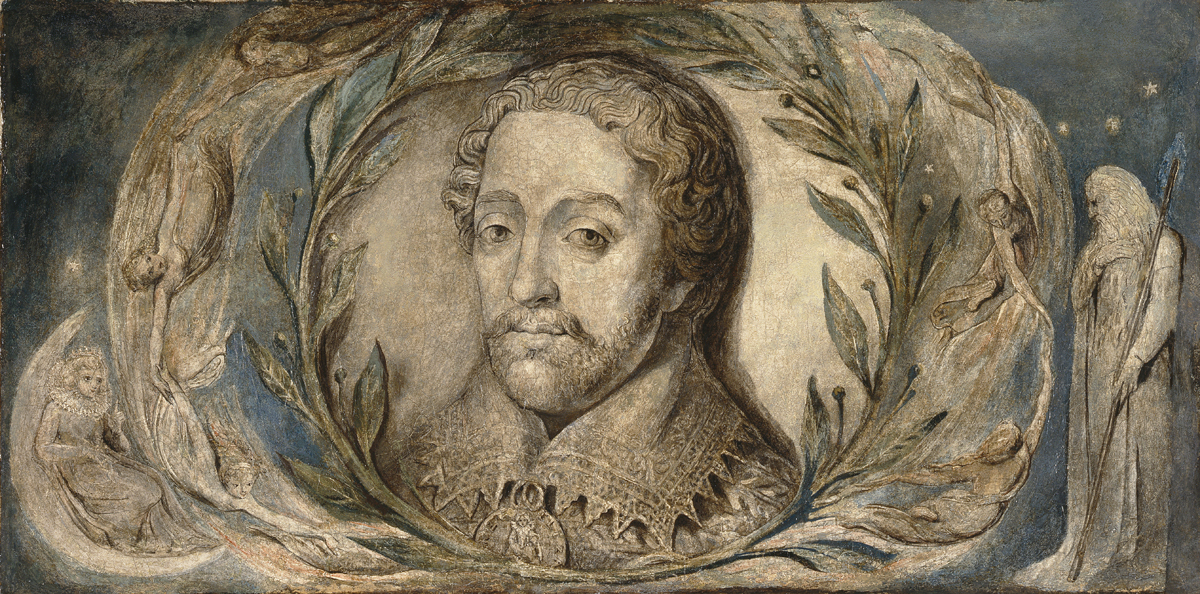
William Blake, Edmund Spenser, c. 1800
Source: Wiimedia Commons

In Book IV, Canto XI of The Faerie Queene (1596), Edmund Spenser describes the marriage of Thames and Medway.  I won't attempt to describe here how this fits into the plot, but it takes place in Proteus's house and the guests include many gods of seas and rivers.  Among these are Nile, Rhine, Ganges, Amazon and 'rich Oranochy, though but knowen late' (Spenser's friend Raleigh had explored the Orinoco a year earlier, hoping to find El Dorado).  English rivers are of course invited, but so too are the rivers of Ireland, where Spenser was living at the time.  Incidentally, there are occasional brief references to the Irish landscape in other parts of The Faerie Queene, e.g. the River Shannon (Shenan) whose battle with the ocean tide is a simile for the struggle between two knights (and perhaps the unequal struggle between Ireland and England too).  I have written here before about Spenser and Ireland and it is not really surprising that this wedding encompasses the Irish rivers, for 'why should they not likewise in loue agree'.

Thames, the bridegroom, arrives with his elderly parents Thame and Isis to the accompaniment of a harp played by Arion.  His bride arrives later with handmaids and sea nymphs.  I will quote here just one stanza, which comes as Thames processes in, dressed in a light blue robe and wearing a coronet in the shape of London.  Various tributaries to the Thames are mentioned, including the one nearest to where I live, the Lee.
And round about him many a pretty Page
Attended duly, ready to obey;
All little Rivers, which owe Vassalage
To him, as to their Lord, and Tribute pay;
The chaulky Kenet, and the Thetis grey,
The morish Cole, and the soft-sliding Brean,
The wanton Lee, that oft doth lose his way,
And the still Darent, in whose Waters clean
Ten thousand Fishes play, and deck his pleasant Stream.
I love that description of the Lee.  It would make a good quiz to match the epithet to the river in this Canto - stately Severn, storming Humber, speedy Tamar - or guess it from a brief description 'decked all with Woods / Like a Wood-God, and flowing fast to Rhy' (the River Rother).  In real life the Thames and Medway meet and merge at Rochester, where Spenser had worked as secretary to the Bishop in 1589.  A year later he mentioned in a letter a poem he was working on, now lost, called Epithalamion Thamesis, which prefigured this section of The Faerie Queene.  There was also a model for this Canto in another river-wedding poem, De Connubio Tamae et Isis, fragments of which appear in William Camden's great topographical work Britannia (1586).  In Camden, Isis is the male god, who comes from a cave in the Cotswolds to meet his bride, Tame, at Dorchester in Oxfordshire, where they retire to the nuptial chamber.  After the celebration they rise as one, Thamisis, and make their way downriver, past Windsor, Runnymede, Hampton Court and Richmond, towards the sea.   

Are there earlier examples of river-marriage poems?  In a an article on the subject ('Spenser, Camden, and the Poetic Marriages of Rivers', Studies in Philology, 1967), Jack B. Oruch notes that the Italian humanist Giovanni Pontano wrote a 'topographical pageant' into his poem Lepidina (1496), in which Sebeto, a river god, marries the patron divinity of Naples.  As for later writers, there is Michael Drayton, whose Poly-Olbion I have mentioned here before - his Fifteenth Song (1612) takes up again the theme of the marriage of Thame and Isis.  The rivers Walla and Tavy are wed in Britannia's Pastorals (1616) by a friend of Drayton's, William Browne of Tavistock.  Browne may also be the author of an anonymous poem in which the Torridge marries the Ock.  And there is a 1613 masque by Francis Beaumont in which the Thames marries the Rhine, part of the celebrations for the wedding of Princess Elizabeth (later called The Winter Queen) and Frederick V.

J. M. W. Turner, Union of the Thames and Isis ('Dorchester Mead, Oxfordshire), 1808
Source: Wiimedia Commons 

The poetic tradition seems to have faded out in the early seventeenth century.  In 1808 Turner exhibited a painting entitled the Union of the Thames and Isis, but this is not one of his mythological paintings.  Instead of Camden's magnificent bridal chamber, prepared for Tame by Grace, Concord, Hymen and the Naiads, we have a view of cows standing in brown water.  The Tate's curators describe this quiet landscape: 'The Thame, hardly more than a stream, is in the foreground while the Thames [Isis] is glimpsed beyond the wooden bridge on the right. Modest and direct, the picture also evokes the seventeenth-century painter Aelbert Cuyp in its lighting and pastoral imagery.'  Two more centuries on, it is hard to imagine a return to the extravagant topological wedding feasts of Spenser's time, though it would be fun to write one in which the river gods make small talk over glasses of fizz, watch the bride and groom trying not to giggle, sit through an inappropriate best man's speech and end up the dancing drunkenly to Abba on a slippery dance floor.

Friday, May 29, 2015

The vast and queachy soil

In this post I want to draw your attention to Complex Crosses, a book of close readings by my friend Edmund Hardy which 'spans the history of poetry by alighting on small fragments'.  I reproduce with permission one of these in its entirety below.
 
Michael Drayton / compounds of place / 1622
From fast and firmer earth, whereon the Muse of late,
Trod with a steady foot, now with a slower gait,
Through quicksands, beach, and ooze, the Washes she must wade,
Where Neptune every day doth powerfully invade
The vast and queachy soil, with hosts of wallowing waves

(Polyolbion, The Five and Twentieth Song, lines 11-15)

The muse trods in gradations from the “fast and firmer” chalky uplands of Lincolnshire into the ooze of “vast and queachy soil”: “with a steady foot” begins on the chalk (to the north and south of the fens) and Jurassic rocks to the west, then down into the levels “with a slower gait” as sedimentation has slowed the landscape with “quicksands, beach, and ooze”, an interdigitation of peat, clay, silt and chalky islands. “Neptune every day” fixes the eroding action of the sea within the long time-span needed to imagine the erosion of the one-time chalk escarpment as the sea breaks in, and sedimentation fills the basin – the long span of Neptune within “every day”. The resulting fens are both sea and land, compounded linguistically in “wallowing waves”, presaging the area’s own self description in the poem “I peremptory am, large Neptune’s liquid field” (line 151). The soil is onomatopoeically queachy, heard and felt as the steady foot of the topographic muse puts a foot in, and finds that foot sucked into the landscape.
- Edmund Hardy, Complex Crosses (2014)

Illustration from Polyolbion (1622) engraved by William Hole

While the topographic muse trod through quicksands, beach and ooze, the inhabitants of the Fens in Drayton's day got about on stilts.  Drayton mentions this in his poem and William Camden, writing a little earlier, drew particular attention to the practice.  In Brittania (Latin 1586, trans 1610) we read of the inhabitants of Cambridgeshire’s peat fens: ‘a kind of people according to the nature of the place where they dwell rude, uncivill, and envious to all others whom they call Upland-men: who stalking on high upon stilts apply their mindes, to grasing, fishing and fowling.’  Isaac Casaubon spent some weeks in 1611 in and around Ely where he ‘made acquaintance with the solitary bittern and the imitative dotterel, with turf-fires and with stilts, and with the stilt walkers who were able to run so quickly.  At Downham, he was surprised to see one man on stilts drive 400 cattle to pasture with the help of only one small boy.’*  It is tempting to draw a comparison with Drayton's poem, which is rarely stilted but does (as I've mentioned before) tend to stride rapidly over the landscape without really touching its surface.

Drayton died in 1631 and in the subsequent decade work began on the draining of the Fens.  It was a process described in a poem that has been attributed to Samuel Fortrey:
I sing Floods muzled, and the Ocean tam'd,
Luxurious Rivers govern'd, and reclam'd,
Waters with Banks confin'd, as in a Gaol,
Till kinder Sluces let them go on Bail;
Streams curb'd with Dammes like Bridles, taught t'obey,
And run as strait, as if they saw their way. 
It is not surprising to read in 'An Account of Several Observables in Lincolnshire, not taken notice of in Camden, or any other Author’, written at the end of the seventeenth century by Christopher Merret, that 'Stilts are now grown out of Fashion.’ 

*  H. C. Darby, The Draining of the Fens, 1940, which contains the two quotes in the last paragraph here too.

Tuesday, December 19, 2006

Charnwood Forest

I have started adding labels to these posts, relating them to different types of landscape. This is not necessarily very helpful because, despite the titles for each entry, Some Landscapes is not an inventory of actual landscapes. But I like the idea of clicking on the word and getting up all entries which refer to mountains by way of highlighting some aspect of landscape in culture, or something about the work of a particular artist.

Of course only a subset of cultural landscapes are likely to give insights into particular places, and this is true for all periods of art. For example, I could boost the number of postings on forests by mentioning Charnwood in Leicesterhire, which features in Michael Drayton's Poly-Olbion (The Sixe and Twentieth Song). But being written in 1622 it sounds like this:
'No tract in all this isle, the proudest let her be,
Can show a sylvan nymph for beauty like to thee:
The satyrs and the fauns, by Dian set to keep,
Rough hills, and forest holts, were sadly seen to weep,
When thy high-palmed harts, the sport of bows and hounds,
By gripple borderers' hands, were banished thy grounds.
The dryads that were wont thy lawns to rove...'
And so on. It is possible to strip out the classical allusion here and focus on what the satyrs were weeping about: greedy (gripple) cottagers killing off the deer. But the dryads provide further distraction: they rove to Sharpley and Cademon, real places which are not described, and on Bardon Hill we are merely told that they are joined by 'harmless elves.' To be fair, there are brief bursts of description in this poem but it does not engage directly with the Leicestershire landscape.

There is a useful on-line summary of the Poly-Olbion by William Moore. His description of the twenty-sixth song from which the lines above are taken is as follows:
'Topographical competition continues in Nottinghamshire, Leicestershire, and Derbyshire. The Vale of Bever (Belvoir) matches herself with previous boasting valleys. The Muse defends the slowness of the Soar River, by analogy to a young girl visiting a sumptuous palace for the first time. The Soar praises its Charnwood Forest for containing all the best features of every other forest. The Trent River, comparing herself favorably with the Thames and the Severn, catalogues her fish. Sherwood Forest, in competition with Charnwood, tells the story of Robin Hood and his bowmen. The Peak, a "withered Beldam," tells of her seven wonders (caves, wells, a hill of sand, and a forest) before the song flows down from the hills along the Darwin (Derwent) River.'