Tuesday, May 30, 2006

Scandinavian Landscape with a Waterfall

Jacob van Ruisdael’s Scandinavian waterfall paintings are partly remarkable because, as Seymour Slive says in his guide to the Royal Academy’s Jacob van Ruisdael exhibition, Ruisdael “never laid eyes on such scenes. His motifs for them were derived from Allart van Everdingen, a Dutch artist who visited Norway and Sweden in 1644 and returned to Holland with a stock of Nordic themes for use in his works. In the late 1650s and early 1660s, when Ruisdael began to paint rushing torrents in rocky mountainous northern valleys studded with conifers, he followed Everdingen’s example closely.” The exhibition includes the large Waterfall in a Mountainous Landscape with a Ruined Castle (c1665-70), which is in a private collection. The Fogg Art museum has another famous example, Waterfall with a Half-Timbered House and Castle.
 
On his trip to Scandinavia Allaert van Everdingen (1621-75) visited the south-eastern coast of Norway and the area of western Sweden around Göteborg. As Slive writes in Dutch Painting 1600-1800, there is no reason to believe he ever returned, even though he received a commission to paint the Trip family’s Cannon Foundry at Julitabroeck in Södermanland, Sweden. An example of the kind of Scandinavian landscape by Everdingen that inspired Ruisdael is the Munich Alte Pinakothek’s Scandinavian Landscape with a Waterfall (1650) (unfortunately the image doesn’t seem to be available on-line - PS: since writing this post the image below has become available).

Allaert van Everdingen, Swedish Landscape with Waterfall, 1650-1675
 
Everdingen’s work would also have an influence on Scandinavian landscape painting: another later artist who admired him was the Norwegian painter Johan Christian Dahl (1788-1837). Contemporary critics described Dahl as ‘the new Everdingen’. According to Andrew Graham-Dixon, Dahl’s training involved “seven years in the Danish capital, where he was taught principally by Christian August Lorentzen, a run-of-the-mill painter who encouraged him to study the many Dutch masterpieces in the Danish royal collection. 'The landscape painters I learn from are Ruisdael and Everdingen,' Dahl wrote in 1812. 'But first and foremost I study nature - a pity there are no cliffs and water here, but then one has to do with fountain water.'”

Monday, May 29, 2006

View of Haarlem with Bleaching Grounds

 
Jacob van Ruisdael, View of Haarlem with Bleaching Grounds (c1665) 

At the Royal Academy’s Jacob van Ruisdael exhibition there are several landscapes showing the local bleaching grounds, where lengths of cloth cover the ground, like abstract collages, blank canvases or (at a stretch) Christo wraps. In the Zurich View of Haarlem with Bleaching Grounds (c1665) for example, the cloth emphasises the light falling in the middle of the wide flat vista, an effect you often see in Ruisdael’s panoramic landscapes. Here is a description of a similar view from the Timken museum site: “Haarlem linen had a great reputation in the seventeenth century, and the linen industry was enormously important to the city's economy. Clothing and uncut cloth were bleached in the fields around the city in a process that took several months. Ruisdael, one of the most important seventeenth-century Dutch landscape painters, completed about fifteen views of Haarlem showing the linen-bleaching fields. In this richly textured canvas, as in other landscapes of the subject, the artist arranges the buildings and rows of linen to lead the eye diagonally through alternating areas of shadow and light.” Whether these paintings could be criticised or praised for transforming scenes of industry into harmonious pictorial compositions is, perhaps, ultimately a matter of taste.

The RA magazine has an article by Jenny Uglow on Ruisdael to accompany the exhibition here.

Sunday, May 21, 2006

A couple of breaks of sunshine

Kenneth Goldsmith’s The Weather is a sort of post-modern version of James Thomson’s The Seasons, based entirely on New York area one-minute weather report transcripts. It begins with ‘Winter’: ‘A couple of breaks of sunshine over the next couple of hours, what little sunshine there is left. Remember, this is the shortest day of the year. Looks like the clear skies hold off till later on tonight. It will be brisk and cold, low temperatures will range from twenty-nine in some suburbs to thirty-eight in midtown. Not a bad shopping day tomorrow, sunshine to start, then increasing clouds, still breezy, with a high near fifty…’

Kenneth Goldsmith has said: “The piece itself is a master narrative of a year, a sub-narrative of the four chapters, and several micro-narratives within the chapters. Storms approach from afar; they get closer; they occur; they pass. Weather, that most organic of phenomenon, is framed as a transaction. Quantified, narrativized, and capitalized, the weather either aids or abets our drive time.” The way weather is treated seems to convey a sense of contemporary landscape, where natural phenomena are present as background noise, like the sound of the radio. Marjorie Perloff has written an interesting essay about The Weather on Ubuweb.

Nothing to do with landscape, but there are some Goldsmith songs here based on cultural theory, for example text by Frederic Jameson sung to the tune of John Coltrane’s My Favorite Things. Not, I think, on this evidence a musical genre likely to flourish.

Saturday, May 20, 2006

Winter Landscape with a Gypsy Encampment

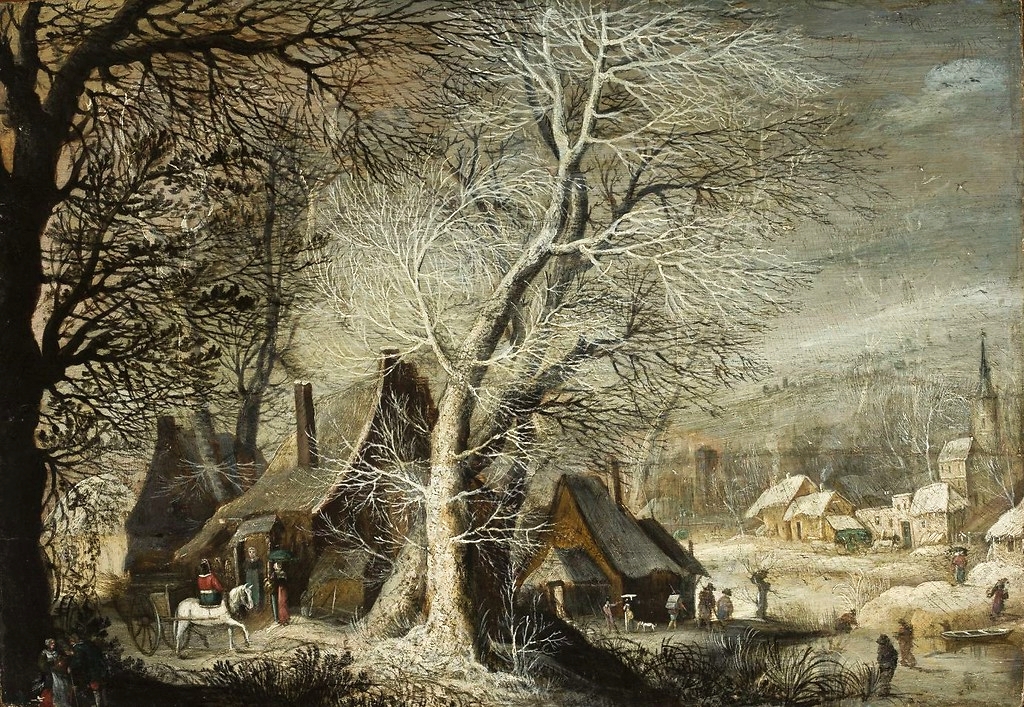
We think of modern artists as obsessively returning to certain types of landscape, whether for their symbolic value or formal qualities. In earlier centuries it is easier to imagine artists merely cornering particular sections of the landscape market. For instance, among early seventeenth century Flemish landscape painters, there were several in Antwerp specialising in woodland scenes, and among these Gijsbrecht Leytens (1586-1643/56) was the master at painting woodlands in winter. In Winter Landscape with a Gypsy Encampment there is a striking contrast between the dark foreground and the silvery-white branches beyond, the wood’s deep shadows and the golden winter light glimpsed through tunnel-like paths between the trees. The Bridgeman library has several other ‘Winterkens’ by Leytens: The Flight into Egypt, The Massacre of the Innocents, Winter Landscape. All these diverse scenes are covered in Leytens’ fine powder snow.

Postscript 2015 It is now possible to embed images in a way that was difficult when I wrote this brief post, so here are a sequence of Gijsbrecht Leytens images on Wikimedia Commons (dates are not given):  

Winter Landscape

A Winter Landscape with Woodcutter
Winter landscape with people strolling on the banks of a frozen river where children play

Friday, May 19, 2006

Valois mists

‘There was a slight stretch of open country to cover before reaching Othys. The village spire was already visible on the bluish hills that extend from Montméliant to Dammartin. The Thève was once again burbling over rocks and pebbles as it dwindled to a narrow stream near its source – where it rests among the meadows forming a small pond amid irises and gladioli’.  
This is a landscape in the Valois described by the narrator of Gerard de Nerval’s ‘Sylvie’ (1854). The translation is by Richard Sieburth, who observes that Nerval worked like a plein air painter: Nerval’s ‘limpid landscapes have often been compared to those of his friend Corot’. However, as with Corot, there is more to Nerval than mere description – this simple landscape quoted out of context conveys almost nothing of what makes ‘Sylvie’ so special (for me ‘Sylvie’ is one of the most perfect works of literature). Sieburth writes that ‘Sylvie’ is not simply ‘a regionalist roman champêtre in the bucolic manner of George Sand’. It has affinities with Poe and Proust: a shifting landscape of memory and ghosts. The Valois of Nerval’s youth merges with that of Rousseau, Catherine de Medici and Charlemagne. So perhaps a more representative landscape is from a dream in which the narrator sees a castle lit by the setting sun, its green lawn framed by elms and limes and on it young girls dancing. The shadows descend and ‘thin clouds of mist drifted over the lawn, spreading tufts of white upon the tips of the grass. We thought we were in paradise.’

For more on ‘Sylvie’ see this French Nerval site.

Monday, May 15, 2006

Memory of Marcoussis

Jean-Baptiste Camille Corot, Souvenir of Coubron, 1872

Like Howard Hodgkin, Jean-Baptiste Camille Corot was an artist who, at least in his later work, painted memories of landscapes rather than views. This is suggested in titles like Memory [Souvenir] of Coubron (above) and many others: Souvenir de Mortefontaine, de Sologne, de Toscane, du lac d'Albano, de Castelgandolfo...   Michael Clarke (Corot and the Art of Landscape) calls such painting an art of ‘reflection and reminiscence’ and compares it to the poetry of Lamartine and de Musset, who also used the term ‘Souvenir’ in their titles. Indeed ‘Corot’s The Shepherd Star of 1864 was possibly inspired by lines by de Musset, of whom the artist recalled "Ah! Musset what a poet… He also has greatly suffered. He took notice of me in the past when none recognized me. I owe him a debt of gratitude."’

Sunday, May 14, 2006

Venice / Shadows


The Green Château, In Central Park, Bombay Sunset Howard Hodgkin sometimes chooses titles that would suggest landscapes, but the paintings themselves never do more than suggest landscapes. House Near Venice (1984-88) includes what appears to be a house reflected in water, but other Venice pictures are no more than blurred hazes of colour. Venice / Shadows (1984-88) suggests the idea of a cool doorway or the pattern of sunlight and Venice Grey Water (1988-89) gives a sense of the lagoon – not grey but shifting greens and blues. Hodgkin’s Venice, like Turner's, is a city of memory and floating forms. Rather than landscapes, these paintings are about passing time, with its moments of clarity and confusion. As Andrew Graham-Dixon has written, they are works in which ‘topography is displaced by metaphor.’

Friday, May 12, 2006

Pier and ocean

Franz Marc, Tirol (1914)
Source: Wikimedia Commons

Robert Rosenblum has succinctly described some of the ways in which artists turned away from landscape at the start of the twentieth century (in his essay ‘The Withering Greenbelt’, published in Denatured Visions: Landscape and Culture in the Twentieth Century edited by Stuart Wrede and William Howard Adams). This included
  • landscape reduced to exquisite, almost abstract detail in the paintings of Monet and Augusto Giacometti;
  • landscape sanctified or mystical, archaic or primordial, as in the work of symbolists like Ferdinand Hodler;
  • unreal expressionist landscapes, both pastoral and apocalyptic, like Franz Marc’s gentle Horse in Landscape (1910) and violent Tirol (1914);
  • landscape reduced to fragments in the Modernist city, in the work of artists from Seurat to Leger, and symbolised by Corbusier’s Pavilion de l’Esprit Nouveau (1925) in which a single tree integrated into the design points to the containment and absence of nature.
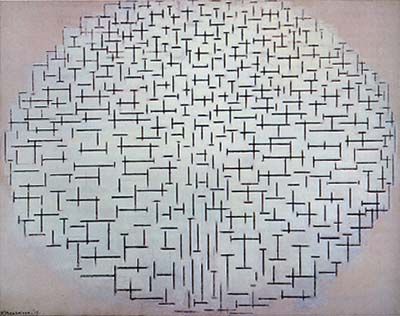
However, for Rosenblum it is Piet Mondrian who best exemplifies the process, going ‘from an espousal of nature and its mysteries, to a rejection of it in favour of an imagery rooted in the utopian city.’ Indeed Mondrian’s gradual artistic rejection of landscape and nature paralleled his own personal movement in 1909-11 ‘to the dunes on the cold northern shores where he felt he could immerse himself in the void.’ The simplified dune landscapes he painted there would be followed by The Sea (1912) and Composition No 10, Pier and Ocean (1915), from which it was a short step to complete abstraction.

Wednesday, May 10, 2006

The Holy Mountain

Arnold Fanck, the director whose work defined the Bergfilm genre, was born in 1889 and first encountered mountains at Davos as a child while recovering from asthma. He became a professional geologist, but also found time to become a skier and amateur photographer. Fanck’s debut film was The Wonders of Skiing (1919) and subsequent films celebrated the mountains through a mixture of documentary and narrative elements. In 1924 Mountain of Destiny so impressed the young dancer Leni Riefenstahl that she got in touch with Fanck to ask if she could appear in his next film. The Holy Mountain (1926) was the first of six mountain films they made together.

The Holy Mountain’s full title was Der heilige Berg: Ein Heldenlied aus ragender Högbenwelt. ‘Heldenleid’ means ‘heroic song’ and the film features a Nietzschean hero (Luis Trenker) who climbs the Alps to find himself, and to escape the rabble below. These elements of the story are undoubtedly difficult to take in light of the subsequent careers of actors and director under the Nazis. Trenker’s tormented Romantic idealist contrasts with the light-hearted young skier Vigo (Ernst Peterson) who features in the joyous and visually beautiful footage of the winter sports. The uneasy blend of fiction and winter sports in the film mirror the divided characters of the two men, who both desire the dancer played by Riefenstahl. Whilst The Holy Mountain is marred overall by Romantic cliché and a proto-Fascist aesthetic, there are certain scenes where the beauty and excitement of mountains is vividly captured.

Mountain landscapes in The Holy Mountain are filmed in dramatic black and white. There is a memorable long-shot of skiers descending a slope, carving patterns in virgin snow. In the opening scenes Riefenstahl is silhouetted against the sea, and in the climactic scene on the mountain, the two climbers are fragile dark figures making their way up, as wind-blown snow cascades down the slope. Riefenstahl developed a similar visual sense in the later films she directed. In Tiefland, filmed during the Second World War at a time when colour films had become the norm, she explicitly set out to show what could still be achieved by black and white photography. And back in 1926, in Fanck’s temporary absence, Riefenstahl had directed one of the best scenes in The Holy Mountain, in which night skiers glide along carrying flares, their moving images reflected in water.

Monday, May 08, 2006

Sahara line

Among critical writing dealing with the origins of land art, Rosalind Krauss’s essay ‘Sculpture in the Expanded Field’ is particularly interesting (it is reprinted in her stimulating collection The Originality of the Avant-Garde and Other Modernist Myths). She argues that for most of its history sculpture was site specific, but that increasingly Modernist sculpture (the kind of work made by artists like Brancusi and Caro) was site-less and self-referential, no longer directly connected to buildings or landscapes. Sculpture had become implicitly defined as not-landscape and not-architecture, but all this started to change in the late sixties when artists began to seek an expanded field of possibilities.
 
To describe these developments Krauss uses a structuralist diagram based on the Piaget group. Sculpture is in one corner, but there are three other options. The opposite of sculpture is art that is both landscape and architecture: site-constructions like Robert Smithson’s Partially Buried Woodshed (1970). Ian Hamilton Finlay’s garden Little Sparta would seem to fit this category (Krauss saw Japanese gardens as an example of non-Western art that is both architecture and landscape). The architecture but not-architecture category covers various kinds of interventions into real buildings - Gordon Matta-Clark’s work springs to mind. Then there is art that is both landscape and not-landscape, which Krauss identifies as the marked sites of land art, including the work of Richard Long. A work like Long’s Sahara Line (1988) can thus be seen as art in the landscape that is nevertheless, like sculpture, an autonomous art work separate from any landscape.

Sunday, May 07, 2006

Views of Suma

Utagawa Hiroshige, The Beach at Suma, 1853

In the preface to his book on Japanese Linked Verse Earl Miner discusses the way Japanese poems are affective - responses in words to something moving – and that recipients of poems would in turn be moved by the way these emotions had been expressed. The same principle applies to landscape paintings. For example, in The Tale of Genji, the sketches and poetic descriptions Genji made during his exile in Suma move Prince Hotaru almost to tears. Miner relates this affective-expressive mode to two terms: 
‘”kokoro” means heart, mind, or spirit – the human capacity to be affected and to understand. “Kotoba” means words, languages, signs, or techniques – the human capacity to make known to others what has been gained by kokoro… Not to possess kokoro was to be barbarian, worse than animals. The warbler among plum blossoms, the frog in summer waters, the stag crying for a mate in autumn – all were poets. All gave voice to experience. Thus being moved and being led to expression defined poetic activity. In addition these animal singers and criers moved one to respond in poetry, just as would the poem of a friend.’
So it is not simply that landscape views provoke an emotional response; the possessor of kokoro will literally be spoken to by the natural world.

Saturday, May 06, 2006

Fallen willow leaves

For landscapes in haiku, an obvious writer to consult is the poet-painter Buson (1706-83), famous for his objective style and visual imagination. For example, from 1742 this poem about a willow tree:
Yanagi chiri
shimizu kareishi
tokorodokoro
The translation posted in several places on the web is by Robert Hass: ‘The willow leaves fallen / the spring gone dry / rocks here and there.’ Earl Miner has translated the last two lines as ‘in fresh waters weathered stones scattered here and there.’
The poem seems to be a simple landscape, describing a scene encountered by Buson, but it is also about poetry and the passing of time. The willow tree alludes to a poem by Priest Saigyo (1118-1190) in which he lingers in the shade watching the reflection of the tree in rippling water:
Michi no be ni
Shimizu nagaruru
Yanagikage
Shibashi tote koso
Tachidomaritsure.
Buson is also referring to an encounter with the tree at Ashino by Basho (1644-94) on the Narrow Road to the Deep North. As Haruo Shirane writes, ‘Basho pauses beneath the same willow tree and before he knows it, a whole field of rice has been planted. In contrast to Basho's poem, which recaptures the past, Buson's poem is about loss and the irrevocable passage of time, about the contrast between the situation now, in autumn, when the stream has dried up and the willow leaves have fallen, and the past, in summer, when the clear stream beckoned to Saigyo and the willow tree gave him shelter from the hot summer sun. Like many of Basho and Buson's poems, the poem is both about the present and the past, about the landscape and about other poems and poetic associations.’ For Buson (as Miner puts it in Japanese Linked Verse), ‘Saigyo and Basho are gone from the earth, remaining however in the mind as a cherished idea shrouded in the mystery of memory.’

Thursday, May 04, 2006

The Cloud

The exhibition A Mirror of Nature: Nordic Landscape Painting 1840-1910 looks interesting but is not coming to Britain. One of the artists included is Prince Eugen of Sweden, a royal landscape painter who bought and promoted the work of the Impressionists. His work is influenced by Impressionism but tends to have a symbolist quality, as in The Cloud (1896). As it says on the exhibition website, ‘The intensity of the colour, the path into the unknown and the cloud in the distance, together with the absolute stillness, can all be interpreted as symbols of a longing for the life to come.’ A sense of Prince Eugen’s range can be obtained from the Waldemarsudde website, including an earlier version of The Cloud (1895). The 1890s must have been the last time a landscape-painting prince could be at the cutting edge of art…

Prince Eugen, A Summer Night at Tyresö, 1895

Postscript 2016

I have now visited Prince Eugen's villa in Stockholm - it lives up to the description in the comment below.  Here's a photograph of the interior, showing landscape paintings on the wall and the view from a window.  The other photograph below is one of the Prince's cloud paintings hanging on the wall.  The accompanying text includes this quote: "What actually interests me are clouds, the huge white and yellow kind that swim around and balloon in the sky."


Sunday, April 30, 2006

Lit dew shimmers


Poet and Chinese scholar David Hinton has specialised in translations from the Chinese rivers-and-mountains tradition. He has been well served by publishers – the books are beautifully produced, as can be seen on the David Hinton website. As I write this I am looking at the Archipelago Books edition of The Mountain Poems of Meng Hao-jan, printed on “60lb Mohawk Vellum” paper, with its imagistic poems spaced elegantly on each page.

The Mountain Poems of Meng Hao-jan is the first English book devoted completely to the High T’ang poet Meng Hao-jan (689-740). The introduction quotes poems by Li Po and Wang Wei to give a sense of how these better known poets revered Meng, and a later poem by Po Chü-i in which ‘Meng himself disappears into landscape while his poems survive as landscape’. Rather than become a bureaucrat or monk, Meng lived a simple life in the mountains of Hsiang-yang. His surviving body of work is not large; ‘it is said that Meng’s practice was to destroy poems after writing them because they inevitably failed to render experience at that absolute level that lies beyond words.’

There are a few sample poems on Hinton’s site which demonstrate the way Meng rendered experience: “My thatch hut grows still. At the bottom stair, in bunchgrass, lit dew shimmers.” In one of these poems, Meng climbs Long-View Mountain to survey the landscape, clouded in mists and blossoms. In another, Meng writes from his ‘bamboo-leaf gardens’ to Ch'ao, the ‘Palace Reviser’ – while Ch’ao toils in the library, Meng lives close to nature, where words start to be forgotten.

Saturday, April 29, 2006

Earthrise


There is currently a trend for uncovering documentary photographs and considering them in the context of landscape art practices and conventions - a recent example is the book Record Pictures: Photographs from the Archives of the Institution of Civil Engineers by Michael Collins. Perhaps the most spectacular set of documentary photographs recovered in this way is Michael Lite’s reprints from the NASA archive. His Full Moon site has some of these images.

Most of the best lunar landscapes were photographed from orbiting spacecraft, e.g. a view of Rima Ariadaeus, a terraced wall crater, and a lunar rille, all photographed by the Apollo 10 astronauts in May of 1969. The best known lunar landscape is one in which the moon is merely the frame: Earthrise (above) photographed by William A. Anders on Christmas Eve 1968 from Apollo 8. For the story of how the photograph came to be taken, see the account by Robert Zimmerman. The ABC site has the black and white image by Apollo 8’s commander Frank Borman, and the famous colour image rotated to the orientation Anders originally saw through the viewfinder.

Is there a danger in aestheticising these photographs? Landscape often gives rise to questions about the overlap between scientific observation and art. The status of these Apollo photographs might be likened to the paintings of John Russell (1745-1806), who made meticulous studies of the moon’s surface using a telescope, like this one.

Friday, April 28, 2006

Scottish streams

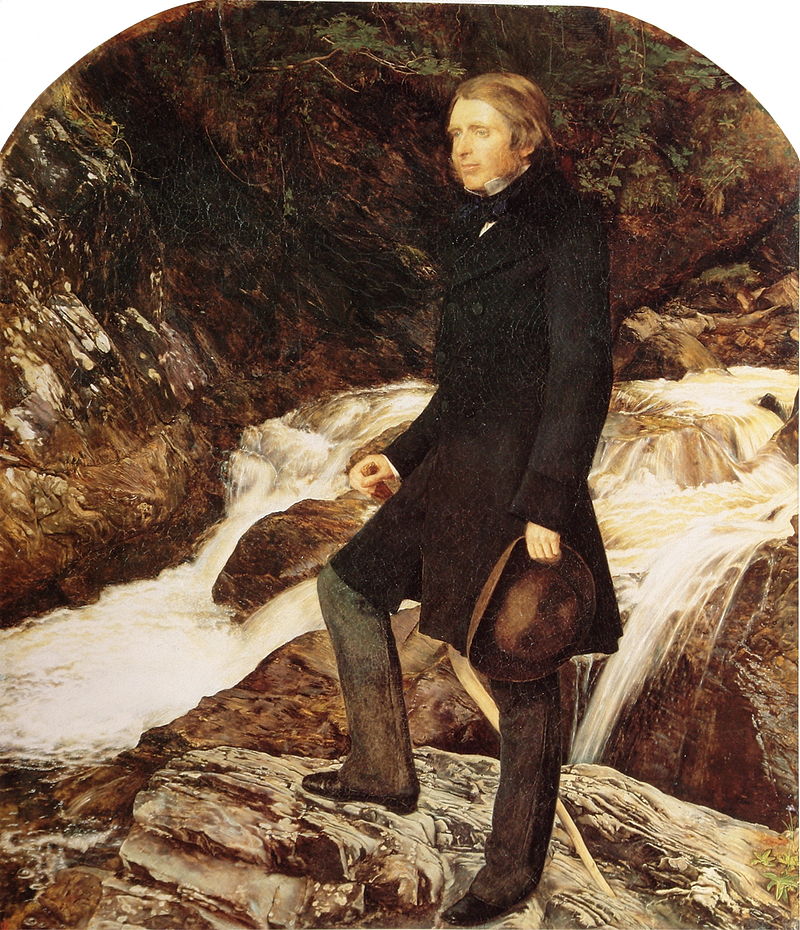
John Millais, Portrait of John Ruskin, 1853-4

In this memorable passage, John Ruskin observes the acoustic qualities of Scottish streams:
'I know no other waters to be compared with them; - such streams can only exist under very subtle concurrence of rock and climate. There must be much soft rain, not (habitually) tearing the hills down with floods; and the rocks must break irregularly and jaggedly. Our English Yorkshire shales and limestones merely form – carpenter-like – tables and shelves for the rivers to drip and leap from; while the Cumberland and Welsh rocks break too boldly, and lose the multiplied chords of musical sound. Farther, the loosely-breaking rock must contain hard pebbles, to give the level shore of white shingle, through which the brown water may stray wide, in rippling threads. The fords even of English rivers have given the names to half our prettiest towns and villages – (the difference between ford and bridge curiously – if one may let one’s fancy loose for a moment – characterizing the difference between the baptism of literature, and the edification of mathematics, in our two great universities); but the pure crystal of the Scottish pebbles, giving the stream is gradations of amber to the edge, and the sound as of ‘ravishing division to the lute,’ make the Scottish fords the happiest pieces of all one’s day walk.'

From Fors Clavigera, Letter XXXII, August 1873, Section 14

Monday, April 24, 2006

Vague snow descending


A John Clare poem gives its title to a new anthology of ‘poems for the planet’, The Thunder Mutters, edited by Alice Oswald, author of Dart. Clare’s biographer Jonathan Bate has reviewed it in The Guardian. Clare is also represented among Oswald’s 101 choices by a transcription of a nightingale song and a prose description of a woodman working in a winter forest. These examples convey her aim in the anthology to highlight poems that enter directly into the natural world through close observation or labour (Oswald herself worked as a gardener). As she says in the introduction, “no prospect, pastorals or nostalgic poems are in here…” So in a way this is an anthology about poets in the landscape rather than ‘landscape poems’.

Nevertheless, one poem in The Thunder Mutters is simply called ‘Landscape’. The poem didn’t have this title in French (frustratingly there is no information about any of the poems apart from some incomplete acknowledgements, so it is unclear to the reader when or in what form this poem, or others like ‘The Thunder Matters’, were first written or published). ‘Landscape’ is a translation by C.F. Macintyre of Paul Verlaine’s ‘Dans l’interminable ennui de la plaine’ (1874). This poem concerns neither nature nor outdoor work - it is a landscape of the mind, a ‘flat land’ with ‘vague snow descending’ and woods where misty grey oaks twist like clouds:
Dans l'interminable
Ennui de la plaine
La neige incertaine
Luit comme du sable.
Le ciel est de cuivre
Sans lueur aucune
On croirait voir vivre
Et mourir la lune.
Comme des nuées
Flottent gris les chênes
Des forêts prochaines
Parmi les buées…

Alice Oswald places this ‘Landscape’ opposite ‘Mississippi Bo Weavil Blues’ by blues singer Charlie Patton, which gives an indication of the anthology’s range. It is a strength of the book that her selections are quirky and personal – she includes a poem by her husband and local epitaphs from Bideford and Great Torrington churches. The combination of famous poems by writers like Marianne Moore, Seamus Heaney, Robert Frost and Walt Whitman interspersed with fragments of oral and experimental poetry make The Thunder Mutters a very enjoyable collection.

Saturday, April 22, 2006

Swordy Well

There is a good John Clare blog which combine extracts from the poems and prose with appropriate images. Some recent posts have been on Clare’s poem ‘The Lament for Swordy Well’ – site of a quarry near Clare’s home which has recently been saved from developers by the Langdyke Trust.

Swordy Well is one of Clare’s special places… it seems inappropriate to use the term ‘landscape’ in connection with poetry so immersed in its subject. In Edwin Paxton Hood’s book The Literature of Labour, published in 1851 when Clare was still living in the Northampton Asylum, it is noted that ‘other poets select a river, or a mountain, and individualise it, but to Clare all are but parts of the same lovely Home, and as every part of the home is endeared – the chair, the shelf, the lattice, the wreathing flower, the fire-place, the table – so is every object in Nature a beloved object, because the whole is beloved.’

One telling example of the way Clare goes beyond other poets in his relationship with the natural world is provided by R. K .R. Thornton, in his introduction to a short anthology of Clare’s verse published by Everyman (1997). Clare is ‘the only poet I know of who would be able to describe the changes in trees not by descriptions of the leaves, not by accounts of the blossom or berries, but by describing changes in the bark.’ Thornton cites as an example ‘Pleasures of Spring’ in which Clare describes the bark of blackthorn darkening, hazels shoots regaining bright freckles and ‘foulroyce’ (dogwood) twigs shining red as ‘stockdoves’ claws.’

Wednesday, April 19, 2006

Small woods, and here and there a voide place

The OED is allowing free access to its online edition this week. Here are four definitions of the word ‘landscape’ along with some illustrative quotations from the seventeenth century.

  • A picture representing natural inland scenery, as distinguished from a sea picture, a portrait, etc: 1605 Ben Jonson in The Masque of Blackness, “First, for the Scene, was drawne a Landtschap, consisting of small woods...”
  • The background of scenery in a portrait or figure-painting (obsolete): 1656 Thomas Blount in Glossographia, “All that which in a Picture is not of the body or argument thereof is Landskip, Parergon, or by-work.”
  • A view or prospect of natural inland scenery, such as can be taken in at a glance from one point of view; a piece of country scenery: 1632 John Milton in L’Allegro, “Streit mine eye has caught new pleasures Whilst the Lantskip round it measures.”
  • In a generalized sense, inland natural scenery, or its representation in painting: 1606 Thomas Dekker in The seuen deadly sinnes of London, “A Drollerie (or Dutch peece of Lantskop).”
The first of these references, The Masque of Blackness, was Ben Jonson’s first masque, performed for Queen Anne at Whitehall Palace on 6 January 1606. It is usually discussed in relation to issues of race and gender, but the artificial landscape scenery is interesting as it was part of an early Inigo Jones design. Here is the full description from which the OED's quotation above is taken:

First, for the Scene, was drawne a Landtschape, consisting of small woods, and here and there a voide place filld with huntings; which falling, an artificiall Sea was seene to shoote forth, as if it flowed to the land, raised with waues, which seemed to moue, and in some places the billow to breake, as imitating that orderly disorder, which is common in nature.

Monday, April 17, 2006

Mountains and clouds, reflected

Charles Tomlinson, a poet who has always drawn inspiration from landscapes and landscape painting, once wrote a review (Modern Painters Spring 1989) in which he described his discovery of Cézanne through books. This intellectual journey began during the war, when it was not possible to view any actual paintings, with a tiny black and white illustration of a view of Gardanne in Eric Newton’s European Painting and Sculpture. However, the first significant book was Adrian Stokes’ Cézanne, which Tomlinson read in 1948. Stokes likened Cézanne’s treatment of form to ‘trees reflected by slightly undulating water’, a metaphor that Tomlinson links to these lines of Wordsworth (The Prelude Book IV) that, like the paintings, focus our attention on the process of perception itself:

As one who hangs down-bending from the side
Of a slow-moving boat, upon the breast
Of a still water, solacing himself
With such discoveries as his eye can make
Beneath him in the bottom of the deep,
Sees many beauteous sights--weeds, fishes, flowers,
Grots, pebbles, roots of trees, and fancies more,
Yet often is perplexed, and cannot part
The shadow from the substance, rocks and sky,
Mountains and clouds, reflected in the depth
Of the clear flood, from things which there abide
In their true dwelling…


Who else did Tomlinson go on to read? Merleau-Ponty’s 1948 essay Le Doute de Cézanne is described quite rightly as a ‘wonderful fifteen pages’. Tomlinson was also stimulated by the discussion of Cézanne’s painting The Abandoned House in André Breton’s L’Amour Fou. Then there were the writings of William Rubin (‘Cézanne and the beginnings of Cubism’, 1977), Theodore Reff (‘Painting and Theory in the Final Decade’, 1978) and Meyer Shapiro (various books). However, Tomlinson ends the review recommending the ‘necessary’ book, Cézanne: A Biography by John Rewald.

A postscript to this list was a letter Tomlinson wrote in the next issue explaining that he regretted having had to exclude Kurt Badt’s ‘remarkable’ The Art of Cézanne (1965), as well as D.H. Lawrence’s ‘Introduction to these Paintings’ (1929), Rilke’s letters on Cézanne and Charles Biederman’s The New Cézanne (1958)… So, to summarise, here were Tomlinson’s favourite Cézanne writers, 17 years ago: Stokes, Merleau-Ponty, Breton, Rubin, Reff, Shapiro, Rewald, Badt, Lawrence, Rilke and Biederman.

Tomlinson mentions the Modern Painters piece on Cézanne in a 1991 interview with David Morley in The North. For more on Tomlinson see The Charles Tomlinson Resource Centre. His new book Cracks in the Universe appears next month.