I recently came across a piece in the Yorkshire Post about the poet, John Wedgwood Clarke, whose book Landfill is the fruit of his year as a poet-in-residence at two Yorkshire rubbish dumps. “At Rufforth", he says, "it felt like I’d landed on the moon of waste. I bounced along in the car over marshy fields of nappies and chicken carcasses and plastic water bottles. They’d had to fire off rockets to clear the gulls before we could step outside.” Reading his interview reminded me of Mierle Laderman Ukeles, the doyenne of landfill artists, who had a retrospective at the Queens Museum in New York earlier this year. Ukeles has been the artist-in-residence at New York City’s Department of Sanitation (DSNY) since 1978. There is a comprehensive article about this exhibition at Hyperallergic with many photographs of her work. I'll quote here one paragraph from this review, concerning a relatively recent project that relates to landscape change.
'The Queens Museum atrium
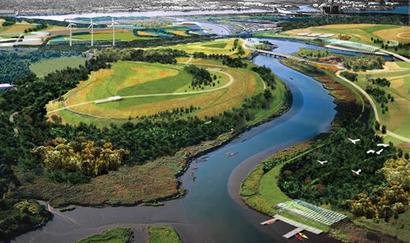
is devoted to the artist’s work on Fresh Kills,
a massive Staten Island landfill that’s currently undergoing a 30-year
process of being transformed into a park, as well as two other, smaller
landfills. [...] “How does a place switch its meaning and become something
else?” she writes in a 2001 proposal. To her, Fresh Kills is “a true
social sculpture composed of 150 million tons from literally billions of
individual decisions and acts of rejection.” Early on she envisioned a
series of projects in which members of the public would donate objects
they considered valuable for embedding in soil at the site.
That proposal gave way to another one, since approved, that she’s been
working on since 2008: “Landing,” an overlook positioned between two
earthworks in Fresh Kills’ South Park. The model and structural drawings
for the project are a bit cryptic, but what’s crucial is the sense of
transformation they convey. As it turns out, maintaining and caring for
the earth offer all sorts of possibilities for developing the world
anew.'
Image of the future Freshkills Park
Source: Wikimedia Commons
In her essay 'Trash: Public Art by the Garbage Girls' (2000), Jo Anna Isaak noted that 'landfills seem to be the oeuvre of choice for a number of women artists.' She discussed the work of Ukeles alongside Agnes Denes' Tree Mountain (considered in two of my earlier posts here and here) and Nancy Holt's New Jersey Landfill Project. You can read about Holt's original proposal at the New York Times site, in an article from 1986 (her Sky Mound remains only partially completed). Isaak quoted Holt's view that landfills would come to be seen as a distinctly late twentieth century version of a distinctive human structure that has a long and varied history, the rubbish dump. Other more recent examples of women transforming landfill sites and garbage dumps include Jean Shin's sculptural installation at Seattle's North Transfer Station and Martha McDonald's song tour of a
construction-waste recycling facility in Northeast Philadelphia.
In North America at least, it seems as if any self-respecting landfill site now has an artist-in-residence. There's probably still time to apply for the scheme that was advertised last month for an artist to work at the waste management centre in Edmonton. The best place to be a landfill artist may well be San Francisco, where 150 artists have now been through the Artist in Residence programme at Recology, the San Francisco Transfer Station and Recycling Center. Clearly the aim of many of these artists is to recycle and transform the rubbish collected in these sites, as much as it is to comment on excessive consumption and environmental degradation. Musicians too can adapt a landfill site to new ends, working with the materials on hand - Paraguay's Recycled Orchestrahave received quite a lot of global attention and were the subject of a documentary, Landfill Harmonic (see clip below). Writers have only their own words, but they can still change attitudes. It remains to be seen whether John Wedgwood Clarke represents the beginning of a new trend for landfill poets.
TheDocumenta 14 catalogue is organised in a way that appeals to my fondness for chronologies - each of the 163 living artists is allotted a double page corresponding to a day during the duration of the exhibition, and is also allowed to pick one date that is particularly important for them. The artists are then ordered in accordance with their special dates, so for example Susan Hiller chose 4 November 1899 (the date Freud's Interpretation of Dreams was published) which means that she gets August 16th, in between artists who went for events in 1900 and 1897. I'm not sure if this makes sense without looking through the catalogue.. in any case it's not really relevant to what I thought I would do here: highlight those artists in Documenta who have been addressing the landscape in various ways. This is not necessarily an exhaustive list but it gives an idea of the range of current practice. Some of these artists are using various media to consider sites round the world that are threatened, contested or marked with traces of recent political change. Others are finding new approaches to the profusion of new land and environmental art practices that emerged in the sixties.
The landscape as artist
Probably every artist at Documenta is influenced at some level by landscape, but some allow it to act on their own work, bring a chance element to the final product. Nevin Aladağ has made a sound piece out of furniture for Documenta but she has previously made city symphonies by filming instruments being played by the environment itself. In City Language I , 'a flute held out the car window is
played by the wind; claves tumble
down streets; a tambourine skates across the water behind a boat'.
That was in Istanbul; in the video clip below she describes a more recent piece made in the playgrounds and pedestrian areas of Stuttgart. Another artist who allows the landscape to complete her artworks is the
Guatemala-based painter Vivian Suter. Leaving her work outdoors, 'she befriends deluge and mud; she invites time to act on her canvases in
the manner of acid biting an etched plate. Implicit in the work is a
politics of insistent experimentation and an embrace of ruin.'
Landscape documentation Khvay Samnang's is represented at Documenta
by work he made in the Areng Valley, the last great forest in Cambodia,
now under threat from a hydroelectric dam project. A few years ago he
highlighted pollution in the lakes of Phnom Phen, wading into them and
pouring buckets of sand over his head. Bonita Ely has had similar environmental concerns and is best known for The Murray River Project. In the video clip below she describes coming to the river in 1977 when concerns over pollution were first emerging. She did field research at five locations, objectively photographing the water through cartographic grids (she says she is fascinated by maps and the way they reflect our real interests - "we don't make maps of where daisies grow, we don't make maps of how a butterfly flies across the landscape"). The ecology of the river continues to be disrupted through irrigation and the construction of weirs: "the health of the river depends on flooding but nobody wants it to flood." Ely has recently returned to the original locations to document how they have changed. She has also reprised a performance piece called Murray River Punch in
which she serves up an unappealing cocktail of all the pollutants that are put into
the river.
Landscape performance
Many of the artists here incorporate performance into their multimedia practice. It might seem a stretch to think of Annie Sprinkle and Beth Stephens as landscape artists but perhaps we should. Sprinkle recently took a Guardian journalist on an “ecosexy nature walk” - "a nature walk with a former porn star who keeps encouraging me to find
my Eco spot (or E-spot) is much more exciting than anything I’ve seen on
Countryfile". Something perhaps for a future Robert Macfarlane book? Documenta also contains archival material from the long career of postmodern dance pioneer Anna Halprin. In their catalogue essay Pierre Bal-Blanc and Lou Forster highlight the continuing importance of her outdoor dance deck, 'built in collaboration with Lawrence, her
husband, the landscape architect, urban designer, and ecologist, between
1953 and 1954, in the redwood area of Kentfield, California.' Performances that relate in different ways to nature and landscape stretch from The Branch Dance (1957) to Spirit of Place (2009). You can see the dance deck in the video clip below.
Land art structures Agnes Denes is an artist I discussed here in one of my early blog entries, a short post about Tree Mountain. Much more recently she has made another land art pyramid, in Long Island City, New York.Candice Hopkins describes it in the Documenta catalogue: 'constructed
of stacked wooden terraces filled with soil and thousands of various
living plants, the sculpture arcs nine meters up toward the sky. It is a
social structure. Social because the planted material conveys ideas of
evolution and regeneration; the work also cultivates a micro-society of
people responsible for its planting and ongoing care.' You can see images of it in a Brooklyn Rail article
which praises her pioneering role, as a land artist more interesting in
growing things than excavating new landforms. However, it also notes
that she has been criticised for creating in Tree Mountain a version of mono-agriculture, 'the creatures inhabiting her forests aren’t
allowed the kind of complex habitat that would be more to their liking.
We now know that trees communicate through their root systems, educating
their neighbors. Nature has no voice in Denes’s work.'
Artificial landscapes Lois Weinberger works with ruderals (plants growing on waste ground) and for this year's exhibition at Kassel 'he has
excavated a “cut” through the park beside the Orangerie and then
abandoned it to whatever will emerge.' You can see a similar work made in Cologne on his website - what makes it interesting is the contrast between the 'wild' weeds and carefully mown park grass. Twenty years ago for Documenta 10, Weinberger 'planted a garden amongst the railway tracks of Kassel’s
central station. The plants were cultivated from seeds of ruderal
plants collected throughout Central and Eastern Europe, during and after
the collapse of communism. These nomadic survivors, ‘foreign
immigrants’ to German soil, flourished amongst the transit lines of ‘Old
Europe’, subverting any human projection of territorial sovereignty, or
fixed borders, and still do so today' (Tom Trevor, 'Lois Weinberger: The Three Ecologies').
Louis Weinberger, What is Beyond the Plants / Is at One with Them, 1997
Political landscapes
Mexican artist Guillermo Galinda has made instruments from objects found along the U.S. border and for Documenta he is is composing new music scores, 'odes for
border crossers'. The video below shows a more spectacular work about the U.S./Mexican border, Repellent Fence by the Postcommodity collective. Where borders have come down, there is a fascination in what the landscape retains of societies that have been completely changed. Ulrich Wüst trained as a town planner and began photographing East Germany in the 1970s. There were usually no people in his images - 'the sozialistischer Staat der Arbeiter und Bauern is symbolically devoid of its titular workers and farmers.' Edi Hila lives in Tirana and paints buildings that have been left behind in time. "In these abandoned houses hope and the desire to inhabit them has
departed with the migrant. These houses have been transformed into
objects, almost weird and absurd..."
Disappearing landscapes
Here's a good opening line for one of the catalogue entries. 'In August 1988, four days after appearing in the seminal Freeze
exhibition with fellow students at Goldsmiths College of Art, Lala Meredith-Vula
left London for the Albanian countryside, where she began
to photograph haystacks.' While the YBAs did their thing, she continued
making her photographs in what had been Yugoslavia. 'Their forms are
governed by habits of working the land, which are older
than nations. The needs of animals and the poetic license of farmers
play their parts. Yet, even if haystacks do not belong in the polis, are not political subjects per se, they do bear silent witness to history.' There is actual hay from another part of Eastern Europe in Documenta, woven into the work of Olaf Holzapfel. His hay canvases are made with local people in a village on the border between Lower
Silesia and Greater Poland (as explained in an article in Frieze). They are part of a complicated installation, Zawn, with components that 'range the gamut from architectural models of medieval churches and
nineteenth-century mine shafts to the writings of Austrian critic
Kristian Sotriffer and the graphic work of Hermann Glöckner.'
Landscape as memory
Finally, there is art made from the artist's own memories of places that have undergone profound change. Abel Rodriguez was born around 1944 in the Colombian Amazon and became an expert in
plants. He was employed by a Dutch NGO, Tropenbos International Colombia, that wanted local experts and later moved to the city, assuming a Western name. There he began working again with the NGO, creating
botanical drawings from memory. These jungle landscapes 'are the
visions of someone who sees
the potential of plants as food, material for dwellings and clothing,
and for use in sacred rites.' He doesn't consider his pictures as art,
but talks about what they show and how the animals and plants in them behave with the changing
seasons. Fish "start going up the river because they know that the
water is going to
rise, and they're looking for the overflows to enjoy the abundance of
worms and seeds." Monkeys "stay because they like to look at their
reflection, as ugly as it is, in the water."
Still on the subject of Land Art, discussed in the last posting, I thought it was interesting that Ben Tufnell divided environmental art into (i) 'healing' land reclamation projects, (ii) symbolic warnings / poetic meditations and (iii) art that simply bears witness to environmental concerns. In the first category he has several exmples, including Agnes Denes' Tree Mountain which I have discussed here before. However, for the other two categories he focuses on just one example each: Joseph Beuys' Eichnen 7,000 and, rather surprisingly, for 'bearing witness' the recent text works of Hamish Fulton.
Clearly Hamish Fulton feels strongly about the natural environment and has contrasted his own 'leave no trace' approach with that of Richard Long, as well as the more American land artists with their bulldozers. Tufnell gives the example of Fulton's To Build is to Destroy. No Man-Made Obstacles for the Winter Winds. 14 Seven Day Walks, Cairngorms, Scotland, 1985-1999, which criticises the building of ski lifts. But I have to say that for me, the idea that Fulton's walks leave no trace is increasingly hard to hold onto when, like any art works that are sold and exhibited, the artifacts generated by his walks create their own carbon footprint. And of course Fulton is not just walking around Britain - text works based on walks in Tibet, say, make no mention of the flight required to get there.
The way Fulton and Richard Long downplay the process of travel to remote parts is discussed in a critical essay 'Ain't Going Nowhere' by Anna Gruetzner Robins (see Gendering Landscape Artedited by her and Steven Adams). She cites Long, describing A Circle in Alaska / Bering Strait Driftwood on the Arctic Circle: 'I just happened to find myself on the Arctic Circle, and it seemed just the perfect opportunity and place for me to make a circle.' In the work of Long and Fulton, 'the viewer is asked to accept that these journeys are a primal quest divorced from time and space.' Robins compares this to the way colonial explorers tended to write up their exploits. I think this is a useful comparison - although it's hardly surprising that Richard Long or Richard Burton would skip the boring bits, we need to bear in mind what comes before and after their wilderness treks. Robins' essay is well worth reading even (especially?) where it goes rather over the top. She obviously feels bitter about Richard Long, whom she once invited to come and talk to her students - apparently all he did was turn up, play country music tapes and say nothing at all.
Greenmuseum is a virtual space for environmental art with a lot of useful material. Among the featured artists is Agnes Denes, who is probably still best known for ploughing two acres of Manhattan with wheat in her 1982 work Wheatfield – A Confrontation (see below). A year later she designed Tree Mountain-Proposal for a Forest, a work that remained conceptual until the Finnish government announced at the 1992 Earth Summit that it would build the mountain. It would include 11,000 trees, planted by volunteers from around the world. Construction was finished in 1996, but of course the work continues to change: the site is legally protected for four hundred years. Each tree is owned by the person who planted it and their descendents, which means that ownership of an art work is also custodianship of nature. Whilst the trees will outlive their current owners and change hands, the forest itself cannot be owned by anyone. Images from the construction of TreeMountain are available here and there are more recent photographs of the project illustrating a short essay by Agnes Denes, ‘What it Means to Plant a Forest’.
Postscript 2023:
This post originally included a single image of Wheatfield but the online link has long since disappeared. In November this year though I saw this set of photographs at the Barbican's Re/Sisters exhibition. As it's possible to take photographs in art museums these days, I am including my phone picture here.