Saturday, March 30, 2013

Dow Jones, 1980-2009


I am not sure how many artists are currently working in the micro genre of landscape photography digitally altered to incorporate charts of financial data, but two are represented in the Somerset House exhibition 'Landmark: the Fields of Photography'.   Michael Najjar has created mountain scenes based on the NASDAQ, Dow Jones and Nikkei indices, inviting us to see their dramatic peaks and valleys as unnatural and unstable.   In the video clip above he points out a geographical feature corresponding to 9/11 and the precipitous slope that followed the collapse of Lehman Brothers.  Mathieu Bernard-Reymond takes a slightly different approach in his Monuments series, converting these data series into imaginary land art sculptures.  "I use financial charts and statistics as basic shapes to produce photographic representations of global economic and ecological concerns. ... My purpose is to underline their fundamental link to landscape and thus, to human and natural history."

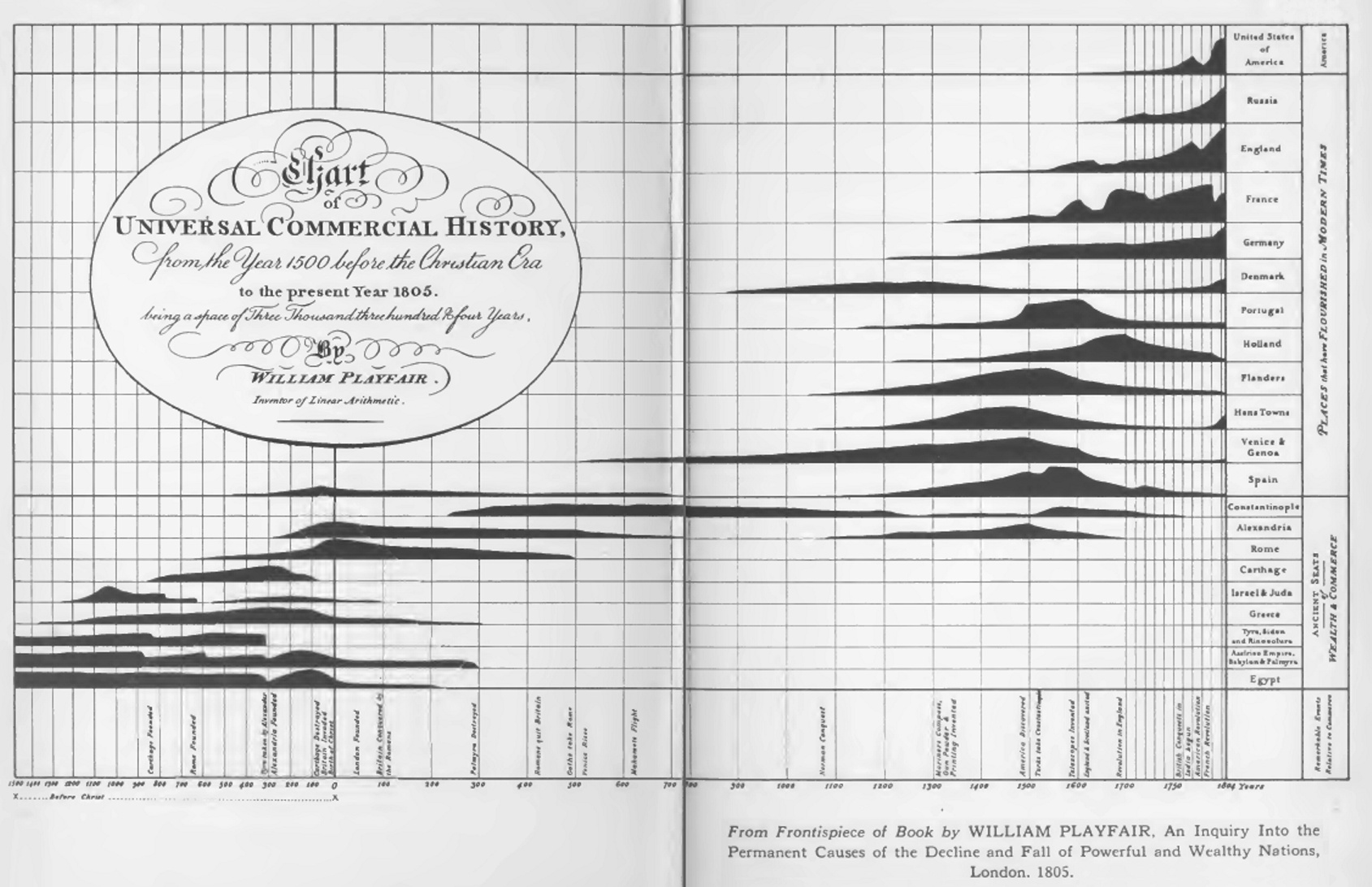
William Playfair, The Universal Commercial History, 1805

Of course line charts have been read like landscapes since their invention by William Playfair and presumably make use of our atavistic ability to judge relative scale when looking at distant hills.  Mountains are also useful metaphors - see for example the Information is Beautiful chart about media scare stories: 'Mountains out of Molehills'.  Some of the Mathieu Bernard-Reymond's charts remind me of the skylines and tally marks Hamish Fulton uses to record his walks.  There may well be artists inspired by Richard Long's conceptual walks who have made zig-zag journeys across a landscape, tracing the exact shape of a financial chart they have superimposed onto a map.  A more challenging project would be to physically climb and descend according to the dictates of an economic series, following the data's upward trends and downward dips (or double dips).  But the ultimate challenge would be to set up a business or run a stock market in order to replicate the mountain profile of the Rockies or the Alps.  Somewhere in the world there is probably a financial trader and accidental landscape artist whose transactions have followed such a path already.

Wednesday, March 27, 2013

Landscape with Banks and Trees

Federico Barocci, The Annunciation, 1582-4

Critics have been queuing up to praise the National Gallery's current exhibition, 'Barocci: Brilliance and Grace'.  Laura Cumming highlighted his mastery of colour, 'especially gold, grey and rose, getting the chromatic key right every time,' and the way he prepared his paintings: 'no artist before him – and maybe only Degas since – made quite so many different kinds of preliminary drawing.'  Adrian Hamilton described his 'technical brilliance and graphic genius' and observed of The Visitation (1583-6) that 'nothing I think in art can compare with the tenderness of the look between the two women as they greet each other'.  Waldemar Januszczak, behind his Sunday Times paywall, has apparently called the show 'inspired' and Brian Sewell found it a 'beautiful, thrilling and intelligent exhibition, its exegeses so self-evident that the turbid and turgid, over-explanatory and occasionally foolish catalogue is virtually superfluous'.  I have not looked into this unfortunate catalogue, but I did have a look round the exhibition, and what none of these critics mention is that it includes a row of three quite beautiful nature studies, which are described by the curators as having an 'immediacy unprecedented in earlier Italian art'.

 Federico Barocci, Landscape with Banks and Trees, a drawing
© Trustees of the British Museum

When Barocci died, 170 sketches from nature were among the works listed in his studio.  Interestingly, of those that survive, none seems to have a direct connection with his finished paintings.  The landscapes you see in the backgrounds of Barocci's religious scenes tend to be views of Urbino's ducal palace, as in The Annunciation reproduced above.  Incidentally, there is a remarkable preparatory chalk sketch for this painting in the show in which the two figures, drawn in smudgy sfumato, meet in front of what appears to be a looming cliff - a blank space where the landscape will go.  In contrast to such sketches, Barocci's nature studies were probably 'spontaneous responses to nature', executed in a style 'evocative of Oriental brush painting.'  The drawing above belongs to the British Museum, to whom it was bequeathed by Richard Payne Knight.  Another, from the Frits Lugt collection, shows a pair of trees delicately drawn in black chalk and brown wash.  It can be purchased in the form of a silk scarf from The National Gallery shop.

 Federico Barocci Study of Trees souvenir scarf
"capturing his original work in all its delicate beauty"

Friday, March 22, 2013

Silt


Robert Macfarlane on The Broomway, photographed by David Quentin

If you've read The Old Ways you'll know that Robert Macfarlane walked the 'deadliest path in Britain' accompanied by his friend David Quentin, a tax lawyer with a sideline in photography.  The images Quentin took that day are now on display at a London gallery and appear in a new standalone e-book of the 'Silt' chapter.  Music too has been composed for the exhibition: 'Silt' b/w 'The Grey Sink' by The Pale Horse - submerged field recordings and inaudible words, half lost in a mist of slow chords and drones.  At the launch event this week, David Quentin gave a self-deprecating account of the photographs, admitting that the film had run out half way through the walk and that the pictures were really the story of Macfarlane's trainers, visible in the first photographs but gone by the time he took the 'Gandalf shot' that was used for the book's back cover.  We are told in The Old Ways that Quentin 'likes wearing britches, likes walking barefoot, and hopes daily for the fall of capitalism.'  Stepping off the page on Wednesday evening in a beautifully cut old-fashioned suit, holding a battered vintage camera that looked as if it had survived several long walks in the Hindu Kush, he seemed splendidly anachronistic.  For there we all were, twenty-first century consumers trying to connect with an experience that had been reproduced and reworked across media and that will be further propagated online. The music so far is only available as a digital download.  The 'book' has a vintage pre-War Penguin cover, but no physical form.  The photographs show a ghostly figure walking through a no man's land that is gradually dematerialising in the mist.

'Out and on we walked, barefoot over and into the mirror-world.  I glanced back at the coast.  The air was grainy and flickering, like an old newsreel.  The sea wall had hazed out to a thin black strip.  Structures of unknown purpose - a white-beamed gantry, a low-slung barracks - showed on the shoreline.  Every few hundred yards, I dropped a white cockle shell.  The light had modified again, from nacreous to granular to dense.  Sound travelled oddly.  The muted pop-popping of gunfire was smudgy, but the call of a cuckoo from somewhere on the treeless shore rang sharply to us.  A pale sun glared through the mist, its white eye multiplying in pools and ripples.'

Saturday, March 16, 2013

The Vision of Ezekiel

Perhaps there are still lovely, overlooked landscapes to be found, even if they are only hidden away in paintings.  Ingrid D. Rowland describes one in a recent article on 'The Gentle Genius', Raphael, for The New York Review of Books. Walking through the Pitti Palace in Florence you can be overwhelmed by paintings large and small, almost shouting for attention.  'Amid all this beautiful clamour any viewer can probably be forgiven for missing out on what The Vision of Ezekiel has to offer beneath its strange image of God descending in a cloud of apocalyptic monsters: an infinitesimal landscape with a tiny Ezekiel in the foreground, no larger than a silverfish, transfixed by a burst of heavenly light. But what a landscape! Its lazy river recedes back into endless depths between steep wooded hills. In the space of perhaps two inches by eight, the painting takes us on a dizzying flight straight up the Tiber valley to the green heart of Umbria, to the road that still leads from bustling cities like Florence and Perugia to Rome. It is a landscape as softened by the slow action of wind and water as Leonardo’s famous drawing of the upper Arno valley is stark and spiky, and it is a vision no less evocative of nature’s omnipresence, of perspectival depth and the artist’s commanding eye—but all contained within the lower margin of a painting that is largely taken up with a bizarre, and entirely unnatural, celestial vision.'

Raphael and Giulio Romano, The Vision of Ezekiel, 1516–1517

Of course Rowland is not the first admirer of this landscape and it is actually mentioned in Giorgio Vasari's Lives of the Artists (1550).  'He also painted a little picture with small figures, which is likewise at Bologna, in the house of Count Vincenzio Ercolano, containing a Christ after the manner of Jove in Heaven, surrounded by the four Evangelists as Ezekiel describes them, one in the form of a man, another as a lion, the third an eagle, and the fourth an ox, with a little landscape below to represent the earth: which work, in its small proportions, is no less rare and beautiful than his others in their greatness.'  In an exhibition at the Prado last year, the painting was hung next to a tapestry of the same subject, woven in Flanders and destined for the canopy bed of Pope Leo X.  However, the tapestry omits the landscape and so do the painting's preparatory drawings.  According to Rowland, 'the landscape seems to have been painted almost as a whimsy, but if so, it is the whimsy of a master. In its perfection this lovingly painted portrait of a place flies in the face of conventional art-historical wisdom, which says that the old masters who managed large workshops entrusted this kind of background detail to assistants and concentrated their own efforts on the faces and hands of the major figures'.  And yet, she concludes, 'when it comes down to it, why should a master painter be interested only in foregrounds, or figures?'

Friday, March 15, 2013

Wafting winds of dusky night


“There’s nothing more boring on this earth than to have to read the description of an Italian journey, except maybe to have to write one — and the writer can only make it halfway bearable by speaking as little as possible of Italy itself.” - Heinrich Heine, 'The Baths of Lucca', 1829

Thus we are warned not to expect 'travel pictures' in Heine's Travel Pictures. When the landscape around Lucca is described, it is by his comic character, the Marquis Gumpelino: "How do you like this natural landscape?  What a marvelous creation!  Just look at the trees, the mountains, the sky, the river down there - doesn't it all look just like a painting?  Have you ever seen the like of it on stage?  The very sight of it makes you a poet, so to speak."  Heine can't disguise his contempt for such contrived sentiments and is accused in return by the Marquis of being "a torn man, a torn soul, a Byron."  Poor Byron, Heine thinks, to be incapable of such transports of emotion before a misty valley.  'Or was Percy Shelley right when he wrote that you'd espied nature in her maidenly nakedness, and so, like Actaeon, were ripped apart by her dogs.  Enough of this: we're getting to a better subject, namely Signora Leticia's and Francesca's apartments...'  And there follows a description of an erotic encounter with the second of these ladies that Byron would certainly have appreciated.

Heine monument on The Brocken

Heine's impatience with Romantic clichĂ© is equally evident in the best known of his Travel Pictures, 'The Harz Journey'.  This walking tour, taken in 1824 during his first year of legal studies at Göttingen University, culminates in a night spent at a crowded inn at the summit of the Brocken.  All of the guests seem to be after a glimpse of the Sublime, assembling in a watchtower to witness the sunset.  Afterwards they return for a supper which gets increasingly rowdy as 'bottles emptied themselves out and heads filled up', whilst the wind outside on the mountain seems to be singing along.  Heine watches two young men about to have a quintessential Romantic moment by flinging open a window and gazing out at the night.  But in their tired and emotional state they open the door of a large cupboard instead.  '"Oh ye wafting winds of dusky night!" cried the first, "How refreshing is your breath upon my cheeks!"'  And after some more fine phrases, the second addresses a pair of yellow trousers, mistaking them for the moon: "Lovely art thou, daughter of the heavens..."

Friday, March 08, 2013

A slightly malfunctioning, holographic forest

 Kelly Richardson, Leviathan, 2011
Image courtesy of the artist and Birch Libralato
Originally commissioned by Artpace San Antonio
Photo credit: Colin Davison

Entering the Towner Gallery's exhibition, Kelly Richardson: Legion, you encounter this ominous landscape of dark trees and glowing water.  There are no natural sounds, only an eerie hum as if the whole place has been irradiated. The sickly yellow light ripples round the base of the trees, apparently emanating from somewhere underwater.  Mondrian used a similar composition for his Woods near Oele (1908), but the yellow light between the trees in his painting comes from the sun and symbolises in Theosophy ideas of enlightenment.  The meaning of Leviathan is obscure - it seems quite appropriate that the artist filmed it in Texas at Caddo Lake, near the town of Uncertain.  Her unsettling works do not tend to reference particular places, even when they are easily identifiable (the Lake District, for example, in Exiles of the Shattered Star (2006), which is seemingly being rained on by asteroids like the ones we recently saw streaking across the skies of Siberia). Leaving Leviathan, you walk into a forest of hanging video screens showing footage of sunlit woodlands.  It looks at first like a sylvan idyll, but the soundscape feels increasingly at odds with the images. Richardson has called this work The Great Destroyer, a reference to humanity.  The incongruous sounds are made by a lyrebird, imitating the noise of a chain saw, a car alarm and gunshots.


The third piece in the exhibition, Twilight Avenger (2008), has been described in an article by David Jager, 'Kelly Richardson: The Radiant Real.  'A magnificent stag appears, preens and begins to graze in a forest at dusk. The stag, however, is phosphorescent green and wrapped in a writhing emerald vapour. The forest, a painterly composite of several different natural locations, has been digitally enhanced to a luxurious degree, and the scene is punctuated by a soundtrack replete with crickets’ chirps and animal rustlings. What is most confounding about this eye-popping paean to pastoral kitsch is how it manages to be remotely believable at all'.  A vision of a stag in a woodland sounds like it should hark back to folklore and legend, but this creature looks like it could have wandered in from a Harry Potter film.  It is the same unnatural colour as the green screens used in chroma key compositing, but when it moves out of shot you realise that the still, empty forest it inhabits is no more real than the stag.

The Erudition is the final work in the exhibition, a vision of the future in which the ghosts of trees flicker on and off in a barren landscape.  In a recent interview, the artist explains how she 'wanted to create a large, slightly malfunctioning, holographic forest ... The landscapes were shot in Dinosaur Provincial Park in Southern Alberta during a residency with the Southern Alberta Art Gallery and then highly manipulated to control the colour, light, mood and importantly to the idea, to remove all signs of humanity. Months were then dedicated to learning two new software programs to create the holopads and holographic trees which appeared to be blowing in a fictional wind. All of the individual components which make up the images were then composited together to produce the final works. From start to finish The Erudition took about a year and a half to see to completion.'  One reviewer has described the result as resembling a forgotten site for some proposed extraterrestrial colonisation.  'Richardson produces a future-world that was, now not so much remembered as stored in the dull chill of a multi-terabyte hard-drive: gone, forgotten, but forever clickable.'

Kelly Richardson, The Erudition, 2010
Image courtesy of the artist and Birch Libralato
Photo credit: Colin Davison

Sunday, March 03, 2013

Red Pool, Scaur River

It is now ten years since Cornelia Parker caused some controversy with The Distance (A Kiss with String Attached), in which she wrapped Rodin's sculpture with a mile of string.  I recall at the time not being particularly impressed with this, but not feeling particularly outraged either.  Cornelia Parker is, after all, one of our leading artists and whilst The Distance may not have been up there with Cold Dark Matter: An Exploded View or Embryo Firearms, it was well done and had a (relatively) clear point to it.  As a temporary installation carefully stage managed by the Tate it was hardly an act of vandalism.  Nevertheless, it prompted James Fenton to write angrily in The Guardian that 'it should be a principle of conservation that nothing unnecessary is done to an original work of art in a public collection, and I don't care what the "conservators" say about the care they took in executing this banal intervention. They wouldn't have dared do this to Brancusi. They shouldn't have done this to Rodin.'

The reason I mention all this is because there are potential implications for land art.  Even if the intervention is temporary, and executed with good aesthetic judgement by a renowned artist, is it really acceptable to alter a landscape that people will have come to enjoy in its natural state?  The issue is discussed in Allen Carlson's stimulating book, Aesthetics and the Natural Environment (2000).  He argues that a temporary artwork, like a Christo piece, can still be an 'aesthetic affront to nature' even if it doesn't have the permanent impact of a Michael Heizer earthwork.  He also questions the view advanced by Robert Smithson that land artists should 'become conscious of themselves as natural agents', i.e. that their art would be equivalent to natural processes, because if these were truly equivalent the artwork would not really be art.  Auguste Rodin and Cornelia Parker were both making art, but their purpose and means were very different and The Distance could not exist independently of The Kiss.

Although The Distance had no simple didactic purpose, Parker has said that it was 'about emotional relationships and love and the impossibility of it.'  This suggests another defence of land art: that aesthetic judgements need to consider the work's message or symbolism.  In particular, there is the issue of whether it can raise awareness of our impact on the environment, something Glenn Parsons' recent book Aesthetics & Nature calls into question, with reference to Andy Goldsworthy's Red Pool, Scaur River, Dumfreisshire (1994-5).  Parsons suggests that 'the fact that people in our time are so ignorant and apathetic about nature that it takes a glowing red pool of water to interest them in it does nothing to mitigate the effrontery of such frumpery.'  Cornelia Parker's views on love and Andy Goldsworthy's concerns about pollution could, it might be argued, have been expressed in ways that did not alter the appearance of an existing sculpture or a Scottish landscape.

Many environmental artworks have sought to 'improve' degraded industrial landscapes.  Such cases could be seen as more akin to restoration (although the distinction between these places and more 'natural' sites isn't necessarily obvious).  Another line of thought holds that land art can bring out or make more evident the underlying qualities of a landscape.  Allen Carlson cites the works of Michael Singer, which have 'been characterised as "gateways," "reflectors," "accents," and "magnifiers " of the site.'  Carlson seems less critical of this approach, which can be viewed as a form of framing rather than a direct 'affront to nature'.  But Parsons asks us to think about hosting a dinner party and returning from the kitchen to find our guest has attempted a temporary 'improvement' by rearranging our furniture, 'gussying up' our living room.  'It is not only the wholesale obliteration of aesthetic qualities that can constitute an aesthetic affront; the milder act of gussying up can be an aesthetic affront as well.'

In light of this, do we really want Andy Goldsworthy going around rearranging the leaves in our woodlands?  Of course it is hard not to love some of Goldsworthy's temporary natural sculptures, but they can still be seen as 'prettifying nature'.  Nature however was not designed as an artwork and it remains unclear who it is that he could be affronting here (leaving aside questions of who actually owns the woods and the degree to which they can be described as being in a natural).  James Fenton's article suggests that Cornelia Parker's work is an affront to Rodin, although, like a woodland, Rodin is not capable of expressing a view.  Carlson and Parsons argue that you can feel affronted on behalf of nature even though nature itself is mute.  It is possible to imagine someone coming upon a mound of colour-sorted leaves and regretting the way they distract from the unadorned beauty (and ugliness) of the site, like a tourist arriving at the Tate only to find that The Kiss has been wrapped in string.


John Schiff, his twine by Marcel Duchamp, 
at First Papers of Surrealism (view south), 1942
 Image: from Toutfait

In their discussion of art in nature both Allen Carlson and Glenn Parson use a provocative analogy for the alteration of a landscape: Duchamp's L.H.O.O.Q.  They acknowledge that the comparison with land art is not direct; Duchamp, after all, only adapted a copy of the Mona Lisa.  Clearly if Cornelia Parker had wrapped a plaster cast of The Kiss it would have been less controversial.  Her use of string was actually inspired by Duchamp, who installed a chaotic web of twine around the First Papers of Surrealism exhibition in New YorkAccounts suggest that some visitors felt this string detracted from the paintings whilst others thought it helped them see the other artists' work in a new way.  Opinion would no doubt be just as divided if his twine was installed out in the landscape instead of in a gallery.  The formal simplicity, beautiful colours and natural materials that you find in Andy Goldsworthy are absent.  Partially obscuring some well known beauty spot (the scenic equivalent of The Kiss), his twine would frustrate some and interest others, before being taken down and remembered only through its documentation - a temporary affront, a memorable talking point, or a complex tangle of aesthetic questions. 
Saturday, March 02, 2013

'Message to Basho', Kiyosumi Garden

Thomas Joshua Cooper, Ritual Object 
(Message to Donald Judd and Richard Serra), Derbyshire, 1975
©Thomas Joshua Cooper, Courtesy Haunch of Venison 

This is one of eighteen Thomas Joshua Cooper photographs currently on show at the Haunch of Venison gallery in London.  The pervading darkness and silvery highlights on every blade of grass are typical of his work, but the subject here is unusual.  Normally the foregrounds of his more intense close-up landscapes feature rocks, trees or dense undergrowth.  Here we have an enigmatic (found?) object, illuminated in such a way that the light seems to emanate from within.  Nevertheless it fits with what Thomas A. Clark said about the third step in looking at a Thomas Joshua Cooper image, as mentioned here before. 'First we admire its scale and intensity, the 'deep blacks and velvety whites' of its surface.  Secondly we penetrate to the place itself - not some famous site, just an assemblage of trees, foliage, water.   Finally the viewer starts to feel the spirit of the place, which ‘will always be alien, unhuman, beyond our preconceptions.’'

Thomas Joshua Cooper, A Premonitional Work 
(Message to Caspar David Friedrich and Francis Frith), 
Blaenau Ffestiniog, Gwynedd, Wales, 1992
©Thomas Joshua Cooper, Courtesy Haunch of Venison

Whatever the Ritual Object is, the title of the photograph refers us to the minimalist sculptures of Donald Judd and Richard SerraThis whole exhibition is based on Cooper's 'ongoing conversation' with predecessors and contemporaries: a Message to Paul Strand and Agnes Martin found in New Mexico, a Message to Minor White in Derbyshire, a Message to E.S. Curtis in The Trossacks.  The way these cultural reference points emerge from the interface between art and landscape reminded me of an artist Cooper has often shared gallery space with in Scotland, Ian Hamilton Finlay.  It also made me think of the way artists and writers stimulate Alec Finlay's work, as in his Scottish reworking of Basho's The Narrow Road to the Deep North. There is a small photograph of light filtering through leaves in the Thomas Joshua Cooper exhibition: 'Message to Basho', Kiyosumi Garden.  This late nineteenth century garden in Tokyo contains a monument with Basho's famous frog poem carved into it, but Cooper makes a more subtle connection with the poet in his haiku-sized image of an ordinary moment stilled, so that it seems at the same time transient and timeless.

Thomas Joshua Cooper, A Premonitional Work, The River Findhorn
(Message to Timothy H. O'Sullivan), 
Morayshire, Scotland, 1992
©Thomas Joshua Cooper, Courtesy Haunch of Venison

Saturday, February 23, 2013

Shadow Sites


There are some interesting things in the V&A's current exhibition, Light from the Middle East: New Photography: Tal Shochat's portraits of fruit trees, for example, and Ahmed Mater's Magnetism series in which pilgrims circling the Kaaba turn out to be iron filings surrounding a cube-shaped magnet.  But here I want to draw your attention to Jananne Al-Ani's video installation Shadow Sites II (2011), a sequence of aerial views in which the camera zooms down to reveal unexplained structures in the desert.  The exact history and identity of these sites is deliberately obscure, so that you might be looking at archaeological photography, reconnaissance film, land art documentation or footage from the lunar module descents.  There is a rather ominous soundtrack of wind and some unidentifiable machine hum; human life seem absent until there are a few bursts of distant radio crackle.  The artist's intention had been to explore "the disappearance of the body in the contested and highly charged landscapes of the Middle East.''  In the video talk that I've embedded below, she discusses her archival research, studying, for example, the panoramic vistas photographed a hundred years ago by German archaeologist Ernst Herzfeld.  She shows how he re-touched an image to remove all trace of his own shadow, which had intruded into the frame.


The aerial views of Jordan in Shadow Sites II are very reminiscent of those taken after the Gulf War by Sophie Ristelhueber.  In the video clip below Ristelhueber describes how she wants to play with uncertainties in scale: in one image, tanks are reduced to the size of match boxes, and she juxtaposes this with what looks like a distant grid pattern on a landscape but is in fact a close-up of a camouflage bag.  In a Guardian interview Ristelhueber explained that she did not want people necessarily to connect her photographs with the war: "I don't give any clue that this is Kuwait. When I exhibited it in Johannesburg, people thought it was Africa; they recognised the sand, weapons and trails of violence." She goes on to say how one of these landscapes seemed uncannily similar to Man Ray's famous photograph Dust Breeding (1920), an image of the build up of dust on Duchamp's Large Glass that has created a kind of miniature desert landscape.  Jananne Al-Ani says in the talk that she was influenced by Ristelhueber's aerial photographs, along with Werner Herzog's film Lessons of Darkness. This chain of art historical influence all the way back to Duchamp further distances Shadow Sites II from the reality of the lived landscape being flown over.  I couldn't help wondering as I left the Victoria & Albert Museum whether this installation in this location would be seen as being about "the disappearance of the body", or simply another example of it.

Thursday, February 21, 2013

The Index to Some Landscapes


Just a brief post to let readers know that I have now completed a new version of the index to this blog.  I had realised that I was no longer able to remember who all the artists mentioned here actually were and so this new index includes their nationality, dates (where known) and an indication of their field of activity.  At the moment it stretches from Tiglath-Pileser I, the Assyrian king and garden designer (reigned 1115 - 1076 BCE), to Levi Van Veluw, the Dutch artist born in 1985. The result is almost the size of a small book: 15,000 words long - goodness knows how many words the blog itself now amounts to.  Walter Benjamin, writing about the urge to catalogue a library, refers to a 'dialectical tension between the poles of order and disorder' and this index represents an attempt to retain some control over the unpredictable rhyzomic growth of the blog.  I'm hoping it will be a pleasure to browse in itself (it certainly is for me).  If you're so minded you could search for every 'painter' or 'Swiss painter', or for a 'Swiss painter' born in '1853' (you'd strike lucky with Ferdinand Hodler).  But it is not a sophisticated database or an attempt at a comprehensive Companion to Landscape in the Arts. I can't help noticing that there are still big gaps: I haven't got round yet to writing anything about Robert Frost or Wendell Berry or Mary Oliver or many other well known figures.  But the list keeps growing and my next post will add a new name near the start of the index: Jananne Al-Ani.  She'll be going in just before Seyed Alavi, Leon Battista Alberti and Alcman, and just after Eileen Agar, CĂ©sar Aira and Yamabe no Akahito...

Wednesday, February 20, 2013

Ice on the Yellow River

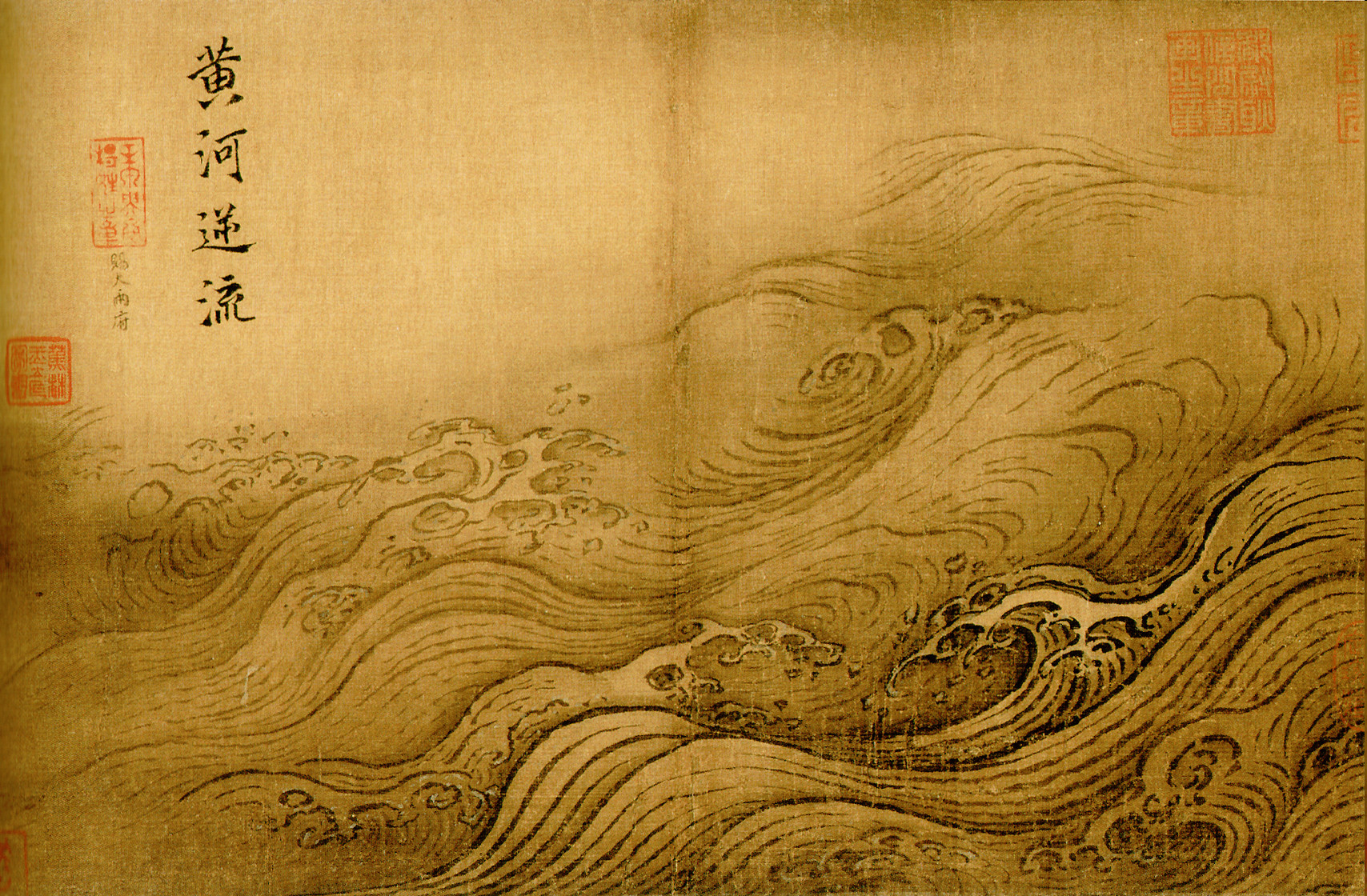
Ma Yuan (1160–1225), The Yellow River Breaches its Course

It would be impossible to summarise the career of Liu Tieh-yĂĽn (1857-1909) briefly.  In addition to writing and scholarship (he was a pioneer in the study of Shang dynasty oracle bones), Liu got involved in traditional Chinese medicine, printing, politics and numerous failed commercial ventures, ranging from a a handicraft weaving shop in Shanghai to a steel refinery in Chuchow.  This admirable breadth of interests was evident from an early age.  According to Harold Shadick, in his introduction to Liu's novel, The Travels of Lao Ts'an, 'he studied the Sung philosophers with his father and spent much time with a group of friends who formed a sort of club with the intention of preparing themselves to help the country in her hour of need.  They discussed questions of military science, economics, and mathematics, and practiced boxing.  Liu T'ieh-yĂĽn himself specialised in the study of flood control and also showed great interest in music, poetry, astronomy, and medicine.'  His research into river conservancy stood him in good stead when the Yellow River flooded in 1887.  Liu was given charge of work to repair a breach in the dike, and on the strength of this spent three years as an adviser to the Governor of Shantung.  However, when his fictional alter ego, Lao Ts'an, is offered a similar position he politely declines, having no intention of settling into official life.  'That night he wrote a letter thanking Governor Chuang [and] before daylight he cleared his account at the inn, hired a wheelbarrow, and left the city.'

Later in the novel, Lao Ts'an arrives at another inn, at Ch'ihohsien on the banks of the Yellow River.  There he is told that the town is full of people unable to cross the partially frozen river, with its drifting blocks of ice as big as a house.  Li Ts'an wanders down to the river dike to look at this spectacle.  There follows one of the descriptive passages for which this novel is renowned in China: a precise depiction of the way the ice is gradually packed together and wedged solid.  'The ice from above kept coming down block after block, until at this point it was caught by the ice in front, couldn't move, and came to a standstill.  More ice came and pressed it with a rustling sound, ch'ih-ch'ih, until the ice behind, pressed harder by the flowing water, simply jumped on top of the ice in front.  Pressed down in this way the ice in front gradually went under...'  As night is falling, Li Ts'an returns to the inn; 'each willow tree on the dike cast a shadow of moving threads on the ground, for the moon was already shining brightly.'  But after supper he goes out again and watches the boatmen still hard at work, breaking the ice.  Eventually, he raises his head from the river and looks up at the hills.  'The snow-white line reflected the light of the moon; it was extraordinarily beautiful. The mountain ranges rose tier on tier, but they could not be clearly distinguished.  A few white clouds lay in the folds of the hills so that you could hardly tell cloud from hill unless you looked intently. ... The hills stretched away to the east farther and farther until gradually the sky was white, the hills were white, and the clouds were white, and nothing could be distinguished from anything else.'


(This post uses Wade-Giles spellings.  Liu Tieh-yĂĽn is Liu Tieyun, the courtesy name for Liu E.  The novel is also spelled The Travels of Lao Can.  The YouTube clip above shows a news item about ice on the Yellow River this year - it is still a regular occurrence.)

Sunday, February 17, 2013

In the Field


I spent Friday and Saturday at In The Field, a symposium on the art and craft of field recording. During the two days we heard about a diversity of methods - from undersea hydrophone recordings made by Jana Winderen to impressions of the Hong Kong soundscape written for SalomĂ© Voegelin's Soundwords project - and approaches ranging from the collective educational audio projects Claudia Wegener develops in Africa to the solo expeditions made by Simon Elliott to capture the intimate sounds of ospreys and peregrines.  Chris Watson came along briefly to talk about an installation he created at the London Children's Hospital in which patients remixed recordings he made on each of the seven continents.  He also mentioned In Britten's Footsteps, a collaboration with cellist Oliver Coates performed at Aldeburgh last week, which involved 'twenty speakers, split between the floor, head height and ceiling, developed to give an accurate spatial representation of the environment in which Watson had recorded the sounds' (The Liminal).  I think the weekend's highlight for me was a presentation by Christina Kubisch, whose Electrical Walks I wrote about here in 2010.  A recording she played of the beats made by different security gates sounded like the kind of music Chris Watson was making with Cabaret Voltaire all those years ago.

Reverberant flats on Peter Cusack's favouritesounds.org site

The most relevant talks from a landscape perspective were those that dealt with sound mapping, a subject I wrote about here last year, following a Wire Salon.  That event featured Ian Rawes, who modestly took on the job at this symposium of roving microphone holder, a role he could be seen as holding for the city itself in his work compiling the London Sound Survey.
  • Peter Cusack started his talk with a quote from The Peregrine: 'the hardest thing to see is what is really there', and suggested that the same is true for sound.  He therefore focused on just one recording: children playing in a reverberant space created by a semi-circle of flats, which would surely leave its residents with "a particularly strong sonic memory".  The block of flats' shape reminded me of the garden designed to produce echoes that John Evelyn observed in Paris and I wondered if Cusack had sought it out deliberately for its acoustic properties.  But  he had been there as part of a project to document sounds under the flight path to Tegel Airport: every four minutes the children's voices have to compete with the noise of aircraft overhead.  This too will be form part of their memory of living in these flats, a sound that will disappear when the airport is eventually closed.
  • Udo Noll, who has recorded sounds with Peter Cusack in Germany, talked about radio aporee, his global soundmap project. Various contributors had mentioned the importance of striving for the highest possible fidelity in their recordings but radio aporee is participative and welcomes all recordings of a reasonable standard.  Noll has now developed a radio aporee app, although he remains somewhat sceptical: "I don't like phones much and apps even less".  Is this augmented reality experience really progress?  Well, if artists don't work in this space, he argued, other commercial interests will.  Given that the non-mediated world is increasingly "a lost country", it seems better to have the option of coming upon a GPS-generated poem than some piece of corporate marketing.  This is also a way of inscribing a landscape without altering it - better, perhaps, to have the option of tuning in to a Simon Armitage stanza as you walk over the West Yorkshire moors, than coming across it carved into a rock.
  • Francesca Panetta described the creation of a similar sound app, Hackney Hear.  This sadly doesn't stretch as far as Stoke Newington, otherwise I could hear it as I type this, but it can't be long before we get one - she has also created Soho Stories, Kings Cross Streetstories and, most recently, an app to accompany Rachel Lichetenstein's Diamond Street.  Users of Hackney Hear have actually preferred its field recordings to the interviews and commissioned texts (Iain Sinclair, inevitably).  The talk concluded with an introduction to The Guardian's new interactive panorama from the top of the Shard, which incorporates clips from The London Sound Survey.  As she zoomed out, the sound of swirling wind and distant sirens gave way to more immersive soundtrack.  She clicked on various sound samples across the city to show us how it worked, but time was running short.  The final sound we heard was 'Land of Hope and Glory' emanating from the Albert Hall and for a moment it seemed as if the whole symposium was about to end with an echo of the Last Night of the Proms.  
 
 The Guardian's interactive view from the top of the Shard

Finally I should mention that In the Field is also the title of a new book of interviews with field recordists, edited by Cathy Lane and Angus Carlyle, who co-organised the weekend's event with Cheryl Tipp.  I may have more to say about this in a future post. 

Monday, February 11, 2013

Anamorphic landscape in the form of Saint Francis of Paola

Emmanuel Maignan, Saint Francis of Paola (detail), 1642

I have talked here before about landscapes that are transformed into bodies, and vice versa.  Another example can be found at the top of the Spanish Steps in Rome, in a corridor of an old convent building, part of the TrinitĂ  dei Monti.  There on the wall is a fresco, painted in 1642, showing a landscape with figures, buildings and small boats.  But there is something slightly uncanny about the dark shadows of the hills and certain incoherent shapes encroaching into the view.  As you walk away, towards the form of a large tree framing the view, and then look back, the landscape is no longer readily apparent: it has been replaced by the bearded figure of Saint Francis of Paola, founder of the Order of the Minims to which the convent belongs.  The painting is explored in Anamorphosis, or De Artificiali Perspectiva, a 1991 film by the Brothers Quay.  'Anamorphosis thrives on mystery, and its masters rarely give away their secrets', the narrator says.  But the film includes an animated demonstration using thread and paper figures: 'a peep at the apparatus which Emmanuel Maignan supposedly used to construct his anamorphic fresco of Saint Francis.'

Emmanuel Maignan, Saint Francis of Paola, 1642

The Brothers Quay, Anamorphosis, or De Artificiali Perspectiva, 1991

Sunday, February 10, 2013

Our Banner in the Sky

Frederic Edwin Church, Our Banner in the Sky, 1861

The National Gallery's new exhibition ‘Through American Eyes: Frederic Church and the Landscape Oil Sketch’ includes a version of this patriotic sunset, painted within a month of the Confederate attack on Fort Sumter.  As the Terra Foundation site explains, 'Union troops were out manned and their commander raised a flag of truce along with the American flag. The Confederate side responded by bombing the American flag and continued until the Union’s Major Robert Anderson lowered the American flag. Showing their loyalty to the Union, Anderson and his troops saluted the flag and sang Yankee Doodle. Northerners were outraged about the demeaning treatment of both the flag and the Union forces. The tattered flag became a symbol of the North’s resilience and artists used the image in their work. When the war was over, the flag was raised again over Fort Sumter in victory.'  In Church's painting, which was subsequently widely distributed as a lithograph, the North Star shines through a gap in the clouds and an eagle soars above the broken tree.  It resembles a painting Church completed a year earlier, Twilight in the Wilderness, that is easy to read as a premonition of war, with its dark and fiery sky over an unpeopled landscape. 

Frederic Edwin Church, Twilight in the Wilderness, 1860

The original painting Our Banner in the Sky (the National Gallery is showing a sketch) can currently be seen at the Smithsonian American Art Museum's exhibition on The Civil War and American Art.  It immediately inspired imitations and continues to interest artists: Marc Handelman's 2005 version crops and inverts the image - 'a defiant gesture on the part of the artist to express his own ambiguity of feelings regarding national identity', according to the Saatchi Gallery.  (Another Saatchi artist, Ged Quinn, has recently made a version of Twilight in the Wilderness). The print below was clearly based on the elements of Church's composition but introduces a lone figure: 'a Zouave sentry watching from a promontory as the dawn breaks in the distance. His rifle and bayonet form the staff of an American flag whose design and colors are formed by the sky's light. Below, in the distance, is a fort - probably Sumter. The print is accompanied by eight lines of verse: When Freedom from her mountain height / Unfurled her standard to the air, / She tore the azure robe of night / And set the stars of glory there. / She mingled with its gorgeous dyes / The milky baldrick of the skies, / And striped its pure celestial white / With streakings of the morning light.' 

Pro-Union patriotic print: Our Heaven Born Banner, c. 1861

Tuesday, February 05, 2013

The Domain of Arnheim

"The usual approach to Arnheim was by the river. The visitor left the city in the early morning. During the forenoon he passed between shores of a tranquil and domestic beauty, on which grazed innumerable sheep, their white fleeces spotting the vivid green of rolling meadows. By degrees the idea of cultivation subsided into that of merely pastoral care. This slowly became merged in a sense of retirement — this again in a consciousness of solitude. As ­the evening approached, the channel grew more narrow; the banks more and more precipitous; and these latter were clothed in richer, more profuse, and more sombre foliage. The water increased in transparency. The stream took a thousand turns, so that at no moment could its gleaming surface be seen for a greater distance than a furlong. [...]  The windings became more frequent and intricate, and seemed often as if returning in upon themselves, so that the voyager had long lost all idea of direction. He was, moreover, enwrapt in an exquisite sense of the strange. The thought of nature still remained, but her character seemed to have undergone modification; there was a weird symmetry, a thrilling uniformity, a wizard propriety in these her works. Not a dead branch — not a withered leaf — not a stray pebble — not a patch of the brown earth was anywhere visible. The crystal water welled up against the clean granite, or the unblemished moss, with a sharpness of outline that delighted while it bewildered the eye." - Edgar Allan Poe, 'The Domain of Arnheim', 1847
This uncannily perfect landscape is the work of the narrator's friend Ellison, now deceased, but a man who had been borne from cradle to grave by 'a gale of prosperity'.  Having inherited a fortune, he spent four years searching for a site that he could re-shape according to his aesthetic ideals.  Ellison believed it would be possible to unite the beautiful and the sublime, to combine vastness and definitiveness, to design 'a landscape whose united beauty, magnificence, and strangeness' would resemble 'the handiwork of the angels that hover between man and God.'  There is something godlike in the way he controls the traveller's passage and manipulates their mood like a poet, passing from the georgic to the bucolic, before they enter the silent gorge as the sun begins to set.  The boat then emerges into a clear basin of water, its surface reflecting steep hills of flowers that resemble a 'cataract of rubies, sapphires, opals and golden onyxes, rolling silently out of the sky.'

At this point the visitor must descend into a light canoe of ivory and proceed alone, past wooded slopes that display 'not one token of the usual river dĂ©bris' and through another winding channel until a gate of burnished gold is reached.  The story is nearly at an end and, this being Poe, one expects some kind of dark revelation, perhaps a sepulchral vision like  Böcklin's Isle of the DeadThe boat descends rapidly into a vast amphitheatre. 'There is a gush of entrancing melody; there is an oppressive sense of strange sweet odor; - there is a dream-like intermingling to the eye of tall slender Eastern trees - bosky shrubberies - flocks of golden and crimson birds - lily-fringed lakes - meadows of violets, tulips, poppies, hyacinths, and tuberoses - long intertangled lines of silver streamlets - and, upspringing confusedly from amid all, a mass of semi-Gothic, semi-Saracenic architecture, sustaining itself as if by miracle in mid-air, glittering in the red sunlight with a hundred oriels, minarets, and pinnacles; and seeming the phantom handiwork, conjointly, of the Sylphs, of the Fairies, of the Genii, and of the Gnomes.'

Poe wrote another story two year's later, 'Landor's Cottage: A Pendant to "The Domain of Arnheim"', in which a walker, travelling through 'one or two of the river counties of New York' comes upon another magical vista.  This vale, emerging from the mist, with its crystal clear lakelet, emerald grass and triple-stemmed tulip tree, is described in (rather laborious) detail, as is the house itself.  Eventually the reader is led inside and shown the interior decoration of Landor's cottage.  The simple furniture has 'evidently been designed by the same brain which planned 'the grounds': it is impossible to conceive anything more graceful.'  Hopes of meeting the designer of all this beauty are disappointed however, as the narrator ends abruptly at this point: 'it is not the purpose of this work to do more than give, in detail, a picture of Mr. Landor's residence - as I found it.'  To what extent the narrator has projected his own dream landscape onto the New York countryside remains unclear.

Harry Clarke, Landor's Cottage, 1919
Public domain

'Landor's Cottage' and 'The Domain of Arnheim', along with Poe's essay about an ideal room, 'The Philosophy of Furniture', form the basis of a "study of the inner refuge" made by a character in Paul Auster's novel The Brooklyn Follies.  Taken together, he says, they comprise "a fully elaborated system of human longing."

Friday, February 01, 2013

A banked-up, soothing, wooded haze

Seamus Heaney's first foray into translation, Sweeney Astray, published thirty years ago, was a version of Buile Shuibhne, which survives in seventeenth century manuscripts but probably written five hundred years earlier.  It tells the story of an early seventh century Irish king driven mad by the curse of a priest after the battle of Mag Rath (Moira), who wanders for years in the wilderness, lamenting his fate and composing poems in celebration of nature.  I find it tempting to read this not just as a version of the Wild Man legend, but as a distant memory of a real poet of landscape; there is a ninth century law tract mentioning stories and poems composed by Suibhne Geilt and another fragment that may be older which includes a nature poem attributed to him.  Kenneth Hurlstone Jackson’s wonderful anthology A Celtic Miscellany features several extracts from Buile Shuibhne alongside other early Irish nature poetry, remarkable for its freshness. He says that 'comparing these poems with the medieval European lyric is like comparing the emotions of an imaginative adolescent who has just grown up to realise the beauty of nature, with those of an old man who has been familiar with it for a lifetime and is no longer able to think of it except in literary terms.'  It was reading Jackson's book that first got Seamus Heaney interested in the Sweeney story.


When Heaney began work on Sweeney Astray his instinct was 'to snatch certain moments of definition and intensity out of their place in the story and to present them as lyric poems in their own right.'  I am glad he didn't, because it is good to read the vivid descriptions of nature in their context: the stanzas praising 'all the trees in Ireland', for example, are prompted by Sweeney's feelings of homesickness, brought on by the bellow of a stag, and they give way to memories of his flight from the battlefield, overtaking a startled fawn and riding him from mountain to mountain on 'a high demented spree.'  Nevertheless, for Heaney 'the hankering to skim off certain favourite lines persisted' and when he saw the photographs Rachel Giese had taken around Sweeney's old kingdom of Dal-Arie, he finally felt 'emboldened to snip lyric leaves off the old narrative boughs.'  The result was a collaboration, Sweeney's Flight (1993) that intersperses their photographs and poetry, as well as including a full and revised version of Sweeney Astray.  My copy above is turned to a page with a few words uttered by Sweeney when he is about to leave Ailsa Grag, a bleak island in the outer Firth of Clyde, and is longing for the consolation of woodlands.  'I imagine treelines / far away, / a banked-up, soothing / wooded haze.'

Sunday, January 27, 2013

Stepping Stones

I've been reading the late Dennis O'Driscoll's Stepping Stones: Interviews with Seamus Heaney.  Among the interesting things I learnt was that Heaney's poem 'The Mud Vision', in which a strange religious apparition briefly visits modern secular Ireland, was partly inspired by Richard Long.  As Heaney explains in another interview, 'the actual mud-vision idea came from seeing a work by the English artist Richard Long, a big flower-face on a wall, made up entirely of muddy handprints. It began as a set of six or eight petals of mud and then moved out and out concentrically until it became this huge sullied rose window.'  Another strange image - a tree-clock made of tin cans - appears in the poem 'Fosterling', although this was not inspired by a piece of land art.  In Stepping Stones, Heaney recalls that it came from an old story about a Faustian pact: a band of tinkers built a fantastic clock in a tree and set it to the wrong time to fool the devil when he returned for the local people's souls.  Such marvels took Heaney many years to work into his poetry.  Growing up he inhabited a 'lowlands of the mind', a silted place where poetry was 'sluggish in the doldrums of what happens'. It took a long time 'for air to brighten, / Time to be dazzled and the heart to lighten.' 


I've embedded above a brief YouTube clip showing Dennis O'Driscoll interviewing Seamus Heaney and below I've set down a few observations on five landscape-related Heaney poems, with comments derived from Stepping Stones:

  • 'The Peninsula'   Heaney mentions in Stepping Stones that this poem (in his second collection, Door into the Dark) was written after a drive to the Ards peninsula in County Down. In it he writes about the way landscape can restore the ability to really see the world when it seems there is 'nothing more to say.'  Heaney imagines driving all day around the peninsula, a 'land without marks', until dusk arrives, when 'horizons drink down sea and hill.'  Then, heading home, details begin to emerge in memory - 'a glazed foreshore and silhouetted log' for example.  Such an experience makes it possible to 'uncode all landscapes / by this: things founded clean on their own shapes, / water and ground in their extremity.'
  • 'Bogland'  "I was putting my right leg into the trousers when I got the first line," says Heaney in Stepping Stones.  We have this pair of trousers to thank for some of Heaney's most famous poems.  "From the moment I wrote it, I felt promise in 'Bogland'  Without having any clear notion of where it would lead or even whether I would go back to the subject, I realised that new co-ordinates had been established."  This last poem in Door into the Dark would open the door to others in which the bog and its Iron Age victims serve partly as metaphor for events in Northern Ireland: 'Tollund Man' in Wintering Out and then the poems of North: 'Kinship', 'Punishment', 'Strange Fruit'... The drowned bodies are inseparable from their landscape: the Bog Queen preserved on the gravel bottom, 'between heathery levels / and glass-toothed stone'; the Grauballe Man, who 'lies / on a pillow of turf / and seems to weep / the black river of himself'.
  • 'Gifts of Rain'   In Stepping Stones Heaney is asked about a new interest in the semantic and phonetic in his fourth collection, Wintering Out, where poems take the sound of words as their subject.  I've described one of these, 'Anahorish', before, but there is also 'Toome' and 'Broagh', in which the rain beating on 'windy boortrees / and rhubarb-blades' ends suddenly like the word itself, with that gh that strangers find 'difficult to manage.' 'Gifts of Rain' describes a flooded landscape and the swollen river Moyola 'harping on / its gravel beds.'  This too is a phonetic place poem: 'The tawny guttural water / spells itself: Moyola / is its own score and consort, / bedding the locale in the utterance...'  
  • 'Höfn'   Heaney is periodically drawn into politics by O'Driscoll's questions and this poem, with its aerial view of a melting glacier in Iceland, is the pretext for a question on the environment (Heaney says he inclines more to lament than protest).  'Höfn' focuses on Heaney's primal fear of the glacier as it looked that day, an 'undead grey-gristed earth-pelt', so cold that it would 'deepfreeze the seep of adamantine tilth'.  Heaney is of course 'a man of the soil' and tells O'Driscoll that he has rarely felt as exposed as he did that day over the "stony grey scar of ice."
  • 'Postscript'   This is the last poem in The Spirit Level and is similar to 'The Peninsula', but much more specific: the drive is 'out west / into County Clare, along the Flaggy Shore, / in September or October, when the wind / and the light are working off each other.'  The poet observes swans on the surface of a lake but is content to drive on rather than park and try to 'capture' the moment.  The 'known and strange things' will, he realises, pass by and through him like the wind, catching 'the heart off guard' and blowing it open. Asked about this poem in Stepping Stones, Heaney says that it came to him quickly, as he recollected a windy day on Galway Bay: "we drove on into this glorious exultation of air and sea and swans."  You can hear him read the poem in the clip below.

Friday, January 25, 2013

Even Over Eden

Exhibition booklet showing a detail from
Adam Pynacker, Landscape with Sportsmen and Game, 1665

The Mall Galleries have a new exhibition, 'Memory & Imagination', that brings together contemporary art works with Dutch Italianate landscape paintings from the Dulwich Picture Gallery.  The term Dutch Italianate immediately makes you wonder what memories of their northern landscape Dutch artists brought with them to Rome, or what dreams of Italy permeated the work they painted back in Holland.  Eventually, as Brian Sewell writes in his introduction to the show, there developed a 'nowhere landscape to be found in neither north nor south, ideal and decorative, serene and perfect; in these, that which might be northern is warmed by a southern sun and that which might be southern cools in a northern dusk or dawn'.  Adam Pynacker's Landscape with Sportsmen and Game is an example of this fusion, with its silver birch trees and golden sunlight, although most people these days remember it for those extraordinary blue leaves in the foreground (an unintentionally surreal effect caused by chemical changes in the paint). 

When I was asked last year whether I had any suggestions for contemporary artists whose work might be justaposed with Dutch landscapes, I immediately thought of Martin Greenland, whose Before Vermeer's Clouds I mentioned here a few years ago.  I was therefore pleased to see his oil painting Even Over Eden (2004-11) hanging among the Cuyps, Wijnants and Wouwermans and to have a chat with him at the this week's private view.  He was explaining that his compositions are imaginary, painted in the studio, with no use of photographs, and yet at the same time deeply inspired by the Lake District where he walks and sketches.  Here is what he says on his blog about another of these recent pictures, National Park: 'I set off in this work to produce a winter painting which was ABOUT my home landscape rather than of it. I have begun to realise that what is seen in my paintings is what I KNOW, which is as a result of what I have seen. The mountains have hints at and are the essence of the south-west Cumbrian mountains but as usual I had to invent them and to delight in exploring the landscape through the paint, to explore in the paint and to be enlivened by the success of the invention.'

Further down the same wall you come upon John Stark's Aurora (Goddess of Dawn) (2007) which on inspection turns out to be a kind of Et in Arcadia Ego Faecem - the goddess is, as the Mall Gallery delicately puts it, 'emptying her bowels in an Italianate landscape.'  I'm not normally that keen on finding turds in landscape art and managed to write a whole post recently about Paul Noble's drawings without referring to that aspect of them that led The Sun to dub his work 'plop art' (admittedly this was like visiting a Chris Ofili show and not mentioning the elephant dung in the room).  Nevertheless, as Brian Sewell says, the Dutch artists in Rome did not avoid indelicate subject matter: some of them all but forgot the ancient monuments, using them 'as background and setting for their preferred human subjects whom Salvador Rosa dubbed the flea-ridden scum of society, those who shit, piss and pick their noses without embarrassment or shame'.  Defecation was apparently 'a recurring motif for the Dutch Italianates and several of the paintings in this exhibition include defecating dogs'. 

It would not have been surprised to spot such earthy details somewhere in Emily Allchurch's photographic collage Worldscape (after Patinir) (2008), with its wind farm, digger and protest signs visible among green hills and mountains.  I shouldn't think her work is Brian Sewell's cup of tea, but then he expresses little admiration for the original formula of the worldscape - 'everything a traveller has ever seen, piled Pelion on Ossa in immeasurable distances and perhaps framed by a proscenium arch, the viewer's eye compelled to leap from repoussoir to repoussoir across clear bands of brown and green and blue that have scant reference to reality.'  Tom Hunter's poetic Swan Song (2002) is composed almost as if he wants it to have no reference to reality.  In fact it is a photograph of a river near where I live.  I was just reading the gallery notes ('Hunter depicts the deprived inner-city borough of Hackney as a rural idyll') when Michael Portillo interrupted proceedings to make a speech and welcome the City accountants whose company is sponsoring the exhibition.  Returning to Memory and Imagination I became absorbed in the final contemporary work on display, Jeffrey Blondes'  time-lapse landscape film Length of Days (2011) (similar in conception to a film I mentioned here last year, Jem Finer's Still).  I stood for a while in front of this, but the changes were barely perceptible (the clip below is a speeded-up version).  It seemed to be frozen at an appropriately timeless moment, with an Italianate light glowing behind the wintry trees.


Friday, January 18, 2013

Dark mires where only priests should wade

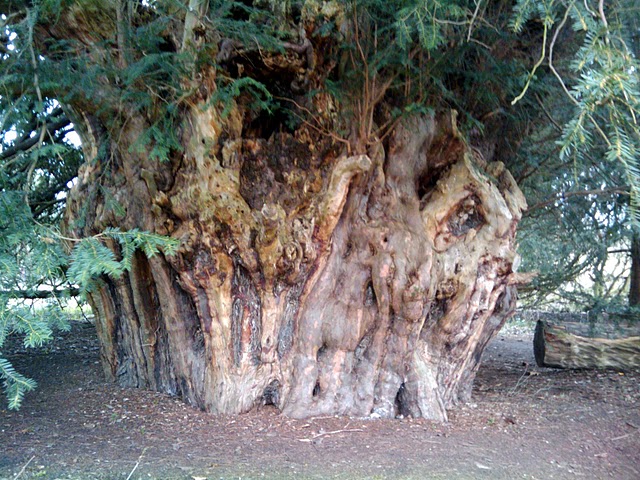
The Ankerwycke Yew, Berkshire
Said to be the site of Henry VIII's first liaisons with Anne Boleyn
  
Amongst the praise heaped on Hilary Mantel's Wolf Hall it was not surprising to see it described as 'a dark mirror held up to our own world'.  Reading its sequel, Bring Up The Bodies, I found myself thinking less of any political parallels than of the ageless issues of truth and lies, suspicions, rumours and the limits of what we are ready to believe of people.  I'm not sure why they are calling the current police inquiries into sexual abuse Operation Yewtree - it calls up historical associations with lutes and longbows, poison and burial.  Thomas Cromwell's investigations into accusations of treason, adultery and incest were not given a name.  He makes use of information about Anne Boleyn received from her ladies-in-waiting, but is unsure how far to trust what they relate, or what they say about the king himself.  It is likely, he thinks, 'that in conversations between themselves they trespass in places where a man would never trust his footing.  The king's body is borderless, fluent, like his realm: it is an island building itself or eroding itself, its substance washed out into the waters salt and fresh; it has shores of polder, its marshy tracts, its reclaimed margins; it has tidal waters, emissions and effusions, quags that slough in and out of the conversations of Englishwomen, and dark mires where only priests should wade, rush lights in their hands.'

Saturday, January 05, 2013

Clearing Winter Storm, Yosemite National Park

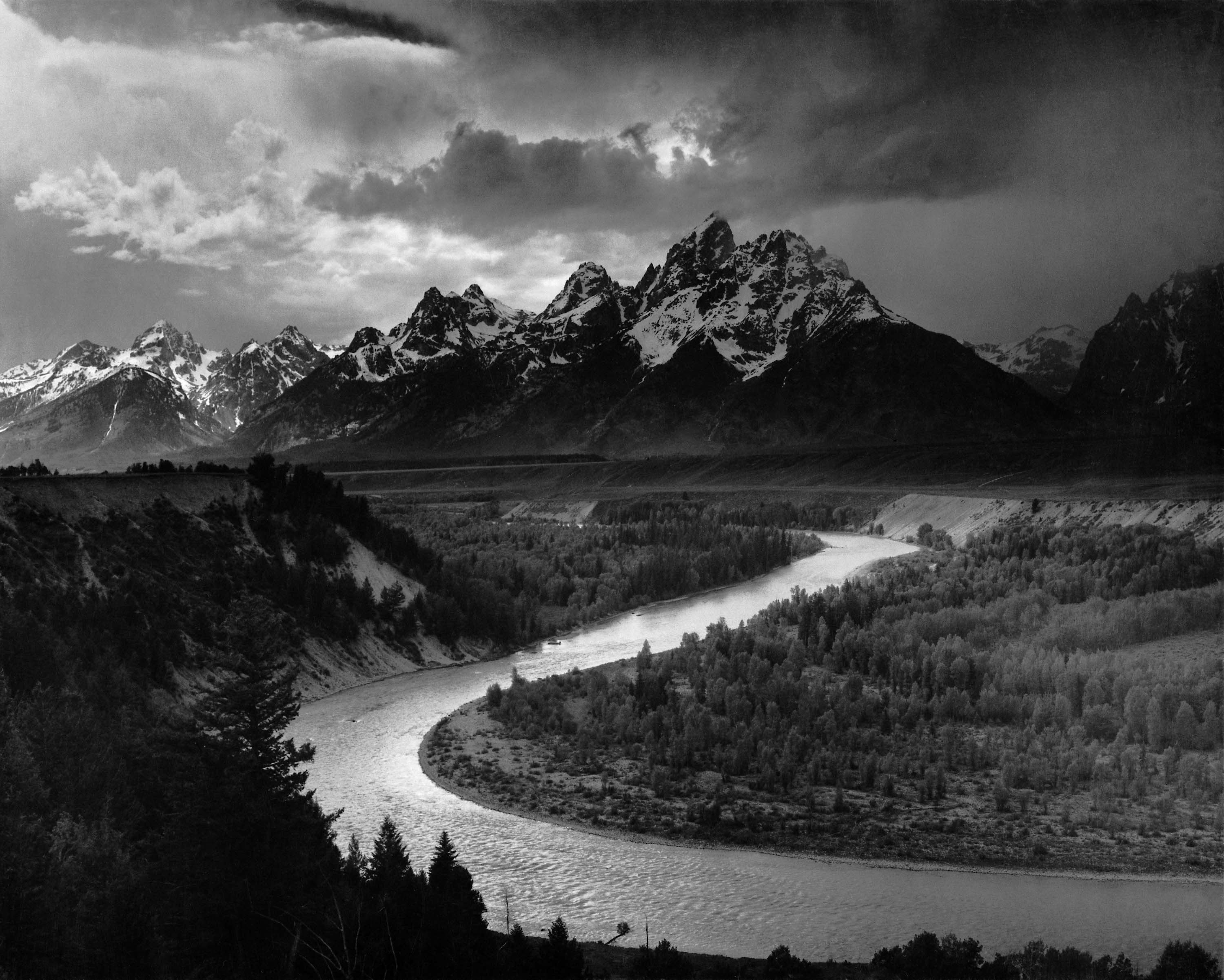
Ansel Adams, The Tetons and the Snake River (1942)
Source: Wikimedia Commons
This image was included on the Voyager Spacecraft Golden Record. 

Old photograph albums are littered with images of mountains, lakes and rivers that were of momentary fascination to the photographer on their travels, but are ignored now in comparison to the accompanying snaps of family members.  Perhaps it's not surprising therefore that Geoff Dyer's Borgesian history of photography, The Ongoing Moment, largely excludes landscape views.  He only finds one thing to write about Ansel Adams, 'the most popular and arguably the most influential photographer in American history', according to the website for the Adams exhibition currently on in London.  It is a passing reference to an atypical non-landscape photograph, 'unexceptional in every way', that Adams took of the model Charis Wilson.  Ansel Adams is certainly not a photographer you go to for human interest.  Alastair Sooke of the Telegraph doesn't warm to him: 'Adams’s photographs have an enamelled over-intensity that can feel inhuman. In his pictures, Adams presents an alternative to reality. With consummate skill, he isolates and composes a scene so that it resembles a snapshot of perfection. Yet it also remains distant and unattainable.  Even a familiar image such as Clearing Winter Storm, Yosemite National Park, California, about 1937 has an extraterrestrial quality: all that wintry vapour could be clouds of nebular gas coalescing into a faraway planet at the beginning of the universe. On such a cosmic scale, humans are irrelevant. Adams’s vision is at best detached, at worst cold and misanthropic.'

One of the advantages of seeing the exhibition with children this week was that I felt I had permission to enjoy these images as an 'alternative to reality' (on another of the miserable wet days we have been experiencing here in London).  I didn't feel I had to keep reminding myself that these mountains and rivers are not the timeless wilderness his photographs might lead you to suppose.  Nor was I in danger of being seduced into planning a holiday to 'the great landscapes of the Golden State' (the exhibition is sponsored by Visit California).  Instead I became absorbed in the shadows, patterns and visual echoes that Adams brought out of monumental vistas and detailed studies of surf and foam, seaweed and barnacles, icicles and snow.  Adams was one of the photographers who led the move away from Pictorialism (soft-focus images intended to look like paintings) but his images are all highly composed.  One interesting early print shows the influence of Ukiyo-e woodblock prints: a mosaic of flat planes showing sky, rocks and slope of trees and Marion Lake. (You can see this photograph at Artblart - an interesting blog brought to my attention just this week by its author Marcus Bunyon).  Alastair Sooke sees something of 'a deadening effect' in this formalism, given that Adams's wanted the images to provide an 'equivalent' to the emotions he felt out in the landscape.  Nevertheless, these photographs would be 'unexceptional in every way' if their musical configurations of form and light and shade wasn't deeply satisfying at some level.  And on that note here, is a clip of the late Dave Brubeck, talking about Ansel Adams' notion that 'photographers are in a sense composers, and the negatives are their scores'.