'The unframed scene casts landscape into a new kind of subject. The view is not given an off-the-peg edge, independent of and indifferent to its contents. It is given a bespoke edge that responds to and defines the character of the scene.'
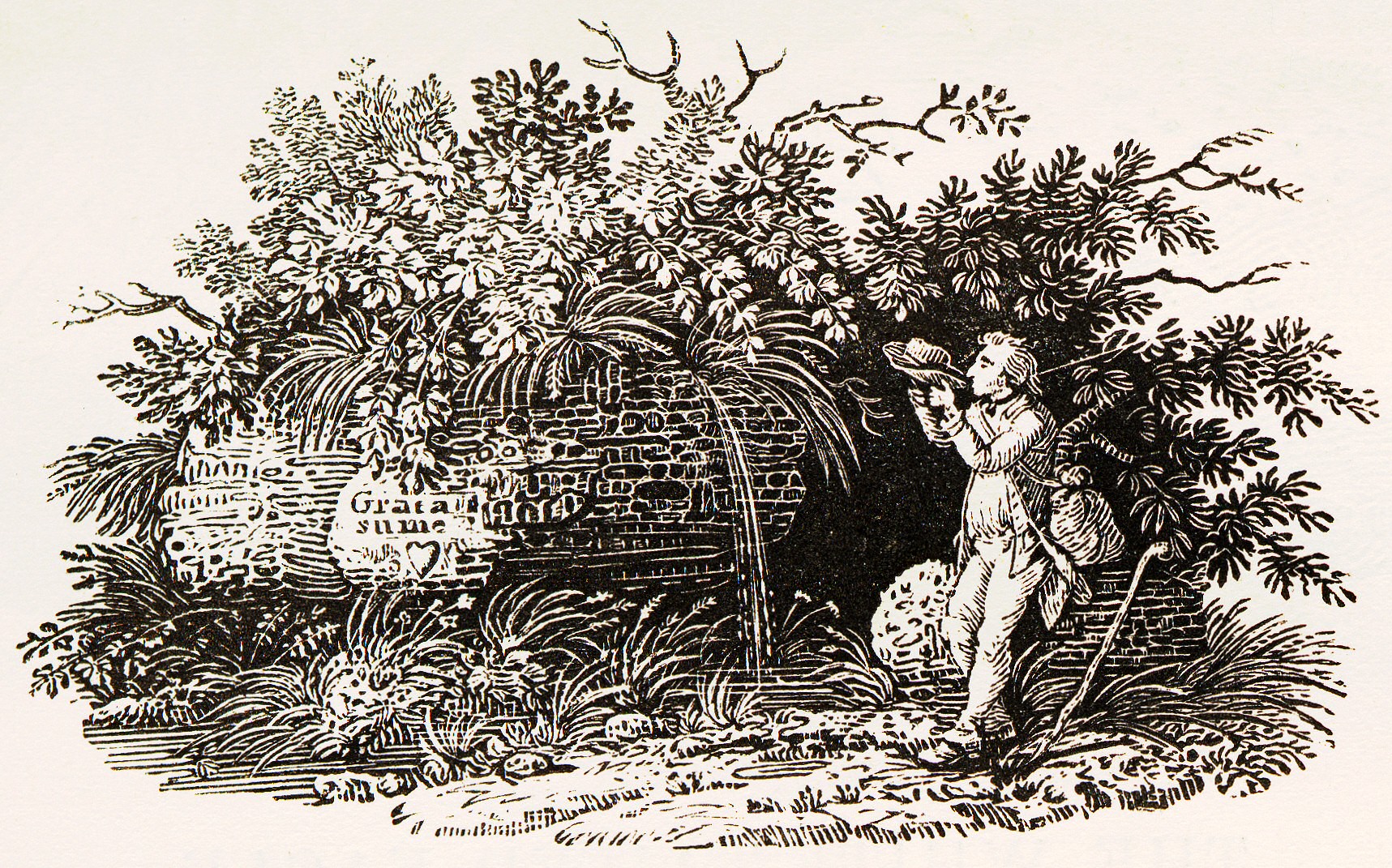
Tom Lubbock makes this interesting observation in his essay 'Defining the vignette', written to accompany a 2009 exhibition Thomas Bewick: Tale-pieces and reprinted in his posthumous collection, English Graphic. You can see in the image below of a thirsty traveller how the vignette's edges are defined by branches, leaves and tufts of grass. Lubbock saw this as 'place-portraiture', with Bewick isolating a site's distinctive features, 'those elements by which you would know it again'.
Thomas Bewick, Tail-piece - apparently of Thomas Bewick himself
as a thirsty traveller drinking from his hat, 1797
In his essay Lubbock includes a vignette of a hunter in the snow and then, underneath, the same image with a rectangular frame added. Without the frame, the snow's whiteness feels stronger, drawing into itself the whiteness of the surrounding page. Charles Rosen and Henri Zerner had previously described the way light in Bewick's landscapes 'changes imperceptibly into the paper of the book, and realises, in small, the Romantic blurring of art and reality.' Unfortunately I cannot convey the effect here because the background of the JPEG is a different white to the computer screen and thus creates its own frame.
Thomas Bewick, Hunter in the Snow, 1804
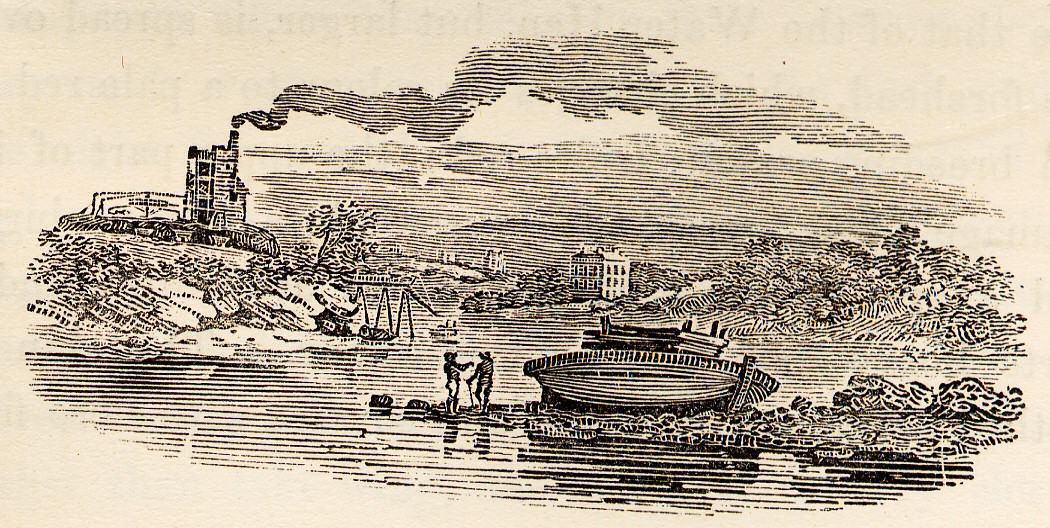
When Bewick drew something like the sea, he had no clear border to give the vignette its outline and so his lines seem to fade and blur at the edge of the image. Bewick's soft and hard edges draw attention to the ontology of perception, the distinction between things that can be delineated, like a tree, and things that cannot, like the sky. Sometimes the sky is given shading, as in the view of sea-cliffs below, and sometimes it is left blank, to give a feeling of clear open air.
Thomas Bewick, Bird's Eggs from Sea-Cliffs, 1804
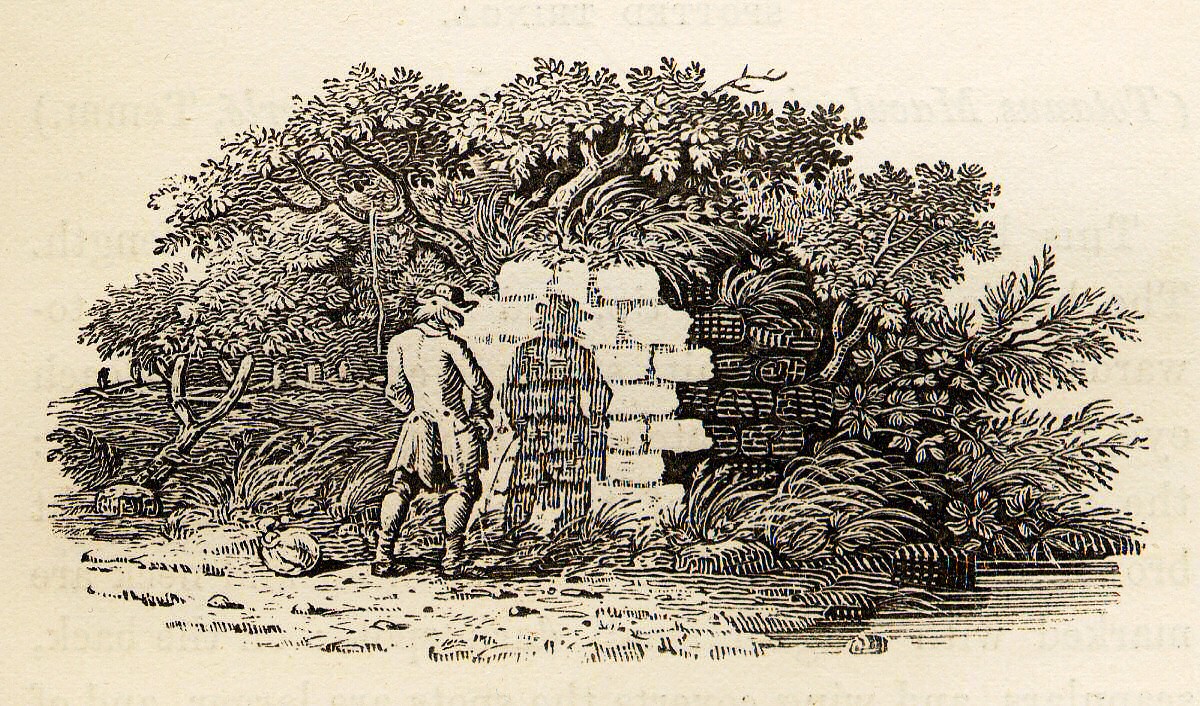
Lubbock concludes his essay by drawing attention to the way vignettes differ from traditional window-like landscape views. Their figures cannot pass out of view, they are rooted in their scenes. You cannot imagine the man below ever coming to the end of his piss and walking away - if he did, he would 'start to dematerialise or break up'. (NB: this pissing figure is my example - Lubbock has a much more idyllic scene of a man on a grassy bank looking up at the sky!) Bewick's vignettes remind us how the world shrinks to what we are conscious of at a particular moment. 'They communicate what it's like to be in the middle of something, to feel things in the now, to be entirely absorbed in your sensations.'
Eusebius: 'Now that the whole countryside is fresh and
smiling, I marvel at people who take pleasure in smoky cities.'
Timothy: 'Some people don’t enjoy the sight of flowers or
verdant meadows or fountains or streams; or if they do, something else pleases
them more. Thus pleasure succeeds pleasure, as nail drives out nail.'
This exchange can be found in The Godly Feast, one of the Colloquies written by Erasmus (first published in 1518 and then added to over the years; the Craig R. Thompson translation is available at the Catena Archive). Erasmus has Eusebius argue that "nature is not silent but speaks to us everywhere and teaches the observant man many things if she finds him attentive and receptive." To prove his point he suggests a visit to his "little country place near town, a modest but well-cultivated place, to which I invite you for lunch tomorrow." Timothy is worried he and his friends will be putting Eusebius out, but Eusebius reassures him: "you’ll have a wholly green feast made, as Horace says, 'from food not bought.'"
When they meet at this villa, Eusebius shows Timothy his statue of Jesus at the entrance to the garden: "I’ve placed him here, instead of the filthy Priapus as protector not only of my garden but of everything I own; in short, of body and soul alike." Eusebius stresses the utility and lack of luxury in his garden. What appears to be marble is merely painted concrete - ''we make up for lack of wealth by ingenuity". There is a lesson for life in this: appearances can be deceptive, he warns Timothy. A delightful stream is not all it seems either. It is used to drain kitchen waste to the sewer, like Sacred Scripture cleansing the soul. Elsewhere there are herbs for cooking and medicine, exotic trees, an aviary, orchards and bee hives.
In addition to the garden itself, Eusebius has had frescoes painted showing views of nature. This second, painted world even extends beneath their feet: "the very ground is green, for the paving stones are beautifully colored and gladden one with painted flowers". He explains to Timothy that:
"One garden wasn’t enough to hold all kinds of plants. Moreover, we are twice pleased when we see a painted flower competing with a real one. In one we admire the cleverness of Nature, in the other the inventiveness of the painter; in each the goodness of God, who gives all these things for our use and is equally wonderful and kind in everything. Finally, a garden isn’t always green nor flowers always blooming. This garden grows and pleases even in midwinter."
Eusebius is proud of his garden but he is just as keen to mention his library, globe and paintings. I like the fact that place names have been added to his religious paintings, "to enable the spectator to learn by which water or on which mountain the event took place". It is clearly the ideal of a Renaissance scholar, and the garden is a highly artificial landscape. Indeed, John Dixon Hunt has pointed out that it is 'substantially architectural: walled, with galleries and pillars, it may be seen as much as a city as a garden.'
Disappointed Lucy Honeychurch gets her wish when Mr Emerson and his son George kindly offer to swap rooms ("women like looking at a view; men don't"). The next morning she wakes and leans from the window, 'out into sunshine with beautiful hills and trees and marble churches opposite, and close below, the Arno, gurgling against the embankment of the road.' Forster spends a paragraph describing the scene below - river men, children, soldiers, a tram temporarily unable to proceed. 'Over such trivialities as these many a valuable hour may slip away, and the traveller who has gone to Italy to study the tactile values of Giotto, or corruption of the Papacy, may return remembering nothing but the blue sky and the men and women who live under it.' Eventually, over the course of the novel, Lucy chooses life over culture, George over the aesthete Cecil (memorably played by Daniel Day Lewis in the film), and A Room with a View ends with the newlyweds in Florence again, looking out over the Arno from the same window.
It is landscape - the desire for a good view - that leads to the novel's decisive moment, placing Lucy in the situation where George is compelled to kiss her. Along with the other English travellers in Florence, they are invited by the chaplain, Mr Eager, to make an excursion into the hills.
"We might go up by Fiesole and back by Settignano.
There is a point on that road where we could get down and have an hour’s
ramble on the hillside. The view thence of Florence is most beautiful—far
better than the hackneyed view of Fiesole. It is the view that Alessio
Baldovinetti is fond of introducing into his pictures. That man had a
decided feeling for landscape. Decidedly. But who looks at it to-day? Ah,
the world is too much for us.”
Alesso Baldovinetti, Nativity (detail), between 1460 and 1462
And so they set off on the excursion and stop on the hillside with its view of the Val d'Arno. The group separate and
Lucy finds herself at a place where 'the view was forming at
last; she
could discern the river, the golden plain, other hills.' But then she slips and finds herself on a terrace covered with violets.
From her feet the ground sloped sharply into view, and
violets ran down in rivulets and streams and cataracts, irrigating the
hillside with blue, eddying round the tree stems collecting into pools in
the hollows, covering the grass with spots of azure foam. But never again
were they in such profusion; this terrace was the well-head, the primal
source whence beauty gushed out to water the earth.
Here, unexpectedly, she encounters George who sees 'the flowers beat against her dress in blue waves'. He steps forward and kisses her.
In the Merchant Ivory film there are no violets - presumably they couldn't find any on location. Instead there is long grass and poppies and a rather overwhelming Puccini aria sung by Kiri Te Kanawa. The second kiss, which again takes Lucy by surprise, takes place after a tennis match some months later, when they are back in England. As she observes George playing in the fading sunshine, she imagines the landscape of Italy overlaying the familiar surroundings of Surrey.
Ah, how beautiful the Weald looked! The hills stood out above its
radiance, as Fiesole stands above the Tuscan Plain, and the South Downs,
if one chose, were the mountains of Carrara. She might be forgetting her
Italy, but she was noticing more things in her England. One could play a
new game with the view, and try to find in its innumerable folds some town
or village that would do for Florence. Ah, how beautiful the Weald looked!
Everything in Forster is tinged with irony (see my earlier post on Howards' End) and of course these lines are there to show how Lucy is unaware of her own feelings, for George and the place he first kissed her. But having grown up on the edge of the South Downs, I would love to believe that they are capable of becoming the hills of Tuscany.
A couple of days ago I read inThe Guardianthat 'police have warned young people not to attend illegal raves this weekend, promising a tougher approach after two “quarantine raves” attracted 6,000 people last Saturday.' It made me think of the final chapters of Richard King's book The Lark Ascending which discuss the outdoor rave scene's emergence thirty years ago, followed by opposition that led to the introduction of the Criminal Justice Bill. Jeremy Deller told a similar story last year in Everybody in the Place (although the participation of children in his film meant he left out some of the drug history). King describes an early rave organised by Cymon Eckel and the Boys Own network which culminated in dawn breaking over a misty Sussex reservoir. One of them would later describe seeing 'a flock of geese descend from the sky to make a perfect landing at the water's edge.
And here in the early hours of a perfect English summer's day, five hundred people sitting, or collapsed, on hay bales, grew energised by the dawn and looked out onto the water of Weir Wood Reservoir that borders Ashdown Forest, the location that inspired A. A. Milne's '100 Aker Wood', and the haven Eckel and his friends had created was experienced by all those present as their private Acid House Pooh Corner.'
Last year I saw Richard King give an interesting talk on his
book at the Stoke Newington Literary Festival. He began with his view that the popularity of
Ralph Vaughan Williams' composition comes from the way it conveys musically a sense of
freedom and at the same time connectedness to an unspecified British
landscape. The full subtitle of The Lark Ascending on my paperback edition is 'People, Music and Landscape in Twentieth Century Britain', making clear that this is not merely a study of music inspired by nature. In fact there is little in the book about music written to convey a spirit of place - from Vaughan Williams he skips over British landscape composers like Ireland, Bax and Finzi, moving instead to Ewan MacColl's 'The Manchester Rambler' (in a discussion of the Kinder Scout trespass) and then forward to Stan Tracey'sjazz suite inspired by Under Milk Wood. Later chapters discuss the music of Donovan, Gavin Bryars, Kate Bush, Penguin Cafe Orchestra and Ultramarine. It got me listening anew to some of this on Spotify, though I have to admit I find the late sixties Donovan albums pretty hard going...
The book ends in the 1990s, although there is a brief epilogue featuring Rob St John (it mentions Surface Tension, a piece of music I described here five years ago). In the new century, issues of ownership and access to land have become ever more complicated, and now the age of coronavirus has raised a whole new set of questions. The idea of assembling at a rave by a Sussex reservoir this summer would come up against ethical choices around social distancing, pitting hedonism and personal freedom against the interests of the more vulnerable in society. It is however still possible to go for a ramble, and so, given the reference to Manchester in that piece about an illegal rave, I'll end here with the closing lines of Ewan MacColl's song:
So I'll walk where I will over mountain and hill
And I'll lie where the bracken is deep
I belong to the mountains, the clear running fountains
Where the grey rocks lie ragged and steep
I've seen the white hare in the gullies
And the curlew fly high overhead
And sooner than part from the mountains
I think I would rather be dead
Literature and Nature in the English Renaissance: An Ecocritical Anthology edited by Todd Andrew Borlik was published last year and so far has a solitary one star review on Amazon. "Frankly,
if a book of out-of-copyright texts is THAT expensive, you may as well
download the contents list to Kindle and go and find the texts yourself.
Absurd pricing." At £84, it is certainly out of reach of my pocket, but as this reviewer notes, the contents list is freely available. Here are two sections:
In this post I wanted to highlight the first text above, Robert Southwell's poem 'A Vale of Tears'. Here are its first four stanzas:
A vale there is, enwrapt with dreadful shades,
Which thick of mourning pines shrouds from the sun,
Where hanging cliffs yield short and dumpish glades,
And snowy flood with broken streams doth run.
Where eye-room is from rock to cloudy sky,
From thence to dales with stony ruins strew'd,
Then to the crushèd water's frothy fry,
Which tumbleth from the tops where snow is thaw'd.
Where ears of other sound can have no choice,
But various blust'ring of the stubborn wind
In trees, in caves, in straits with divers noise;
Which now doth hiss, now howl, now roar by kind.
Where waters wrestle with encount'ring stones,
That break their streams, and turn them into foam,
The hollow clouds full fraught with thund'ring groans,
With hideous thumps discharge their pregnant womb.
It is certainly a pretty bleak-sounding place, where pleasant landscape features we associate with pastoral poetry provide no comfort ('crystal springs crept out of secret vein, / Straight find some envious hole that hides their grace'). Surrounded by all this, the mind turns inward and dwells on sin and the need for repentance. 'Come, deep remorse,' the poet concludes, 'possess my sinful breast; / Delights, adieu! I harbour'd you too long.'
Robert Southwell was a Jesuit Catholic martyr: canonised in 1970; hung, drawn and quartered at Tyburn in 1595. A recent profile of him in The Tabletdescribes his training in France and Rome and return to England in 1586 to undertake clandestine missionary work.
'Southwell’s literature infiltrated the Catholic
country houses of England. Though he was a priest without a pulpit and
an outlaw, Southwell hoped that word of a Catholic revival would
disseminate through the secret printing presses to the peasantry,
yeomanry, and lesser gentry. [...] His great poem “A vale of teares”, issued in the year of his death,
likens England’s perceived fallen state under Elizabeth I to a “dumpish”
(melancholy) wasteland, “Where nothing seemed wronge yet nothing
right”. In the absence of a settled spiritual solution to England’s
break from Rome, the poem offered Catholics a negative solace.'
In a 2018 article, Gary Bouchard cites critics who have explained the poem in terms of a prescribed Ignatian penitential framework or in psychological terms as a 'therapeutic scene'. His own view is that it can be read as an anti-pastoral, contrasting it
specifically with Spenser's 'The Shepheard's Calender' (1579). But he also notes that some of the language and imagery is proto-Romantic - a landscape one could imagine 'Victor Frankenstein and his creature passing through'. Southwell had crossed the Alps via the St. Gotthard Pass on his journey to Rome in 1578 and would have seen sights that later writers and artists would come to admire for their sublimity.
J. M. W. Turner, A Ravine in the Pass of St Gotthard, 1802
I will close here with one more stanza from the poem:
The pines thick set, high grown and ever green,
Still clothe the place with sad and mourning veil;
Here gaping cliff, there mossy plain is seen,
Here hope doth spring, and there again doth quail.
Reading Robert Southwell's poem prompts the obvious thought that in these dark times - of climate crisis, global pandemic, economic hardship and racist brutality - it is hard not to feel that we are all walking through a vale of tears.
The passing of Christo has prompted various articles and obituaries - I have included some links below. The Guardian published one about Wrapped Coast (1969), where Christo and Jeanne-Claude used 90,000 square meters of
erosion-control fabric and 56 kilometres of polypropylene rope to
transform a craggy shoreline south of Sydney into something that more
closely resembled a chalk cliffscape. I wrote about this work in my book about chalk cliffs, Frozen Air. Wrapped Coast had its own unique qualities, moving with the wind,
creating a cliff surface in constant motion, but it also obscured and
smoothed over the irregularities of real earth and rock. Something like
this happens when we view cliffs at a distance, as a landscape composed
of shapes and simple colours. I wonderedhowthis fake coastal feature might have changed people’s experiences of being there.
For some it must have de-familiarised a place they had known for years. Perhaps in covering over the natural backdrop to their experiences it brought old memories back into focus. For others, with no prior knowledge of that coastline, the reality of the landscape could only be imagined, hidden under a vast dust sheet.
Screenshot from the Kaldor Public Art Project film (below) of Wrapped Coast, 1969
The Guardian article quotes Australian collector John Kaldor, who released a statement following Christo’s death. “It wasn’t an easy task to find a coastline close to Sydney
and get permission to wrap it,” Kaldor recalled. “The reaction was
mostly disbelief and ridicule.” One of the volunteers who helped assemble it, Ian Milliss, recalled how the artists seemed very glamorous.
"They would fight all the time but she was the
organiser. There was a very clear division of labour: he was up in the
studio putting it all together in his mind, but she made sure everything
happened on the ground.”
“Little Bay wasn’t just a beautiful object in the landscape. It was a
total work. You looked at it like you look at the pyramids, as a huge
piece of embodied labour and organisation. To me that was the thing that
was most impressive about it – more than the scale of it, more than the
beauty.”
Christo's relationship with landscape and nature is not straightforward - Running Fence, the 44.5 mile-long white nylon fence they stretched across
California in the mid-70s,
required a 450-page environmental impact report. I wasn't surprised to find a short notice of his death in Plastics News...
Here are three more appreciations.
Lynne Hershman Leeson: 'I worked in the office for the two weeks while Running Fence
remained on view. (Meanwhile, Jeanne-Claude operated the secret decoy
unit—something she learned from her father, who was a general in the
French army, so that no one would interrupt her work.) On the very last
day the work was up, I took a helicopter ride over the landscape. Only
from that distance could I see its entire expanse. It was breathtaking.'
Adrian Searle: 'Surrounding a group of small islands near Miami with floating pink fabric
in 1983, and extending floating, interconnecting piers or pontoons
covered in yellow fabric across a huge Italian lake in 2016, the artists
transformed these places, albeit briefly, into a kind of gorgeous
abstraction.'
Jerry Saltz: 'Today, the week of his death, amidst the extended three and a half years
of this terrible long American night, I wish we could enlist them to
wrap the White House in black fabric shroud, a hyper-lucid mummified
metaphor for the ghost ship of current pain and racism. Instead we can
only mourn them, as we grieve for ourselves.'
Well, the weeks drag on and I am starting to forget what hills, rivers and shorelines actually look like. I keep wondering whether it is worth the health risk to hire a car or take a train to see something other than Victorian terraces. But where would we go? The virus has drawn attention to the way we pick destinations to experience and how much effort we are prepared to make to get to them. Conversely it has shown how much interest there is in exploring the local streets - not exactly deep topography, but still a lesson in noticing previously overlooked details. I'm sure I'm not alone in having made a short film based on these exercise walks - it seemed an obvious thing to do, even if I am no Jonathan Meades (despite insisting on posing in similar shades).
Lockdown walks near our home in London
Mersea Island photographed by me in 2011
When I asked my wife where, in theory, she would most like to travel to
outside London, she thought about it for a bit and then started reminiscing about Mersea Island. I was thinking about this when I started reading a place-themed edition of the Moving Image Artists Journal, since Mersea Island is actually where the editors Danial & Clara have been living under lockdown. How, I wondered, did these different filmmakers, with all the possibilities of
mobility before coronavirus, choose particular landscapes to be the
focus of their films? A few examples from the thirteen articles:
Estrangement and escape: The Super 8 artist Autojektor lives in London but made Basilisk in the
Black Forest. They refer to the story of Hansel and Gretel, lost in the woods, and write of being an
innocent abroad themselves: 'as someone that had only been out of the country once
before as a kid, it was easy to lose myself.' The landscape became a creative space to escape from our permanently connected world. 'I would purposely get myself lost – I’d let my phone run down and I’d
walk into the thickest woods and heaviest fog until I started to panic.
And then I would sit and write.'
Memory and family history: 'Landscape is the lens through which I see the world, and the landscape
of my lifetime is defined by loss,' writes Seán Vicary. His project, Chain Home West,
involved 'active place-based research, that was often reflexive and
sometimes even ritualistic or performative.' The film's locations had
personal associations and centred on his desire to seek out the site of a mobile
radar unit that his father had been assigned to during the war.
Hauntology and psychogeography: For Headlands, Yvonne Salmon and James Riley headed to a hauntologically-rich location in North Cornwall: setting for a 1981 BBC Series, The Nightmare Man,
and linked to a 17th century maid who is recorded as having encountered
fairies (or possibly aliens). On their filming trip, 'things happened
which we found difficult to explain' and they returned from Cornwall 'not the same
people who started out on the journey.'
Aesthetic choice: Peter Traherne's Atmospheric Pressure began with an attempt to make a film inspired by Gawain and the Green Knight. In looking for locations he found a farm in Sussex with flooded fields and dead pigs. 'Needless to say, the location charmed me. Maybe not the carcasses but the texture of it all.' The Gawain theme was dropped in favour of a film about 'The Farmer', although the real farmer's involvement was not straightforward: 'we could never shoot his scenes, for he must always be elsewhere.' The film crew eventually left with 'dark images of a world of weather and animals; images that were densely uncommunicative yet surfeited with sense and matter'.
Residency: finally, some settings get chosen because they are readily to hand. Daniel & Clara write about filming with old VHS cameras on walks near their former home in Hastings, or assembling footage taken on a daily basis in Portugal to form a composite landscape film (see below). They have also taken the opportunity to film when invited to participate in exhibitions or other projects. In another article, Amy Cutler (whose curating I have written about here before) discusses her recent filmmaking and refers to an artist residency on the Finnish fortress island of Örö last winter.
Sadly such opportunities are no longer available in 2020 (we were actually due to go to Finland this summer but have now cancelled the holiday). Experimental films will have to stay closer to home. Fortunately there is a lot you can do without leaving the house at all - I've recently been looking through old VHS footage from the 90s, exploring the landscape of memory and family history. And I know from her tweets that Amy, confined to her flat, has been interrogating and repurposing old nature documentaries. If it is possible to head out of London soon, perhaps even to Mersea Island, I will take the time to record some footage and keep it ready, just in case we have to go into lockdown again...
I was intrigued by a story in the Guardian the other day: 'almost a century after it was shot, a brief but beautifully made
documentary that could be the first talking picture directed by a woman
in Spain has been discovered after the forgotten and miscataloged
footage was re-examined during the coronavirus lockdown.' You can read the article for the story on the film's rediscovery and how they found out about the director, María Forteza. In the context of this blog, it was interesting to read the comments by archivist Josetxo Cerdán, that the film was
'well shot and structured, and
far better than most of the “aesthetic documentaries” of the time that
were intended to show off the beauties of the countryside and of
historical monuments. “They tend to be
painfully dull: you get a monument, then another monument, then a
mountain,” he said. “But this isn’t like that. You have the explanatory
prologue and the little narrative of the boat arriving on the island and
then the tour. The camera is also very well positioned in every shot.”'
That last point can be seen in the two screen grabs I have included here. In the first shot, sheep move across the screen haloed by sunlight, and in the second a man walks down a narrow street of shadows. Although music forms the soundtrack, you can imagine the sound of a bleating flock and the quiet of a town resting during the heat of the day. The film features music by Isaac Albeñiz (1860-1909), one of whose compositions for guitar is Mallorca. Albéniz is best known for his Impressionist Iberia suite which is inspired by twelve places in Spain.
I'm not exactly sure what Josetxo Cerdán defines as 'aesthetic documentaries', although it is easy to imagine them. By this time, the travelogue film, which dates back to the beginning of cinema, often resembled a clichéd series of moving postcards. As the BFI website explains, they were often commissioned to promote tourism
'with bodies such as the Travel and Industrial
Development Association (TIDA) in the 1930s, and with Tourist Boards from all
countries and regions up to the present. The postcard analogy is therefore very
apt, with films such as Claude Friese-Greene's The Open Road series (1924-1926)
being largely a compilation of beautifully composed, and strangely familiar
views, probably informed by a swift visit to the local gift shop.'
Mallorca has been dated to between 1932 and 1934. I must admit I am unfamiliar with early 1930s Spanish travelogue films, so am not really able to contextualise it. All I know about is the parody Luis Buñuel made, Land Without Bread, released in December 1933. His controversial pseudo-documentary highlighted the poverty and disease of the inhabitants of Las Hurdes. Graham Greene, who saw it in 1937, described it as "an honest and hideous picture", although the truthfulness of the filmhas long been disputed (see a Guardianarticle from 2000, 'Buñuel and the land that never was'). As I write this, the news is full of hideousness and it is tempting to keep to a diet of cultural escapism. Travel looks impossible for some time and any footage recalling the simple pleasures of tourism now seems charming and nostalgic, no matter how clichéd it is.
Master of the Darmstadt Passion, Saint Onuphrius, 1460
You could write a whole book about landscapes in
depictions of the Desert Fathers and Desert Mothers (and I would read it). A chapter on Saint
Onuphrius would certainly include this painting, which I photographed three years ago in Zurich. The desert here resembles a summer lawn and the little stream seems to provide just enough water to irrigate a few herbs. Also in Switzerland, the Kunstmuseum Basel has an austere landscape from 1519 in which Onuphrius prays among bare red rocks and broken tree trunks. It was painted by a local artist, Conrad Schnitt. Sadly there is no image freely available online -
all I could find was one overwritten throughout with 'Alamy' to prevent
copying. I'm therefore only able to provide a tiny detail below, showing a distant building that I'm guessing is the monastery Onuphrius lived in before he headed into the desert. In the Zurich painting there is a similarly-placed structure, which looks like a beautiful medieval castle standing out against the golden sky.
We only really know about Onuphrius from an account of Paphnutius the Ascetic, a fourth century Egyptian anchorite. Paphnutius ventured into the desert to see what it would be like to be a hermit and there he saw a wild man covered in hair, wearing only leaves. This was Onuphrius, who said he had survived as a hermit out there for seventy years. They spoke until sunset and spent the night in prayer. In the morning Onuphrius died and Paphnutous covered his body with a cloak and left it in a cleft in the rocks because the ground was too hard to bury him.
You would think such an inhospitable place would always appear as a bleak-looking landscape in art. But this isn't always the case, as can be seen in Cornelis Cort's print. Here there are trees in full leaf and plentiful water in a wonderfully well-drawn river. I have reproduced another print below by Albrecht Dürer. It shows John the Baptist with a saint once thought to have been Saint Jerome, but as the National Gallery curators write, there is no lion to be seen and 'instead,
the garland of hops points towards Saint Onuphrius.' They note that 'the relatively densely worked areas in the centre of the print contrast with almost rudimental landscape in the background.' However, for me, the distant vista is beautiful rather than 'rudimental', with its sense of space and light, and that sea fringed with trees and dotted with two small boats beneath waves of cloud...
Albrecht Dürer, John the Baptist and Saint Onuphrius in the Wilderness, c. 1503-4
I won't try your patience here by describing lots more images of Onuphrius in the history of art. There have been many icons in which his standing figure is placed in front of his cell, between hills or on a rocky plain. Artists whose views of the saint are set in interesting wilderness landscapes include Lorenzo Monaco (c. 1370-1425), Francesco Morone (1471-1529), Jan van Haelbeck (1595-1635), Francisco Collantes (1599-1656) and Salvator Rosa (1615-1673). I will conclude with just one more: a painting orginally made for the Buen Retiro Palace in Madrid. The artist
responsible for the figure of Onuphrius is not known but the painter of the landscape
is unmistakable. The life of a hermit in this sublime landscape looks almost inviting.
Claude Lorrain, Landscape with Saint Onuphrius, c. 1638
Thomas Kerrich,
Diagram of Three Landscapes Drawn towards and away from the Sun, 1796
I just came upon a photograph I took of two remarkable drawings by Thomas Kerrich - I think they were in Patrick Keiller's 2012 exhibition, TheRobinson Institute? I last featured Kerrich here when I highlighted one of his views of the beach at Lowestoft, far more minimal than you would expect from a painting done in 1794. These sketches come from around the same time: the cloud study is undated, but the three landscape views in circles were drawn around noon on March 18, 1796. Those three circular views could almost be conceptual art and remind me of photographs taken through Nancy Holt's Sun Tunnels. The colour trials might be strange light effects somewhere beyond the stratosphere, although at first glance this image could be taken for fleeting impressions of pennants in a regatta and foam tipped waves.
Thomas Kerrich,
Cloudscape with Colour Trials, c.1795
The Tate has some other nice cloud studies by Kerrich - I have included one below. The British Museum also has five of his sketches which 'record changes in the light
and weather along a stretch of coastline near Lowestoft and Pakefield
in Suffolk in August 1794.' The curators suggest that
'Their immediacy and freshness are due to the fact
that they were done directly from nature, as indicated by the artist's
notation; but also because as an amateur, Kerrich was not constrained by
conventional landscape formulae and was free to explore weather and
cloud effects with a simplicity and directness not equalled until the
work of Constable nearly two decades later.'
Thomas Kerrich, Study of Two Clusters of Cumulus Clouds,
c.1795
I recently read Jeremy Noel-Tod's excellent anthology The Penguin Book of Prose Poetry and it prompted me to get down a few books from our library and look up some examples of prose poems. James Wright, for example: in Above the River: The Complete Poems there are several short prose pieces written during the seventies, when he and his wife were spending their summers in Europe. I have chosen seven of these in order to quote brief imagistic landscape descriptions; but as usual when I do this kind of thing, I need to apologise for taking such descriptions out of context and failing to do convey the actual point of the poems. Still, as I sit writing this in London under lockdown, these fragments of text are a pleasant reminder of the light and beauty of Italy, and an excuse to include again a photograph of the Colosseum from our 2014 trip.
The Colosseum, Rome
As Donald Hall notes in his introduction, James Wright's Italy was a literary place: the landscape of Catullus, Virgil and Ovid, of Goethe's Italian Journey, Keats and Shelley, and the American novelists - Henry James, Edith Wharton and William Dean Howells (who was 'the other literary
figure born in Martins Ferry, Ohio'). Sometimes thoughts of Ohio comes to Wright when he writes about Italy. In the poem 'One Last Look at the Adige: Verona
in
the Rain', he imagines the Ohio river once looking something like the
Adige, 'to the people who loved it / Long before I was born'. Verona was, for Wright, 'one of the earth's
loveliest places' and I will begin and end my quotes there.
On a sunlit day its pink and white marbles glow from within, and they glow from within when it is raining.
- The Arena, Verona
In all directions below us were valleys whose villages were just beginning to appear out of the mist, a splinter of a church here, an olive grove there. It was a life in itself.
- San Gimignano
The fragrance of the water moves heavily and slowly with mussel shells and the sighs of drowned men. There is nothing so heavy with earth as the sea's breath and the breath of fresh wilderness, the camomilla fields along the shore.
- Bari
All over Apulia, currents of sea air snarl among winds from the landwise mountains. I can see thistle seeds tumbling everywhere, but I lose their pathways, they are so many.
- Apulia
At noon on a horizon the Colosseum poises in mid-flight, a crumbling moon of gibbous gold. It catches an ancient light, and gives form to that light.
- The Colosseum, Rome
It is only the evenings that give the city this shape of light; they make the darkness frail and they give substance to the light.
- Venice
Its shape holds so fine a balance between the ground and the sky that its very stones are a meeting and an intermingling of light and shadow. At noon, even the fierce Italian sunlight cannot force a glare out of the amphitheatre's gentleness.
- The Arena, Verona
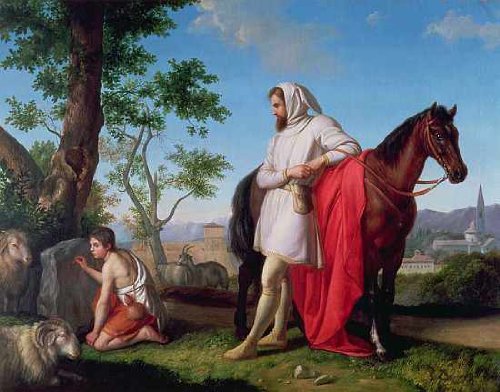
There is one of Wright's prose poems written in Italy that I particularly like, 'The Lambs on the Boulder'. It is about Cimabue and the story of how he 'discovered' Giotto, then just a shepherd boy, scratching sketches of lambs on a rock. I always like the idea of treating such fanciful stories seriously (a different example of this impulse is Eric Rohmer's serious treatment of pastoral in The Romance of Astrea and Celadon). 'One of my idle wishes,' Wright says, 'is to find that field where Cimabue stood in the shade and watched the boy Giotto scratching his stone with his pebble.' He imagines the way Cimabue would have observed the boy:
I wonder how long Cimabue stood watching before he said anything. I'll bet he waited for a long time. He was Cimabue.
I wonder how long Giotto worked before he noticed that he was being watched. I'll bet he worked a long time. He was Giotto.
He probably paused every so often to take a drink of water and tend to the needs of his sheep, and then returned patiently to his patient boulder, before he heard over his shoulder in the twilight the courtesy of the Italian good evening from the countryside man who stood, certainly out of the little daylight left to the shepherd and his sheep alike.
I wonder where that boulder is. I wonder if the sweet faces of the lambs are still scratched on its sunlit side.
I was thinking the other day about the old cliché that alien planets in Dr Who were always filmed in quarries. Apparently David Tennant (the tenth Doctor) once said "I've been to many planets in the solar system, and you'd be surprised how many of them look like quarries in Wales." There is, you may be unsurprised to learn, a website devoted to the locations of Dr Who up until 2012 and from this I have extracted and listed below the complete list of quarries. The most frequently used (four times each) are Springwell Quarry and the Gerrards Cross Sand and Gravel Quarry. Springwell Quarry is in Hertfordshire and was first used in 1972 for The Three Doctors. The locations website has a small photograph from this with the caption 'The Brigadier begins to wonder if he really is at Cromer ...' They note that 'part of the quarry is now a landfill site, but a huge
part of the quarry still exists, and has been left
to its natural state'. As for Gerrards Cross Sand and Gravel Quarry, this was first used for an episode broadcast four days before I was born, and most recently in 1984 for Attack of the Cybermen (their photo is captioned 'The Doctor realises gastropods are involved.') The quarry is still in use.
The image above shows the first use of a quarry in Dr Who, for the 1964 series The Dalek Invasion of the Earth. This story was mainly set in central London but John's Hole Quarry in Kent was used as the site of a Dalek mine. As noted already, the locations website stops in 2012 and the last quarry location it mentions is Aberthaw Quarry in Wales. I imagine there have been more recent examples, but I've not been watching Dr Who since the Tom Baker era so can't really comment on this myself. I see from Wikipedia (which has information on every series) that overseas locations are now used, but I hope they still manage to fit some quarries in. Some of the recent Jodie Whittaker episodes were made in South Africa. The Daily Express relayed the news that Jodie had 'opened up on what the experience was like.
She told Doctor Who Magazine how the shoot in the warm country lasted three weeks.
The actress said: “It was warm, so that was good!"'
Aberthaw Quarry (The Time of Angels)
Argoed Quarry (Utopia)
Associated Portland Cement Company Quarry (The Macra Terror)
Beachfields Quarry (Frontier in Space)
Beachfields Quarry (Planet of the Daleks)
Beachfields Quarry (The Invasion of Time)
Betchworth Quarry (Genesis of the Daleks)
Betchworth Quarry (The Deadly Assassin)
Castle Cement Quarry (Battlefield)
Cloford Quarry (Time and the Rani)
Cwt y Bugail Quarry (Rigcycle) (The Five Doctors)
Gerrards Cross Sand and Gravel Quarry (Attack of the Cybermen)
Gerrards Cross Sand and Gravel Quarry (The Dominators)
Gerrards Cross Sand and Gravel Quarry (The Tomb of the Cybermen)
Gerrards Cross Sand and Gravel Quarry (The Twin Dilemma)
Hanson's Aggregates (Binnegar Plain quarry) (Death to the Daleks)
John's Hole Quarry (The Dalek Invasion of Earth)
Little Rollright Quarry (The Stones of Blood)
Shire Lane Quarry (The Savages)
Slickstones Quarry (The Hand of Fear)
Springwell Quarry (Delta and the Bannermen)
Springwell Quarry (Earthshock)
Springwell Quarry (The Three Doctors)
Springwell Quarry (The Twin Dilemma)
Tank Quarry (The Krotons)
Trefil Quarry (Enemy of the Bane)
Trefil Quarry (Planet of the Ood)
Trefil Quarry (The Temptation of Sarah Jane)
Vaynor Quarry (Last of the Time Lords)
Warmwell Quarry (Survival)
Warmwell Quarry (The Greatest Show in the Galaxy)
Wenvoe Quarry (The Impossible Planet)
Wenvoe Quarry (The Satan Pit)
Wenvoe Quarry (Utopia)
West of England Quarry (The Krotons)
Westdown Quarry (Time and the Rani)
Whatley Quarry (Time and the Rani)
Winspit Quarry (Destiny of the Daleks)
Winspit Quarry (The Underwater Menace)
Worsham Quarry (The Android Invasion)
Wrotham Quarry (The Dominators)
One use now made of writing on landscape that didn't exist when I started this blog is the Instagram Caption. Many websites now offer Instagrammers advice on captions for their landscape photographs, because of course these images won't simply speak for themselves. "Having a cool
text will bring attraction to your photos and your social profile will
gain popularity (that means more followers, likes, comments…)" Some of the phrases suggested are inspirational statements with no definite author that seem to have arisen spontaneously from the internet itself, but others are real quotes. Elite Daily, for example, has a Top Thirty for you to pick from, ranging from "Sometimes, all you need is a change in scenery" (no author) to "I seek to sea more" (which I guess I guess is just a bad pun? Again, no author). The actual writers in this list form a strange kind of pantheon: Confucious, Cat Stevens, John Ruskin, Dr. Seuss, John Muir, Mattie Stepanek and George Santayana.
Here are some other Instagram caption sites:
Captionclick has "150+" quotes. "Nature captions for Instagramare in demand as we live on the most beautiful planet i.e Earth.... We see nature, enjoy it and click pictures of every moment and post it on social media..." They have a section of real quotes which includes some writers I have featured here on this blog in the past: Gary Snyder, Walt Whitman, Jane Austin (sic), Dante Alighieri and Henry David Thoreau.
Quotesmaster boasts "200+" nature captions. None of these are attributed to writers, although "Nature is not a place to visit it is home" is there and this is an unpuctuated version of the Gary Snyder quote provided on the other site. Interestingly, but perhaps not surprisingly, the actual word "landscape" appears nowhere in their list.
Sweety High gives just 13 examples but offers specific advice to Instagrammers. "For the pic of you looking happy and carefree among the trees," they suggest: "Study nature, love nature, stay close to nature. It will never fail you" (Frank Lloyd Wright). Or, "for the over-the-shoulder image of you creating art inspired by the world around you", there is: "The richness I achieve comes from nature, the source of my inspiration" (Claude Monet). And then there's Gary Snyder again: "For the shot of you camping out in your favorite place: 'Nature is not a place to visit. It is home'
- Gary Snyder."
I have embedded a video above with suggestions form a site called Travel+Leisure. They recommend using their list of nature captions "so you can spend more time exploring our nation's amazing national parks, or chasing fleeting natural wonders
— and spend less time brainstorming. That way, when the Wi-Fi signal
picks up again, you can thank us for your most-liked nature posts ever." They have some different suggestions of writers, including Edgar Allen Poe, Sylvia Plath and Robin Williams ("Spring is nature's way of saying ‘let's party!"). They also suggest embellishing a John Muir quote: '"The mountains are calling and I must go.” ― John Muir *insert mountain emoticon*' [it occurs to me that the resulting post would provide an interesting semiotic combination of icon, index and symbol].
These websites may sound a bit obscure, but lists of suggested Instagram captions appear everywhere. Good Housekeeping, a media institution that dates back to 1885, had some seasonal spring quotes recently, although Robin Williams didn't feature in their selection. Dickens, Neruda and Lady Bird Johnson were on the list, whilst they also had songwriters like The Beatles and John Denver (though sadly nothing from George Formby's 'Springtime's Here Again').
So do people on Instagram really use these quotes? I have just checked and the asnwer is: Yes! However, the quotes and authors seem mostly to be turned into hashtags. There are 1,218 posts with the hashtag #natureisnotaplacetovisititishome and 5,802 with #garysnyder. Instagram actually allows you to 'follow' #garysnyder, along with the 'related hashtags' which are as follows: #sunrise_sunsets_aroundtheworld,
#treesilhouettes,
#worldonsunset,
#skypainters,
#firesky,
#cloudscapephotography,
#powerofnature,
#sunsetsworld,
#cloudshot,
#mothernature. Nothing here about poetry, Buddhism, or ecology - presumably the algorithm's idea of 'garysnyder' is based on what photographs people have captioned with his name.
I should probably point out that in their 11 tips for crafting the perfect Instagram caption, Hootsuite advice against the use of quotes of 'the cliché inspirational variety'. They also recommend a special app for ensuring Instagram texts are clear and use simple words: "Readability is key, especially on a medium like Instagram where users
scroll through content quickly. The Hemingway app will help you craft
clear, punchy copy that draws in a scanning set of eyes." This suggests that accompanying a landscape photo with a quote from, say, Gerard Manley Hopkins, would not be advisable.
In some ways the unattributed caption suggestions on these sites are as interesting as their choice of literary quotes (especially as some of them seem to have been put through a translation package to give sentences like this: "I receive more than I initially seek when I walk in the nature.") Most of these lists include a section of 'funny' captions. The IG site explains that "by using nature captions for Instagram in lighthearted tone, does not
mean that you are not appreciating it. It is actually the opposite
instead, you are so awed by the nature that it is reflected through your
witty personality." The first suggestion in its list is this: "You won’t experience nature on the internet."
Alvíssmál ('All-Wise's Sayings')is a poem in the Poetic Edda in which Thor outwits a dwarf called Alvíss, 'All-Wise'. All-Wise is 'the image of an ogre' and as 'pale as a corpse', but otherwise he's a kind of Robert Macfarlane character, ascending from the underland to list and explain poetic words and phrases for natural phenomena. Here, for example, is the exchange on clouds, beginning with Thor's question.
'Tell me this, All-wise - I reckon, dwarf,
that you know all the fates of men -
what those clouds are called which mix with showers,
in each world.'
'Clouds they're called by men, and hope-of-showers by the gods,
the Vanir call them wind-floaters,
hope-of-dew the giants call them, power-of-storms the elves,
in hell the concealing helmet.'
W. G. Collingwood's illustration of the poem:
The god Þórr holds his daughter Þrúðr while conversing with the dwarf Alvíss
Here are some of my favourites from the rest of Alvíssmál - the elves seem best at coming up with memorable kennings.
Earth: 'splendid-green' (the giants), 'the growing one' (the elves)
Sky: 'wind-weaver' (the Vanir), 'the dripping hall' (the dwarfs)
Moon: 'the hastener' (the giants), 'counter of years' (the elves)
Sun: 'everglow' (the giants), 'the lovely wheel' (the elves)
Wind: 'the waverer' (the gods), 'din-journeyer (the elves)
Calm: 'wind-end' (the Vanir), 'day-soother' (the elves)
Ocean: 'rolling one' (the Vanir), 'liquid-fundament' (the elves)
Fire: 'waverer' (the Vanir), 'ravener' (the giants)
Wood: 'wand' (the Vanir), 'lovely boughs' (the elves)
Night: 'unlight' (the giants), 'sleep-joy' (the elves)
Some of these kennings endow nature with human abilities (weaving, journeying) whilst others (used elsewhere in the Poetic Edda) attribute elements of landscape to the human body: a beard is a cheek-forest, a head is a shoulder-rock. Humanity was created, according to the 'Seeress's Prophecy', from driftwood and people are often compared to trees. One hero, Helgi, is called a 'splendidly-born elm'. Warriors are an 'apple-tree of strife' or a 'maple of sharp weapons'; the blood they shed is 'slaughter-dew'. Animals too can be linked to landscapes - wolves are heath-wanderers - and places can be names for animals - one of the dwarf Alviss's phrases for the sea is 'eel-land' (I prefer the kenning for sea used in Beowulf - whale-road.)
I have quoted so far from the translation by Carolyne Larrington (The Poetic Edda
itself was compiled in Iceland in the 1270s, drawing on much older
material). There is an excellent online resource, the Skaldic Project, which has a list of kennings found in the wider corpus of Skaldic verse, including those The Poetic Edda (i.e. the Codex Regius). Some of the longer kennings can read like cryptic crossword clues or compressed landscape poems in their own right. I will conclude here with three examples from the site's list of 'big kennings' - those with at least four referents. 'Generosity' is gold, arising in a landscape of green rocks or from the 'salty, cool meadow' of the sea, whilst 'poetry' is a powerful drink, found in a cave on the 'path of the snow-drift.'
On 5 October 1899 attendees at the Norfolk and Norwich Festival heard the first performance of Edward Elgar's Sea Pictures, with Elgar conducting and Clara Butt singing, dressed as a mermaid. The five songs were each based on a nineteenth century poem.
'Sea Slumber Song' by Roden Noel
Sea-birds are asleep,
The world forgets to weep,
Sea murmurs her soft slumber-song
On the shadowy sand
Of this elfin land...
Roden Noel (1834-94) was a poet attracted to sublime landscape: he called an 1885 collection Songs of the Heights and Deeps. One of these poems is 'Suspiria' - a word that for the modern reader recalls De Quncey's Suspiria de Profundis and the Dario Argento films it has inspired. Like the film Suspiria, it is full of colour and drama. 'Do you remember the billowy roar of tumultuous ocean? / Darkling, emerald, eager under vaults of the cave, / Shattered to simmer of foam on a boulder of delicate lilac, / Disenchantless youth of the clear, immortal wave?' (and so on). A posthumous collection was called My Sea and Other Poems and its editor praised Noel's nature poetry: 'numerous are the poets, still living, who will babble to you of brooks and flowers, but few or none who care to fathom the deeper mysteries of nature'. It was the sea, above all, that 'had an overmastering fascination for him' and his poems inspired by it ring with a 'grand yet subtle music'.
In Haven (Capri) by Caroline Alice Elgar
... Closely cling, for waves beat fast,
Foam-flakes cloud the hurrying blast ...
The second 'Sea Picture' uses text by the composer's wife, who had also written 'The Wind at Dawn', a poem she gave Elgar on their engagement and that he had set to music in 1888. 'The Wind at Dawn' gives a dramatic description of a day beginning: 'The wind went out to meet with the sun / At the dawn when the night was done, / And he racked the clouds in lofty disdain / As they flocked in his airy train...' C. Alice Roberts was actually a published novelist before she met Elgar. In his book about the composer, Jerrold Northrop Moore notes the landscape symbolism in her book Marchcroft Manor (1882), where 'the feminine presence of Nature is recognised as the initiator of insight.' In it she describes the beauty of autumn days when 'the lights and shades which we see varying and changing in the sunlight, enter into and work strange changes in the lives of some of us as well as play over the surface of the waters and hills.'
Sabbath Morning at Sea by Elizabeth Barrett Browning
The ship went on with solemn face:
To meet the darkness on the deep.
The solemn ship went onward...
This one can't be called a seascape poem. Harper's Magazine for some reason reprinted it a few years ago and explained that 'for a modern audience, this may still be one of the less approachable of
her major poems. It seems a typical example of Victorian religious
sentimentality – the theme is the approach of death, and on All Saints
Day, the narrator finds herself on a ship at sea.' Of more interest to readers of this blog would be 'A Sea-side Walk', published three years earlier in 1836. Again, the mood of the landscape affects the thoughts of those walking through it: 'For though we never spoke / Of the grey water and the shaded rock, / Dark wave and stone unconsciously were fused / Into the plaintive speaking that we used / Of absent friends and memories unforsook...'
Where Corals Lie by Richard Garnett
The deeps have music soft and low
When winds awake the airy spry,
It lures me, lures me on to go
And see the land where corals lie.
Richard Garnett was a biographer employed by the British Museum - Constance Garnett, translator of the Russian classics was his daughter-in-law and Bloomsbury writer David Garnett was his grandson. His poems are (perhaps deservedly) seldom read these days. Looking through the contents list of his collection Io in Egypt a few titles look promising, but they are marred by stale and out-dated language. 'Summer Moonlight', for example, begins with clouds leaving the moon 'half pillaged' of her light, until suddenly she is revealed and lights up a cascade. Then, in an effect quite hard to imagine, the 'lustrous foam' melts 'into the rosy fires that made / The brown demureness of the rocks superb.' Another poem, 'Fading leaf and Fallen-leaf', sounds almost Japanese in its theme, but I couldn't get beyond the opening lines: 'Said Fading-leaf to Fallen-leaf, / "I toss alone on a forsaken tree..."'
The Swimmer by Adam Lindsay Gordon
With short, sharp, violent lights made vivid,
To southward far as the sight can roam;
Only the swirl of the surges livid,
The seas that climb and the surfs that comb...
The final poem is by an Australian poet whose reputation has fluctuated over the years - Bernard Shaw mocked him but he is the only Australian in Westminster Abbey's Poet's Corner. The Queen (praised for her coronavirus speech yesterday) actually quoted him in her 1992 annus mirabilis Christmas message. 'The Swimmer' appeared in Gordon's second collection Bush Ballads and Galloping Rhymes, published a day before his suicide in 1870. The phrase 'galloping rhymes' is an allusion to his career as a jockey. At Blue Lake in South Australia an obelisk was erected to commemorate one of his horse-riding feats: 'This obelisk was erected as a memorial to the famous Australian poet.
From near this spot in July, 1864, Gordon made his famed leap on
horseback over an old post and rail guard fence onto a narrow ledge
overlooking the Blue Lake and jumped back again onto the roadway...' From a landscape perspective this monument may be his most significant contribution - few of his poems stop long to admire a view.
Stamp issued in May 1985
Sea Pictures itself is apparently not well known outside Europe, possibly affected by Elgar's Last Night of the Promsreputation, as an Arts Fuse article suggests. I cannot comment on the music because it so far removed from what I normally listen to, but it certainly drew praise at the time. 'A certain amount of less favourable criticism was directed towards the
poetry,' however, according to an ABC article. 'Elgar did seem to have sentimentally Victorian tastes when it
came to lyrics.' Of the five writers he alighted on, only Roden Noel could really be described as a landscape poet and his work is now largely forgotten. It is strange how some creative figures have an afterlife only via another medium, painted by a great artist, say, or inspiring a character in a novel, or in this case, drawn into a piece of music that has carried this odd little collection of poems floating out of their original time like flotsam drifting on the sea.
Occasionally you read a sentence in an old book and you become suddenly aware of the vertiginous gulf of time separating you from its writer. In one of Martial's Epigrams (4.25), written in 89 CE, he describes a region of northern Italy where he imagines spending his old age. Its first line mentions the coastal town of Altinum and in a footnote to the poem, translator Gideon Nisbet says that its remains 'now lie a little inland. After its sack by Attila the Hun in 452, its inhabitants, the Veneti, relocated to islands in the lagoon where their descendants would one day build Venice.' So there is Martial, writing for a civilised and sophisticated Roman audience, unaware of the fate that would befall this town four centuries later, or the whole subsequent history of the rise and fall of the Venetian Republic. Nor at that point could he foresee that he would spend his final days back in Spain, at Bibilis, the town where he had grown up. Or that Bibilis too would disappear, to be replaced by a city the Moors called Qal‘at ’Ayyūb, the castle of Ayyub, and which we know today as Calatayud.
Sundial from St Buryan Church, Cornwall
Source: Wikimedia Commons
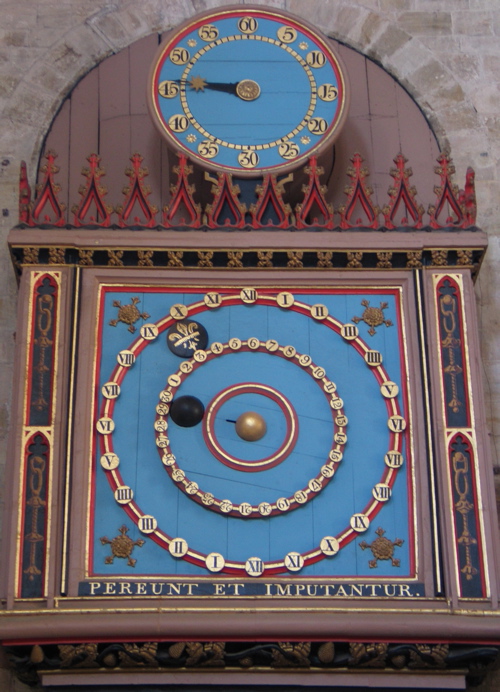
Martial dealt with the passing of time in a poem in praise of his friend, Julius Martial (5.20). Instead of having to spend time on 'frowning lawsuits and the gloomy Forum' he imagines their days devoted to living well and spending time with books. 'As it is now, neither of us lives for his own benefit; each of us can feel his best days slipping away and leaving us behind. They're gone, they've been debited from our account.' That line - bonosque soles effugere atque abire sentit, qui nobis pereunt et imputantur - inspired a fashion for carving the phrase Pereunt et imputantur onto sundials. I've included here a couple of examples. It is tempting here to digress onto the fascinating topic of sundial mottoes, but I will refer you instead to an Atlas Obscura article (here) and return to the poetry of Martial.
Sundial from Exeter Cathedral
Source: Wikimedia Commons
Even those of us who enjoy living in busy capital cities sometimes long for a more peaceful and beautiful environment. Martial wrote (6.64) admiringly of the home of his friend Julius Martial, sited well above the streets of Rome, on the Janiculan Hill, a place 'more blissful than the gardens of the Hesperides'. Here is a late 19th century public domain translation of the next few lines:
Secluded retreats are spread over the hills, and the smooth summit, with
gentle undulations, enjoys a cloudless sky, and, while a mist covers
the hollow valleys, shines conspicuous in a light all its own. The
graceful turrets of a lofty villa rise gently towards the stars. Hence
you may see the seven hills, rulers of the world, and contemplate the
whole extent of Rome, as well as the heights of Alba and Tusculum, and
every cool retreat that lies in the suburbs...
It is pleasing to think that Martial was able to enjoy a pleasant garden in his retirement. The twelfth book of Epigrams was written in Spain and one of its poems (12.31) describes a retreat apparently gifted by his patron and mistress, Marcella.
This grove, these fountains, this interwoven shade of the spreading
vine; this meandering stream of gurgling water; these meadows, and these
rosaries which will not yield to the twice-bearing Paestum; these
vegetables which bloom in the month of January, and feel not the cold;
these eels that swim domestic in the enclosed waters; this white tower
which affords an asylum for doves like itself in colour; all these are
the gift of my mistress; Marcella gave me this retreat, this little
kingdom, on my return to my native home after thirty-five years of
absence. Had Nausicaa offered me the gardens of her sire, I should have
said to Alcinous, "I prefer my own."