Monday, August 29, 2011

Rain-saturated, churning, chanting thunder

The education in Latin shared by English gentlemen was obviously an influence on their landscape gardening.  As Tim Richardson puts it in The Arcadian Friends, 'from the schoolroom to the garden, Virgil set the scene, Horace set the tone, Cicero inspired the political iconography, Pliny extolled the creature comforts, and Ovid directed the sensual fantasy narrative.' Beyond this basic pantheon it is interesting to consider any other writers who touched on landscape themes or inspired future landscape thinking.  One example, less well-known today, was Persius (Aulus Persius Flaccus) who lived in Rome and died young (his dates were 34-62).  His Sixth Satire was translated by Dryden in the 1690s.  In it, a land-owner rejoices in his life free from the concerns of business and state: 'here I enjoy my private Thoughts' and do not care if crops fail or neighbouring farmers have 'a larger Crop than mine.' However, the poem is not concerned with farming or landscape specifically, its general theme is 'an admirable common-place of Moral Philosophy; Of the true Use of Riches'.

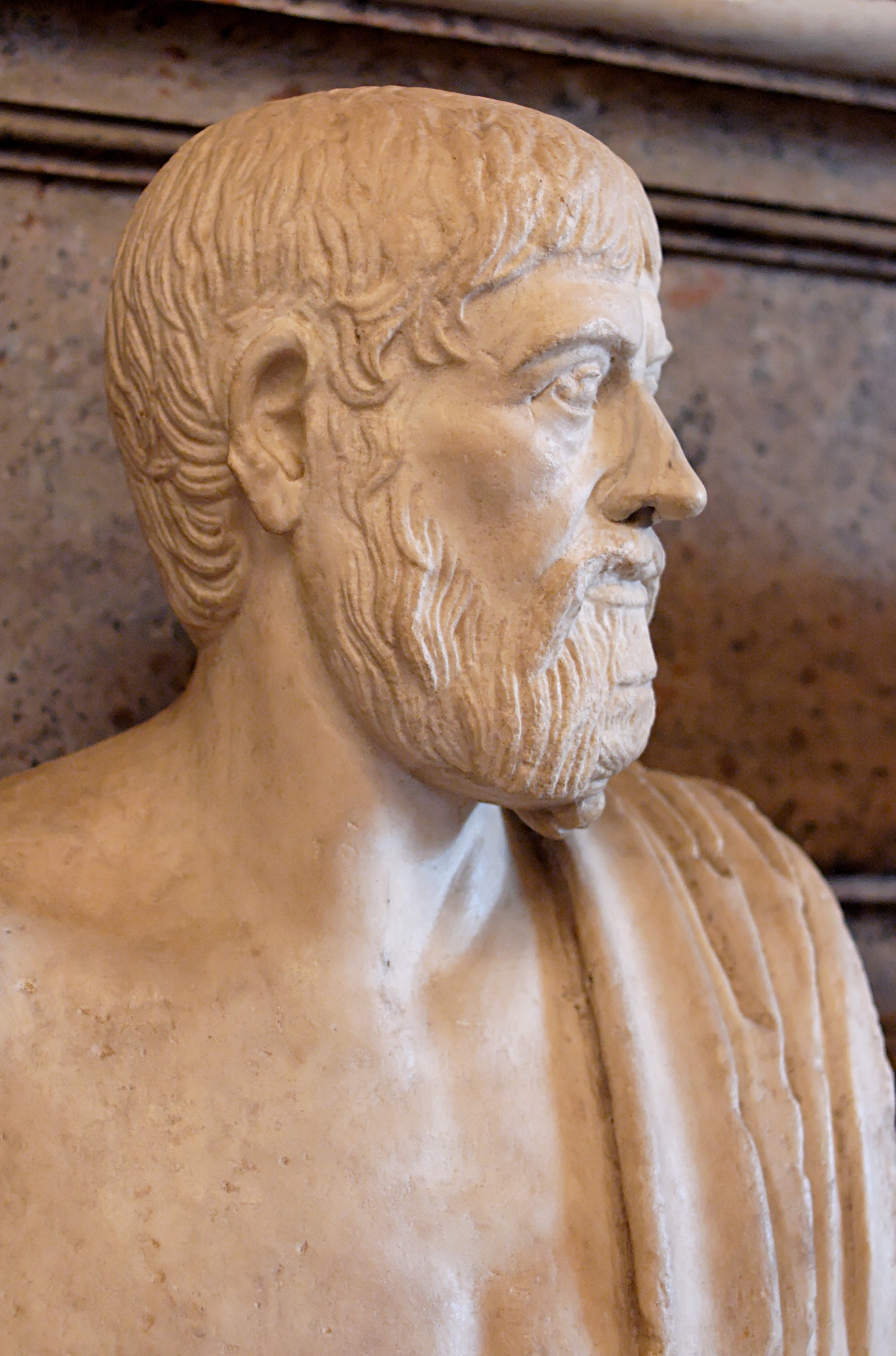
The erudite Joseph Addison had read more widely than these Latin writers and in a piece for The Spectator in 1712 showed off his knowledge of Greek: 'my compositions on gardening are altogether after the Pindarick manner, and run into the beautiful wildness of nature, without affecting the nicer elegancies of art.'  According to Richardson, 'Pindar's verse mingles an admiration of the grandeur of raw nature with an ability to complement its changefulness and variety through elegant expression.'  This makes him sound like an interesting wilderness poet, although as with Persius there is no direct writing on landscape in his Odes.  Addison was probably thinking more about the way Pindar wrote. Horace, for example, compared Pindar's writing to a wild landscape: 'a river bursts its banks and rushes down a mountain with uncontrollable momentum, rain-saturated, churning, chanting thunder – there you have Pindar's style...'

Pindar (Roman copy after a Greek original of the 5th century BCE)

Sunday, August 28, 2011

The Valley of the Shadow of Death

Jonathan Tyers, the owner of Vauxhall Pleasure Gardens, had his own private estate at Denbies in Surrey.  There he named an 8-acre woodland 'Il Penseroso' after Milton's poem - perhaps, as Tim Richardson says in his book The Arcadian Friends, Tyers 'viewed Vauxhall Gardens as its equivalent, the more jocund L'Allegro' and the melancholy woodland as 'a kind of penance for the jolly hedonism of Vauxhall.'  In this wooded part of the garden there was a hermitage called the Temple of Death which contained, in addition to a memorial to garden designer Lord Petre, a model of a white raven and a clock that chimed every minute, to remind visitors of the transience of life.  Black leather-bound copies of Edward Young's Night Thoughts and Robert Blair's The Grave were available for perusal on a table.  Beyond the hermitage was a gateway with posts made from upright coffins, 'its arch surmounted by a pair of human skulls (reputedly real - one belonging to a highwayman, the other a prostitute's)'.  This was the entrance to the Valley of the Shadow of Death.  Here the two artists Tyers had previously employed at Vauxhall were asked to decorate the interior of a temple.  Either side of an allegorical statue by Louis-François Roubiliac were paintings by Francis Hayman: The Death of a Christian (peaceful and accompanied by an angel) and The Death of an Unbeliever (about to be speared by a leering skeleton).  Richardson concludes that 'any visitors who arrived thinking they might have an amusing time with the happy-go-lucky proprietor of Vauxhall Gardens were in for a disappointment.'

William Blake, illustration intended for the 1805
publication of Blair's poem 'The Grave'

Wednesday, August 17, 2011

The Back Bay Fens

Frederick Law Olmsted, Plan for the Back Bay Fens, 1887

Within the essays and conversation that make up Landscape Theory (see my previous post), there are many interesting comments that could serve as the basis for posts here, but I'll just pick one example for now.  In the course of the seminar Anne Whiston Spirn observed that we no longer perceive some works of landscape art as having been designed and constructed.  Frederick Law Olmsted's plan for the Back Bay Fens, for instance, was 'the first attempt, so far as I know, to construct a wetland.  Olmsted proposed the Fens as a combination of utility and beauty, a restoration of polluted tidal marsh flats to serve human needs.  The power of that restoration wasn't lost on people in Boston at the time, but within a generation people forgot that it was constructed.'  So, Spirn asked, 'how did Olmsted move from the pastoral, pictorial style he had used in Central Park, to the idea of reconstructing a marsh?  Well, Martin Johnson Heade had been painting coastal marshes north of Boston.  Perhaps his paintings influenced Olmsted.  Certainly they must have contributed to public acceptance of Olmsted's revolutionary proposal.'  

Martin Johnson Heade, Marsh with a Hunter, 1874

Tuesday, August 16, 2011

Theoryscapes


Landscape Theory (2008), edited by Rachael Ziady DeLue and James Elkins, is Volume Six in the 'Art Seminar' series, which addresses current issues in writing about art through roundtable discussions and invited contributions.  It is a really rich and readable anthology of writing about landscape; the theory doesn't get too heavy despite the forbidding cover - an empty seminar table rather than a picturesque landscape.  Interestingly, one contributor to the book, Jill H. Casid, noticed the way that the general preface to the whole series, written by Elkins, is actually 'implicated in the discourse of landscape with its rehearsal of what we might call the metaphorics of theoryscaping.  Current writing on the visual arts is compared to a "trackless thicket" in order to assert that it is "not a wilderness."  Instead, visual graphs (that are given the look of geological formations [they are 3D area charts]) convert "theory in art history" into a "landscape of interpretive strategies" through which the series offers a well-blazed and navigable trail.'

I thought it might be interesting here to try to summarise briefly the seminar discussion (70 pages in the book!) and in doing so add links to some relevant earlier posts on this blog.  The event took place in June 2006 at the Burren College of Art in Ireland and brought together art history, geography and landscape architecture academics (plus an independent scholar - Rebecca Solnit).  James Elkins opened the discussion by remarking that in the years since the original publication of Denis Cosgrove's influential Social Formation and Symbolic Landscape (1984), it has become increasingly possible to move beyond the idea of landscape-as-ideology. There was general agreement to this, including from Cosgrove himself, who nonetheless recalled that his book had been a reaction against two then-prevalent ways of thinking about landscape: as the romantic, aesthetic response to nature or as more scientific, geographical analysis. Elkins introduced a third notion, landscape as a work of physical production, leading to discussion of the etymology of 'landscape' - the OED defines it in relation to art but another root is the Old English 'landscipe', which concerns the shaping of a place.  A fourth version of landscape, the representation of space and time ('landscope') provoked discussion of the priviledged position of the observer in art history and those 'timeless' landscapes without figures, like Ansel Adams' photographs of Yosemite.

The problems of separation - either by framing a view or more generally from the unbridgable distance between observer and those actively shaping the landscape - led to the first mention of phenomenology as a way of thinking more about our experience of landscape. Jessica Dubow talked about the recent turn to phenomenology in cultural geography, which has moved beyond the study of images (or images-as-texts) to a more direct encounter where the subject is inside the landscape. There was some further discussion of ideology and whether it is helpful to think of 'landscapes' in the postmodern global cultural economy (Arjun Appadurai's notions of 'finance-scapes', 'techno-scapes' and so on).  But the last words of the morning session were Denis Cosgrove's, concluding that a focus on virtual spaces 'raises issues in relation to the materiality of landscape that phenomenology emphasizes.'

The conversation recommenced with discussion of the extent to which landscape became less central to twentieth century art.  David Hays referred to a different trend in landscape architecture, where art has become less influential: ecological concerns now dominate and 'art' is seen as almost a dirty word (although there are exceptions -  Anne Whiston Spirn mentioned Martha Schwartz's Splice Garden). The discussion then turned to maps, panoramas and their military origins and from map-making to the distinction between cartography, the conceptual visualisation of the landscape, and chorography, a more sensory, descriptive approach.  But in the midst of this I was struck by Denis Cosgrove's comment that 'mapping removes us a little from the suffocating embrace of ecology when thinking about the natural world and places and our relations to them.'  Trenchant stuff - just as well no ecocritics had been invited!  The absence of any ecological discussion in this seminar was interesting to me (since this blog has always focused on forms of landscape art, rather than environmental art) but disappointing too, given the natural expectation that there would be cutting edge theoretical thinking in this area.

At this point in the seminar James Elkins intervened to change the subject and ask whether it is possible to imagine landscapes outside of their representation in art.  The subsequent discussion touched on the way tourists see Yosemite through the lens of Muybridge and Adams, partly because the park's infrastructure leads them to specific viewpoints. These photographs are social acts - people rarely take a view without posing in front of it - but such views are still based (for Elkins) on the late-Romantic Western tradition of painting and photography. This view has been put forward in Joseph Leo Koerner's writings on Friedrich and indeed one participant, Michael Newman, suggested that Friedrich's hyperreal style clearly pre-figures our contemporary digital landscapes. I was surprised there wasn't more exploration at this point of different perspectives, although participants did mention the Silent Traveller books, written in England by Chiang Yee, and the landscape architect Nicholas Brown, who 'walks somewhat in the spirit of Richard Long.'  But time was obviously running short and after a few more questions from the audience Elkins closed the seminar, inviting participants to head out for a hike 'in what we persist in pretending is the actual landscape'.
The Burren landscape

Friday, August 05, 2011

Landscape from Finnmark

This week I popped into the National Gallery to see an interesting new exhibition: 'Forests, Rocks, Torrents: Norwegian and Swiss Landscapes from the Lunde Collection'.  These two countries were in many ways very different in the nineteenth century - Switzerland prosperous, independent and rapidly industrialising, Norway poor, dominated by Denmark and Sweden and dependent on exporting its natural resources.  Swiss artists tended to stay in Switzerland whereas the Norwegians tended to travel. The importance of getting away from the familiar is illustrated in the case of Peder Balke (1804-87) who studied art in Christiania and Stockholm and began his career painting conventional landscapes.  In 1832, as Christopher Riopelle and Sarah Herring write in the catalogue, he travelled by ship to the North Cape, 'a rugged and largely inaccessible area of the country.  There he found bleak and original motifs which allowed him to define his highly individual painting style.  He continued to explore these motifs in increasingly austere images throughout his career.'  The exhibition includes Landscape from Finnmark (about 1860), an icy view across snow-covered rocks to distant grey mountains, dominated by a single tree, leaning at an angle as if battered by the elements.  The painting reproduced below is another of Balke's Finnmark scenes.

Peder Balke, From Hammerfest, 1851

On entering the exhibition, the first thing you see is a large map on the wall, reproduced from an 1873 Baedecker on Switzerland, with pins showing locations of the paintings: The Wetterhorn, Lake Lucerne, the Valley of Lauterbrunnen and so on.  There are also pin maps of Norway, based on Thomas B. Wilson's 'Handy Guide' to the country of 1888.  These reminded me of another thing I've been doing this week: working on the Some Landscapes Timeline and Map.  I am still compiling this so the screenshots below represent work in progress.  The map shows a selection of places connected to my blog posts - I shall now be able to add a little Google pin on Finnmark.  The timeline, similarly, is no more than another way of viewing the blog, but I suppose you could see it as a rather eccentric history of landscape and culture.  So far it stretches from Sargon II's park at Ninevah (715 BCE) to Hamish Fulton's Everest ascent (2009).   Some of the dates relate to paintings or publications but many involve encounters with landscape: Wang Po at the Pavilion of the Prince of T'eng, Dorothy Wordsworth in Scotland, Olivier Messiaen in Utah, and here, Peder Balke in Finnmark.


Thursday, July 28, 2011

Climbing Mount Kagu

Among the 4,500 poems which make up the Manyōshū ('Collection of Ten Thousand Leaves'), there is one attributed to the Emperor Jomei (593-641), called 'Climbing Mount Kagu'.  It describes the view from the mountain down towards the land of Yamato: 'Over the wide plain the smoke-wreaths rise and rise, Over the wide lake the gulls are on the wing...'  This translation, like others I have seen, omits the poem's descriptive epithet for Yamato, 'island of the dragonfly'.  The phrase refers to the way a dragonfly's tail touches its mouth to form a ring, like the circle of mountains round the plain of Yamato.  It is an example of a pillow-word (makura kotoba), which Geoffrey Bownas calls in his introduction to The Penguin Book of Japanese Verse (1964) 'a qualifier describing, by tradition, certain nouns or concepts.'  Among other examples connected with actual places are 'rock running' for Ômi' (from the image of water gushing over rocks) and 'spring mist' used to modify Kasuga. Pillow-words are often likened to the Homeric stock epithet, although most of those describe people (ox-eyed Hera, swift-footed Achilles, laughter-loving Aphrodite) rather than places (Mycenae rich in gold).  According to Bownas the comparison fails to do full justice to the essence and purpose of pillow-words, whose 'alliterative or assonantal ring' ensure that the reader pauses on the word being qualified.  'Further, since many of the head-words are place names, it is argued that part of the purpose of the pillow-word in its early use in primitive society was to act as a talisman for the good fortune of the place in question.' He goes on to provide his own example poem in the form of a donnish joke about Oxford's 'Heaven-preserve-it Western By-Pass'.

 Pillow shot from Tokyo Story (Ozu-San.com)

The phrase 'pillow shot' has come to be used to describe the short transitional images of landscapes, interiors and objects that are such a distinctive feature of Yasujiro Ozu's cinema.  There are many examples on the excellent Ozu-San website and a montage on Youtube (embedded below).  The first scene of my favourite Ozu film, Tokyo Story (1953), shows an old couple, the Hirayamas, packing for their trip to Tokyo.  The second takes place in the house belonging to their son, a doctor in the capital.  We do not see the journey itself - instead the scenes are intercut with three pillow shots showing smokestacks (see above), a railway crossing and the sign outside their son's office.  These are more than just establishing shots - as David Desser writes in his handbook to the film, 'careful examination of the exterior shots in the rest of the film reveals that the smokestacks and train station are, in fact spaces "connected" to Dr. Hirayama's, but nothing so indicates that at the start.'  This connection resembles the way that particular words in early Japanese poetry were given associative pillow-words.    


The ear/OAR label specialise in avant garde sounds and environmental recordings; landscape-related examples include Kiyoshi Mizutani's Scenery Of The Border, Francisco López's Trilogy of the Americas and the Phonography series.  In 2007 they released a compilation of music inspired by Ozu's pillow-shots.  A review in The Wire concluded that 'despite the range of idioms on display, from delicate electroacoustic tapestries (Bernhard Gunter) and meditative drones (Keith Berry) to bucolic field recordings (Kiyoshi Mizutani) and frequent uses of silence (almost all), each perfectly serves their respective image. Highlights include Steve Roden's beautiful pairing of chiming guitar and hushed percussive patterns; label owner Dale Lloyd's gently shifting gamelan shapes; and Taku Sugimoto's 'Tengu In Linguistics', where he drops six strident piano notes into a reductive vacuum, reflecting another of Ozu's themes, the eschewal of action in favour of the contemplation of the surrounding space.'  Yasujiro Ozu - Hitokomakura followed an earlier compilation dedicated to Andrei Tarkovsky.  The sequence was completed last year with a tribute to Michelangelo Antonioni.

Friday, July 22, 2011

Face to face with sheer mountains of water


The main reason the last three posts have featured both James Wright and German literature is that I've been reading Wright's translations of Theodor Storm in The Rider on the White Horse, originally published in 1964.  Wright's involvement in translating poetry from Spanish and German influenced a transformation in style around the time of The Branch Will Not Break (1963), in which he abandoned traditional poetic forms for a free verse that has been described as 'pastoral surrealism, built around strong images and a simple spoken rhetoric.'  The second poem in that book actually begins with these lines of Theodor Storm: 'Dark cypresses- / The world is uneasily happy: / It will all be forgotten.'   In The Rider on the White Horse it is wonderful to have nearly three hundred pages of German literature translated by such a good poet.  It reminds me that another short novel that I've mentioned here, Adalbert Stifter's Rock Crystal, was translated in 1945 by Marianne Moore (with Elizabeth Mayer).  And Elizabeth Mayer also collaborated with Louise Bogan on books by Goethe and Jünger, and translated Goethe's Italian Journey with W.H. Auden. (That journey came up earlier this week in the comments to my post on landscape seen through windows, when Mike C referred to Tischbein's sketch of Goethe leaning out of a window in Rome).

The Rider on the White Horse contains eight stories, many of which share a similar theme of thwarted love recollected in old age, and also a common setting: the North Friesland coast.  'Aquis Submersis', for example, starts with a description of heathland with its sweet clouds of erica and resinous bushes, a village with one single tall poplar and, out to the west, the 'luminous green of the marshes and, beyond them, the silver flood of the sea'.  Maps and photographs of this distinctive landscape can be found on the Theodor Storm website. 'The Rider on the White Horse' (Der Schimmelreiter) is based on the legend of a horse and rider that appears when storms threaten the dikes.  The New York Review Books site, calls it 'a story of devotion and disappointment, of pettiness and superstition, of spiritual pride and ultimate desolation, and of the beauty and indifference of the natural world.'  It tells the life of Hauke Haien, dikemaster and rider of the white horse, who oversees the construction of a new dike only to see it threatened by the sea in a great storm.  He rides out to stand 'face to face with sheer mountains of water that reared against the night sky, clambered up over one another's shoulders in the terrible twilight, and rushed, one white-crowned avalanche after another, against the shore ... The white horse pawed the ground and snorted into the storm, but the rider felt that here, at last, human strength had reached its limit.  Now it was time for night to fall, and chaos, and death.'

The influence of landscape and weather is not confined to the end of this story - there is, for example, a winter festival (Eisboseln) on the frozen marshes, where Hauke wins acclaim for his victory in a game requiring a ball to be thrown across the fields towards a distant goal.  But the main reason this is such an interesting combination of landscape and literature is that the story itself is about the reimagining and reshaping of the environment.  It is a theme that can be written in practical or mythic terms, as is evident in Theodor Storm's blend of realism and Romanticism.  There are echoes of Goethe's Faust, who towards the end of the play, is rewarded by the Emperor with permission to reclaim land from the sea, only to find his progress impeded by an old couple holding out against the development (a story we still see repeated, as in Donald Trump's construction of a golf course near Aberdeen).  Storm describes the boy Hauke bringing some clay home with him, to sit by his father 'and there, by the light of a narrow tallow candle, he would model little dikes of all sizes and shapes; and then he would set them in a pan of water and try to re-create the beating of the waves against the shore.  Or he would take out his writing slate and sketch the profile of the dike - the side facing the sea - as he felt it ought to look.'  Then, years later, as the dikemaster he is able to contemplate his grand project:  'the tide was low and the golden sunlight of September gleamed on the naked strip of mud, a hundred feet or so across, and into the deep watercourse through which, even now, the sea was pouring.  "It could be dammed up," Hauke murmured...'
Saturday, July 16, 2011

Rome must be like the clouds


A reference to one of Joseph von Eichendorff's poems in that last post reminds me that I've not previously mentioned here one of my favourite Romantic Novellen, his 'Life of a Good-for-Nothing' (1826).  Its guileless hero makes his way to Italy... 'Eventually, when I had covered quite a distance, I gathered that I was only a few miles from Rome. This filled me with joy, for when I was a child at home I had heard many wonderful stories of the splendour of this city. As I lay on the grass outside the mill on Sunday afternoons and everything around was so quiet, I used to think that Rome must be like the clouds moving above me, with wonderful mountains and ravines going down to the blue sea, and golden gates, and tall gleaming towers on which the golden-robed angels were singing. Night had fallen long since, and the moon was shining brightly when I finally came out of the wood onto a hilltop and suddenly saw the city in the distance. The sea was glimmering far off, the immeasurable heavens were twinkling and sparkling with their countless stars, and below them lay the Holy City, of which only a long strip of mist was visible, like a sleeping lion on the quiet earth, while the hills stood round like dark giants watching over it.' (trans. F.G. Nichols)

He walks on over 'a wide, lonely heath' and on to the city where 'the tall palaces and gates and the golden cupolas gleamed in the bright moonlight.'  We have entered a Rome of the northern imagination here, with the same appeal as that dream image of 'Amerika' in Kafka's novel (which I quoted from here in an earlier post). Eichendorff's hero goes 'past a few small houses and then through a magnificent gate into the renowned city of Rome. The moon shone between the palaces and down into the streets as though it were broad daylight, but the streets were all deserted except for the occasional ragged fellow lying in a marble doorway in the warm night and sleeping like the dead. The fountains were plashing in the silent squares, and the gardens along the street were rustling and filling the air with refreshing scents.'  In Rome he encounters a painter and visits his studio in the attic of an old house, where we are given one of those images of the Romantic artist at the window I described yesterday. 'The painter flung the window open, so that the fresh morning air swirled through the whole room. There was a marvellous outlook over the city and towards the mountains, with the early sun shining on the white villas and vineyards. "Here's to our cool green Germany beyond those mountains!" cried the painter, drinking from the bottle he then passed to me. I responded to him politely and in my heart I thought again and again of my beautiful distant home.'

Friday, July 15, 2011

From a Bus Window in Central Ohio, Just Before a Thunder Shower

One of the James Wright poems in The Branch Will Not Break that I didn't mention in my previous post is 'From a Bus Window in Central Ohio, Just Before a Thunder Shower'.  The view through a window provides a natural frame for a 'landscape poem', although if a fixed point of view is required that  hammock at William Duffy's farm would do just as well.  Looking out of the bus in central Ohio, James Wright saw 'cribs loaded with roughage huddle together / before the north clouds', poplars, silver maples leaves and an old farmer calling 'a hundred black-and-white Holsteins / from the clover field.'  It would be great to compile an anthology of 'window poetry' like this, and from my landscape perspective I would be tempted to group them according to what was being seen: storms, sunsets, industrial landscapes, rural scenes, or just some cropped fragment of a city or the slowly moving branches of a tree. A more interesting arrangement might reflect the nature of the frame itself: windows open and closed, windows in castles and palaces, in suburban houses, office buildings, hospital wards, school rooms, prison cells, or the windows of trains, aeroplanes, buses, still or in motion.  A third version of the anthology would order poems according to the nature of the viewer: their identity, their attitude and their mood, projected onto the landscape beyond the window.

In his classic 1955 essay, 'The Open Window and the Storm-Tossed Boat: An Essay in the Iconography of Romanticism' Lorenz Eitner describes a favourite theme in Romantic literature: 'the poet at the window surveys a distant landscape and is troubled by a desire to escape from his narrow existence into the world spread out before him'  The example he gives is Eichendorff's poem 'Longing' where the golden stars and sound of a distant post-horn make the poet's heart ache to travel out into the summer night.  'The window is like a threshold and at the same time a barrier.  Through it nature, the world, the active life beckon, but the artist remains imprisoned, not unpleasantly, in domestic snugness ... This juxtaposition of the very close and the far-away adds a peculiar tension to the sense of distance, more poignant than could be achieved in pure landscape.  "Eveything at a distance," wrote Novalis, "turns into poetry: distant mountains, distant people, distant events; all become romantic."'

Eitner's essay was an inspiration for the Met's recent exhibition Rooms with a View: The Open Window in the 19th Century.  According to the exhibition notes, 'Caspar David Friedrich's two sepia drawings of the river Elbe of 1805–6 (View from the Artist's Studio, Window on the Right and View from the Artist's Studio, Window on the Left) inaugurated the Romantic motif of the open window. Unlike the stark balance between the darkened interior and the pale landscape rendered in these views, the artists who followed Friedrich created gentler versions of the motif. Their windows open onto flat plains in Sweden, parks in German spas, or rooftops in Copenhagen. Artists' studios overlook houses in Dresden or Turin, bucolic Vienna suburbs, or Roman cityscapes saturated with light. In several sitting rooms offering urban views of Berlin, the interiors evoke stage sets to satisfy the artist's delightful mania [sic!] with perspective and reflections. ... Even a barren landscape, when framed in a window, can be transformed into an enthralling scene. Some artists recorded actual sites—Copenhagen's harbor, the river Elbe near Dresden, the Bay of Naples—while others invented, or even largely blocked, the views from their studios or painted them in the chill of moonlight.' 

Caspar David Friedrich, Woman at a Window, 1822

One of the paintings referred to by Lorenz Eitner was Friedrich's Woman at a Window, in which the artist's wife looks out at the world beyond the shutters.  This painting was in the first of the Met's the four exhibition rooms, dedicated to interiors with figures; the second room displayed images of artists' studios.  These suggest another category for an imaginary poetry anthology: domestic scenes in which the window view is just one element.  And when you think about it such interior spaces could feature in a whole companion anthology where the position of the observer is reversed, to be on the outside, looking in.  As Charles Baudelaire says in his prose poem 'Les Fenêtres', 'Ce qu'on peut voir au soleil est toujours moins intéressant que ce qui se passe derrière une vitre. Dans ce trou noir ou lumineux vit la vit, rêve la vie, souffre la vie. (What we can see out in the sunlight is always less interesting than what we can perceive taking place behind a pane of windowglass. In that pit, in that blackness or brightness, life is being lived, life is suffering, life is dreaming.... )'

Friday, July 08, 2011

At William Duffy's Farm in Pine Island, Minnesota

One poem I've never managed to persuade my wife to like is James Wright's 'Lying in a Hammock at William Duffy's Farm in Pine Island, Minnesota'. Our point of contention is not the twelve lines describing what the poet sees from that hammock: a bronze butterfly asleep on a black trunk, a field of sunlight between two pines, a chicken hawk floating over, looking for home.  It is the concluding sentence, 'I have wasted my life.'  Now I don't really feel that this is true of myself, but that doesn't mean the thought doesn't occasionally occur, particularly when I'm alone in a landscape.  It is an inversion of Rilke's memorable final sentence in 'Archaic Torso of Apollo': 'you must change your life' (Rimbaud is another possible source).  James Wright said to David Smith, 'I think that the poem is a description of a mood and this kind of poem is the kind of poem that has been written for thousands of years by the Chinese poets ... It is not surrealistic. I said, at the end of that poem, "I have wasted my life" because it was what I happened to feel at that moment and as part of the mood I had while lying in the hammock. This poem made English critics angry. I have never understood what would have so infuriated them. They could say the poem was limp or that it did not have enough intellectual content. I can see that. But I hope that it did not pretend to. It just said, I am lying here in this hammock and this and that is happening.'


This poem appeared in Wright's 1963 collection The Branch Will Not Break, named after a line in 'Two Hangovers' in which he emerges from sleep to laugh at a blue jay springing up and down, up and down, on a branch in a pine tree.  In 'A Prayer to Escape from the Market Place' Wright says he wants to 'renounce the blindness of magazines' and 'lie down under a tree'.  In 'Today I Was Happy So I Made This Poem' he finds solace in the permanence of the moon.  'Depressed by a Book of Bad Poetry, I Walk Toward an Unused Pasture and Invite the Insects to Join Me' finds him closing his eyes to listen to the sound of a cricket in the maple trees. And in the anthology favourite 'A Blessing', the sight and feel of two horses in a field just off the highway make him realise 'that if I stepped out of my body I would break / into blossom.'  However, that branch can sometimes seem fragile and Wright also describes his darker moods in poems like 'I Was Afraid of Dying', 'In the Cold House' and 'A Dream of Burial'.  The book opens with Wright thinking of Po Chü-i, the great Chinese poet 'uneasily entering the gorges of the Yang-tze', and of the tall rocks of Minneapolis building 'my own black twilight.'  Where, he asks 'is the sea, that once solved the whole loneliness of the Midwest?  Where is Minneapolis?  I can see nothing / But the great terrible oak tree darkening with winter.'

Friday, July 01, 2011

Great green reflections in the blue satin of the sea

John La Farge, Diadem Mountain at Sunset, Tahiti, c1891

There was an interesting article recently by Christopher Benfey in the New York Review about John La Farge, an American painter also known for his stained glass windows, in which historian Henry Adams detected “infinite shades and refractions of light".  In 1890 Adams and La Farge traveled in the South Pacific, first to Hawaii and then to Samoa (where they met Robert Louis Stevenson).  There 'the two friends became connoisseurs of the so-called “afterglow,” when sky and surf were irradiated by the setting sun. Under La Farge’s tutelage, Adams became “gently intoxicated on the soft violets and strong blues, the masses of purple and the broad bands of orange and green in the sunsets.” La Farge took notes on the pattern of the waves breaking across a coral reef, then made a superb watercolor based on his observations. The best description of such scenes, at once overwhelming and elusive, comes from his own account, in what the art historian John Stuart Gordon, writing in the catalog, aptly calls a “stained-glass window of words”:
There was all the charm that belongs to the near coasting of land in smooth waters: the rise and fall of the great green reflections in the blue satin of the sea inside of the reef; the sharp blue outside of the white line of reef all iridescent with the breaking of the surf; the patches of coral, white or yellow or purple, wavering below the crystal swell, so transparent as to recall the texture of uncut topaz or amethyst; the shoals of brilliant fish, blue and gold-green, as bright and flickering as tropical hummingbirds; the contrast of great shadows upon the mountain, black with an inkiness that I have never seen elsewhere; the fringes of golden or green palms upon the shores, sometimes inviting, sometimes dreary.'
The catalog referred to above was produced to accompany the exhibition John La Farge's Second Paradise: Voyages in the South Seas, 1890-1891.  Yale Art Gallery has a very good site where you can look at John La Farge's South Sea sketch books - the first one, for example, covers Samoa and includes a quick sketch of a view out toward the sea.

Saturday, June 25, 2011

A rain-swept valley and two lines of sheep

I have been watching the DVD of Gideon Koppel's acclaimed film sleep furiously (2009), a remarkably poetic documentary shot over the course of a year around the faming village of Trefeurig in Wales, where the filmaker grew up.  Koppel has said 'I wanted to make a film in which moments of intimacy and human gesture became juxtaposed with the infinite space and time of the landscape. I think about the landscape of sleep furiously as an ‘internal landscape’: it has a quality of childhood about it.' The film has the soft light and muted colours of childhood memories (rather like Tarkovsky's polaroids).  At the end of the BBC interview below Koppel explains his preference for using film because it can evoke a world, like paint.  A landscape on a big screen shot in HD video "works like a signifier - it says very strongly: 'this is a beautiful landscape', but that's all it does. The same landscape shot on film allows the audience to engage with that image through their imagination."


There may be nothing new in breaking off from scenes of people interacting to show, for a few seconds, a panoramic landscape like a gently moving painting (as in Werner Herzog), or in holding a camera steady while a car makes its way slowly across the screen and into the distance (Kiarostami), but each time Gideon Koppel does this in sleep furiously it seems fresh and original.  A practice session for the village choir is intercut with shots of an epic landscape of shadowy hills, drifting clouds and crepuscular rays on a distant sea - it sounds too obvious but the effect is genuinely moving, and the sequence concludes modestly with the choir leader's verdict: "well done... at least we have an end now."  John Banville, writing of another landscape in sleep furiously, says 'one of the most beautiful and mysteriously affecting sequences is shot from a high mountainside down into a rain-swept valley into which two lines of sheep straggle slowly from different directions to form a kind of ragged magic square. It is the inexplicable beauty of these images that one remembers long after the screen has gone dark.'

Friday, June 24, 2011

The world is blue at its edges and in its depths

'The world is blue at its edges and in its depths,' writes Rebecca Solnit in A Field Guide to Getting Lost.  Blue is 'the color of an emotion, the color of solitude and desire, the colour of there seen from here, the colour of where you are not.  And the color of where you can never go.  For the blue is not in the place those miles away at the horizon, but in the atmospheric distance between you and the mountains.'

Solnit goes on to describe the blue distances of Renaissance paintings - the hills in Solario's Crucifixion (1503), for instance, or in the right hand panel of Memling's Resurrection (c1490).  I was gazing into one such painting by Jacopo del Sellaio last Saturday at the National Gallery of Scotland when my reverie was broken by the announcement that the room was closing for an hour, due to staff shortages.  (I just found the painting online - reproduced below - but failed to note down any information on it as I was hurried out of the gallery, and there is no information on the website).  I felt like offering to sit in for the attendant so as to look undisturbed at the painting while he had his lunch, but I could see that in the National Gallery of Scotland all male staff must wear tartan trousers.

Jacopo del Sellaio, St Jerome in the Wilderness 
with Saints John the Baptist and Mary Magdalene

In Sellaio's painting the eye follows a succession of mountains set further and further into the distance where sky and sea merge.  These mountains resemble waves of rock, emanating from beyond the horizon.  They look as if they could form an infinite series - every time you reached one, another peak would be visible further on and, as Rebecca Solnit says, you could never actually reach that blue at the world's edge. 


To stare out to sea may be to overlook what is happening in the foreground, and here there is a stark reminder of this in the crucified Christ.  And yet this figure, which entirely fills St Jerome's attention, exists only in his mind's eye...  There is much to look at in Sellaio's figures of the Saints, their rocky backdrops in three contrasting types of stone, the curiously transparent stream flowing around their feet, and the stylised, perfectly shaped trees behind them.  But in the end my eye gets drawn back to that mountain range, receding into the distant blue.

Friday, June 10, 2011

To repeat the forest

Richard Long and Giuseppe Penone both came to prominence in the late sixties making art in the landscape, and their most recent work is currently being shown together at Haunch of Venison in London.  I went along last week keen to see Long's new work but equally interested in Penone, whose installations, sculptures and interventions have involved trees, leaves, rivers, earth and stones. I remember really liking his Breathing the Shadow - a room lined with fragrant laurel leaves containing a small gilt bronze lung - which we saw in 2000 in the old Tour de la Gache of the Palais Des Papes in Avignon.  This new exhibition is full of trees and starts with To repeat the forest - fragment 28, part of a series Penone has been making since 1969 where the trees hidden inside mass-produced lumber are liberated by carving away the pulp to reveal 'the way the tree rose into the sky, from which side it absorbed the southern light, whether it was born in a crowded forest, in a meadow or at the edge of a wood.'  Several works connect the skin of a tree to the touch of the artist - a wall drawing where rings propagate out from a finger print and photographs of like It Will Continue to Grow Except at This Point (1968-78) where a tree has been growing round a cast of the artist's hand.  One room is shared between Long and Penone - a stone spiral and a block of wood.  'Here Penone has chosen to show a wood work in which he has carved into the block following the rings of growth.  Long's sculpture in river stones is a spiral which echoes the expanding rings.'

The Richard Long exhibition is called 'Human Nature' and in addition to the expected text pieces, photographs and floor sculptures it includes a small room with objects that hint at the peopled landscape generally missing from his work - North African tent pegs, scrap metal from Niger and driftwood from the river Avon.  The final room includes a huge mud work called Human Nature (2011) which has a 'human' side made from clay with a Chinese blue pigment and a 'natural' side where Long has used a red clay from Vallauris in France.  Moor Moon (2009) is also a work in two parts, a 39 mile walk 'from one metaphor to another', pairing landmarks on Dartmoor with landmarks on the moon. I have listed the locations below as I think they each have their own poetry.  There is something poignant in the way an airless grey plain of basaltic lava on the moon has been named Sinus Iridium, the bay of rainbows. Here it is matched with Raybarrow Pool, described on Dartmoor Walks as a dangerous mire, 'an enclosed and isolated place'.


Visualising Richard Long striding through the landscape I couldn't help having the rather banal thought that all the walking has certainly kept him fit.  Fibonacci Walk, Somerset (2009) is a text work recording 'continuous walks on consecutive days' in 2009.  These increased in length according to the Fibonacci number sequence: 1 mile, 1 mile, 2 miles, 3 miles, 5, 8, 13, 21, 34, 55, 89.  89 miles?  So he walked 89 miles in one day?  After walking 55 miles the previous day?  Maybe it just seems extraordinary because I spend my days walking something more like a Kolakoski number sequence (1 mile, 2 miles, 2 miles, 1 mile...)  Long now has a lengthy back catalogue of walks that he can return to, re-trace and reinterpret. Two Continuous Walks Following the Same Line, England (2011) for example matches a straight walk northward across Dartmoor with another straight walk northward in 1979. Not much seems to have changed - a pair of buzzards, dead sheep, gorse, ponies... some larksong this time, foxes last time.  You could probably write a whole article on the different ways in which land artists have returned to those places they once made into artworks (for another example see the Simon English project I described last year). Giuseppe Penone too has gone back to the woods in order to photograph the trees he first came upon back in the early Arte Povera days; at Haunch of Venison, It will continue to grow except at this point - radiography (2010) shows the trace of the young artist's hand on a tree, in the form of a ghostly x-ray.

Wednesday, June 08, 2011

The Morning Glory

If I hadn't been so busy at work I might have tried to get to the Aubin & Wills Literary Salon this evening, where Travis Elborough was talking about his seaside book Wish You Were Here and Gavin Pretor-Pinney was due to discuss The Wavewatchers' Companion. Never mind - I was actually at the seaside watching the waves last week, and although I've not yet got round to either of these books, I did have Gavin Pretor-Pinney's earlier bestseller The Cloudspotter's Guide with me.  You can read various reviews and articles online that tell the story of The Cloud Appreciation Society, which Pretor-Pinney founded in 2004, and the writing and design of The Cloudspotter's Guide, rejected by 28 publishers before becoming a runaway bestseller.  The book is not a cultural history, although there are references to clouds in the work of Mantegna and Correggio, Kalidasa and Thoreau.  Keen not to be seen as too highbrow, the author describes himself wondering through the Tate's American Sublime exhibition with the catalogue upside down (his point being that the skyscapes in Bierstadt and Church are as important as the landscapes).  His sense of humour did grow on me - it is hard to resist the comparison of strato-cumulus, 'always in transition', with 'the pop singer Cher at the height of her costume-changing stage routines'.  One species of this cloud, the Morning Glory, is likened to Cher 'in the brass armour bikini and gold Viking helmet she wore on the sleeve of her 1979 album Take Me Home'.  This is a long way from Hubert Damisch and A Theory of /Cloud/, I thought, as I read this, but then Damisch was interested in the painted signifier, Pretor-Pinney in explaining and celebrating the real thing.

Altocumulus stratiformus translucidus I believe
(but feel free to correct me if I've got it wrong...)

The Cloudspotter's Guide includes a brief description of the Cloud Harp, an instrument designed by Nicolas Reeves that responds to the shape of the clouds above it (see video clip below), and in the chapter on stratus there is an account of the Blur Building, designed by Liz Diller and Ric Scofidio for the 2002 Swiss Expo, which took the form of a cloud floating on the surface of Lake Neuchâtel.  The design for this consisted of a metal skeleton covered with 31,400 high-pressure water jets controlled by computer which took account of temperature, humidity and prevailing winds.  'By responding dynamically to the constant changing atmospheric conditions, the system ensured there was always enough fog to envelop the structure, but not so much as to cause a nuisance downwind.'  Artificial clouds and the manipulation of weather for military ends are the depressing subject of the book's penultimate chapter.  A 1996 report for the US government, Weather as a Force Multiplier: Owning the Weather in 2025, describes a future in which an enemy can be hit with fog, rain, storms and lightning, and where clouds are controlled through nanotechnology and are able to communicate with each other.  After this it is a relief to turn to the final chapter, where Gavin Pretor-Pinney travels to a small town near the Gulf of Carpentaria in search of the Morning Glory (the cloud he likened to Cher in her brass bikini).  There he meets the glider pilots who surf this magnificent roll of cloud as it heads inland, and is taken up himself to see the morning sun cascading 'down the cloud's face, casting long shadows along the ripples of its surface.  The undulations gently rose up with the progress of the wave, before disappearing over the crest.'


Sunday, May 29, 2011

Animated Landscapes

After the aesthetic pleasures of Barcelona's victory against Manchester United last night it seemed fitting to head down this morning to Tate Modern for the Joan Miró exhibition.  The first room is particularly interesting from a landscape perspective, was the artist's signature style can be seen developing through a series of increasingly abstract and surreal views of the Catalan countryside.  Before moving to Paris Miró had painted in a cubist-naive style scenes around his family home in the Tarragona mountains.  Vegetable Garden and Donkey (1918), for example, has a strange sky that looks like a set of painted walls and a vegetable patch patterned like a carpet.  After arriving in Paris in 1920, he spent nine months painting The Farm from memory, a work later bought by Ernest Hemingway, who said ‘it has in it all that you feel about Spain when you are there and all that you feel when you are away and cannot go there. No one else has been able to paint these two very opposing things.’  According to the Tate blog, Miró 'boxed with Hemingway as well as having him to stay at Mont-roig, the place outside Tarragona depicted in astonishing detail in The Farm. Miró told a journalist in 1928, ‘The Farm was a résumé of my entire life in the country.’'  

By 1923-4 Miró's forms were becoming freely floating signs and in The Catalan Landscape (The Hunter) the land is reduced to an undulating orange plane.  Sea and sky are delineated by no more than a thin line ruled over the yellow background.  Wave forms and gull shapes are among the most recognisable symbols; elsewhere, according to the artist, there are such details as "the Toulouse-Rabat airplane on the left; it used to fly past our house once a week. In the painting I showed it by a propellor, a ladder and the French and Catalan flags. You can see the Paris-Barcelona axis again, and the ladder, which fascinated me. A sea and one boat in the distance, and in the very foreground, a sardine with tail and whiskers gobbling up a fly. A broiler waiting for the rabbit, flames and a pimento on the right..."

After a couple more years of accelerated artistic development Miró painted a sequence of 'Animated Landscapes'.  In Dog Barking at the Moon (1926), the ladder that had been propped against the wall of The Farm and drifting in the sky in The Catalan Landscape (The Hunter), can now be seen dominating the left had side of the picture, climbing up into the night sky.  The Tate's exhibition is actually called 'The Ladder of Escape', after a 1940 painting, one of his celebrated Constellations, which were begun during the blackouts in Normandy and completed after his flight from occupied France to Spain.  By this stage Miró was painting a purely inner landscape. The Constellations are probably the exhibition's highlight, although I was pleased to see again the 1968 triptych Painting on White Background for the Cell of a Recluse (usually hung in Barcelona at the Joan Miró Foundation).  As Adrian Searle says in his review, 'there's nothing much to the three white canvases. No colour, no forms. Each enormous canvas is painted with a single black line over an unevenly primed white ground. You can tell where the slender brush has run out of paint, is recharged, then continues on its way with the same unknowable purpose, like the passage of an ant or a bird in flight, or the journey the eye makes along a horizon.'

Saturday, May 21, 2011

The Mountain That Had to Be Painted

Contemporary artist Iwan Gwyn Parry tackling Arenig in
'The Mountain That Had to Be Painted'

This week I've been unable to do more than collapse in front of the TV after long days at work, so I have appreciated the fact that BBC4 has been showing a Landscape Season.  There has been a lot of outdoor stuff - lakes (Wainwright), mountains (Munro), the golden age of canals and even a documentary on the A303 ('Highway to the Sun').  They repeated Alice Roberts 'titillating middle-aged men' (according to The Guardian) with her wild swimming, and in 'The Great Outdoors' they took 'a nostalgic look at life for campers, twitchers, ramblers and metal detectors'.  I missed the programme on R. S. Thomas (on too late...) but caught another one set in the Welsh landscape, 'The Mountain That Had to Be Painted'.  This was an account of the time Augustus John and James Dickson Innes spent in the Arenig Valley painting 'a body of work to rival the visionary landscapes of Matisse.'  Whilst it did little to dispel the impression that Auguston John's life is more interesting than his art, the programme provided a valuable introduction to the work of Innes, who died (like some old country singer) at the age of 27 from a mixture of TB and wreckless living.  For more on Innes and the Arenig school, see a recent post on the Footless Crow mountain writing blog. 

Earlier in the week there was an hour-and-a-half long history of English landscape painting, 'This Green and Pleasant Land.'  The programme discussed a sequence of paintings from the time of Charles I (Rubens and Van Dyck) down to World War Two (Paul Nash and the patriotic posters of Frank Newbould), with a final leap forward to David Hockney's recent iPhone sketches. As it started we wondered who the extraordinarily plummy-voiced narrator was - Brian Sewell my wife thought, but it turned out to be Simon Callow.  Fearing a rather conservative survey we nevertheless ended up enjoying the eclectic mixture of people they had invited to talk about each painting - from the 'editor at large' of Country Life, who suggested that Gainsborough's Mr and Mrs Andrews could easily be imagined in his magazine today, dressed in Barbour jackets and Hunter wellies, to a foundry manager who said he had a reproduction of Coalbrookdale by Night hanging up at home in the hallway.  It was worth enduring Peter York explaining his fascination for Atkinson Grimshaw in order to see John Virtue discussing Constable and sketching the sea. Will Self was on amusing form recalling the horror of growing up, as the son of a theoretician of garden suburbs, while actually living in a garden suburb ("that'll do things to a child!").  The programme generally covered the key works you would expect, although I was surprised they missed out Samuel Palmer and spent so much time on Stubbs (who I see I've never mentioned here).  All in all, well worth watching if you have access to the BBC iPlayer - available for 6 more days as I write this...
 
 Will Self discusses William Ratcliffe's

Sunday, May 15, 2011

Tortoise above the Venetian lagoon

A year ago in the LRB Marina Warner wrote a fascinating review of Erik Fischer's monumental four-volume catalogue devoted to the work of Melchior Lorck. Born in Danish-controlled Schleswig-Holstein in 1526 or 1527, he trained as a goldsmith but produced maps, medals, heraldry, portraits and landscape drawings.  Lorck travelled to Italy and then, in 1555, following in the footsteps of Gentile Bellini, to the Turkey of Suleiman the Magnificent in the company of humanist scholar Ogier Ghiselin de Busbecq.  Before leaving he produced the drawing below in which 'a large tortoise is placed on the sheet as if paddling through the air above the Venetian lagoon. Lorck added the sly inscription, ‘Made in Venice from Life’, as if daring the viewer to see the colossal creature flying overhead, a reptilian version of the Rukh, the huge raptor from The Arabian Nights who lifts Sinbad, but is also capable of carrying off an elephant.'

 Melchior Lorck, Tortoise above the Venetian Lagoon, 1555

Arriving in Constantinople, Lorck sketched the view from his window (rather like the wall in Naples painted by Thomas Jones). Marina Warner quotes Busbecq as saying that the view was blocked by bars and parapets, 'in deference to the complaints of the neighbours, who declared that they had no privacy from the gaze of the Christians. Lorck was probably trying to overcome these constraints when he looked out of the window, or perhaps his curiosity was aroused by them, because, in spite of all the attempts to prevent the gaze of Christians, he captures a tiny vignette of a couple making love on a terrace screened by rushes.'  This drawing wasn't in the LRB article but is readily available on Wikimedia Commons - see below.  Warner says that 'if I hadn’t gone to Copenhagen to look at Lorck’s work, I wouldn’t have noticed these figures, squirming like a sea anemone' (a simile that reminded me of Sebald's couple resembling 'some great mollusc washed ashore' in The Rings of Saturn).  'Lorck,' she says, 'doesn’t draw attention to the lovers’ presence in his roofscape, he doesn’t show or refer to erotic couplings from the Renaissance repertory. He simply sets down what he saw. His sepia ink records one tile as being as interesting as the next, in the manner of a surveyor measuring and recording. This mode was very radical for its time, and it would be hard to date the work accurately without further context. Apart from Rembrandt’s tender intimacies – and occasional frank scatology – I can’t think of another artist who makes so little fuss about looking at sex.' 

Melchior Lorck, View over the rooftops of Constantinople, 1555
Source: Wikimedia Commons

Lorck stayed in Constantinople until 1559 and in that year drew a vast panorama of the city from the heights of the fortifications in Galata, overlooking the Golden Horn. 'In the foreground Lorck shows himself at work; the scroll and a chalice for his ink and paint – there are washes of green and pink on the drawing – are being held for him by a seated Ottoman grandee who is wearing the huge rolled turban that marked a mufti or emir, both important definers and upholders of the law. ... The visiting artist is able to record the city, its layout, its dwellings, its fortifications, its trade and shipping, but only because he has been given permission, and that permission was granted because the Ottoman Empire has nothing to fear from being revealed to foreigners, so confident are its citizens, the official proclaims, in what they have achieved and what they are. So The Prospect is triple-faced: an act of intelligence-gathering by a visitor from a hostile power, a reverent homage to a munificent and enthralling country, and a message to the neighbouring European empire about what it has to reckon with.'  

Friday, May 13, 2011

Beyond Twelve Nautical Miles


Two photographs in magazines I’ve been reading this month caught my eye.  The first, from Tate etc. (Summer 2011) is Magritte’s Les Idées Claires (1955), an image chosen by Jeff Koons (who likens the boulder floating over the sea to one of his basketballs in water).  The second, from The Wire (May 2011) is Herbert Distel’s Projekt Canaris (1970), showing a three metre long polyester egg which the artist launched from the coast of West Africa.  A similar piece is referred to in David Clarke’s recent book Water and Art – in Beyond Twelve Nautical Miles (2000) Zhan Wang set one of his stainless steel rocks adrift at sea near Lingshan Island.   And I have written here before about David Nash’s Wooden Boulder, which began as a sculpture in the landscape but after describing the course of a river ended up as another of these art boulders, set free on the sea.  As far as I know the current location of Wooden Boulder remains a mystery.  Distel’s egg  was driven by trade winds across the Atlantic and reached Trinidad seven months later.

I wonder why there hasn’t been more ‘sea art’, floating equivalents to the famous land art projects of the American West?  Tacita Dean may have had trouble ‘Trying to Find Spiral Jetty (1997) but tracking down a sculpture in an ocean could have been even more interesting.  Herbert Distel sought help from the Cuban authorities in locating his egg after it sailed beyond the Canary Islands and was thought to be heading into the Caribbean.  It was eventually spotted by the captain of a Dutch ship who sent a telegram: ‘Egg seen on 6 December 1970 gmt 17.50, about 100 km east off the island of Trinidad.’ Of course I’m not really advocating that we litter the sea with permanent floating art works.  Instead sea artists might take inspiration from Buster Simpson, who has an ongoing project to drop disks of limestone into the Hudson River: rocks that will gradually dissolve and counteract the effects of acid rain.

Monday, May 09, 2011

The Englishman's Home

Garden on the roof of Queen Elizabeth Hall

To the South Bank Centre yesterday where the sixtieth anniversary of The Festival of Britain is commemorated in themed areas 'filled with pop-up structures, artworks, films and exhibitions. Each of these ‘lands’ is themed according to one of the most significant themes in 1951: Land, Power & Production, Seaside and People of Britain.'  These additions may not do much for the architecture of the site but they are clearly going to be popular with visitors and add to the vibrancy you always sense there in summer.  We had a drink in the garden installed on the roof of the Queen Elizabeth Hall which features 'a lush lawn sprinkled with daisies and fruit trees that conjure up a country orchard. With over 90 varieties, the wildflower area is a celebration of the diversity of British flora, attracting insects and butterflies while providing nectar for bees from the hives on Royal Festival Hall’s roof. The garden has a patchwork of vegetable plots – a roof, after all, can be both productive and attractive. And a rustic pergola, clothed with sweetscented climbers, crowns a bridge to the Hayward Gallery punctuated with drought-resistant plants.'

John Piper's mural for the Festival of Britain, 
The Englishman's Home, 1951

Inside the QEH you can see the mural John Piper created for the Festival, comprising 42 separate panels with English buildings that he particularly loved. The Englishman's Home was later installed on the wall of Harlow Technical College's main assembly room, where it remained until the college re-located in 1992.  According to Frances Spurling's recent book on him, Piper was assisted in painting the mural by Joy Mills, who Myfanwy later described as "one of John's girls" and who was 'aware that John found her very attractive, and that Myfanwy knew this.'  Also around the QEH there are other 'Land' installations - a giant Urban Fox, Ben Kelly’s walled Enclosure, and a coal chamber, Black Pig Lodge, by Heather and Ivan Morison (which was roped off for repairs).  Apparently you can also hear 'a collage of sounds taken from across Britain’s landscape through the seasons', which 'reverberates across the incongruous setting of Southbank Centre’s concrete terraces and walkways.  Using an array of speakers and audio tracks, Marcus Coates and Geoff Sample have recreated the acoustic atmospheres of rural Britain.'  I couldn't actually hear anything but possibly didn't locate the correct place to stand - the installations are around until September so no doubt I'll be back at some point.