Thursday, August 27, 2009

View on the Oise

The National Gallery's ‘Corot to Monet’ exhibition charts 'the development of open-air landscape painting up to the first Impressionist exhibition in 1874.'  It is an excuse to display the superb collection of oil sketches they hold from the Gere Collection (which I first saw there ten years ago in the exhibition 'A Brush With Nature').  They have also taken the opportunity to display some new research on Corot paintings; the NG website includes a lengthy Corot bibliography.  In addition to the familiar names in landscape painting they highlight less well known artists like Georges Michel and Paul Huet.  The rooms are full of wonderful paintings of course, but I have some sympathy with the view that a bit more could have been done to give the exhibition focus with a few loans from elsewhere.

 
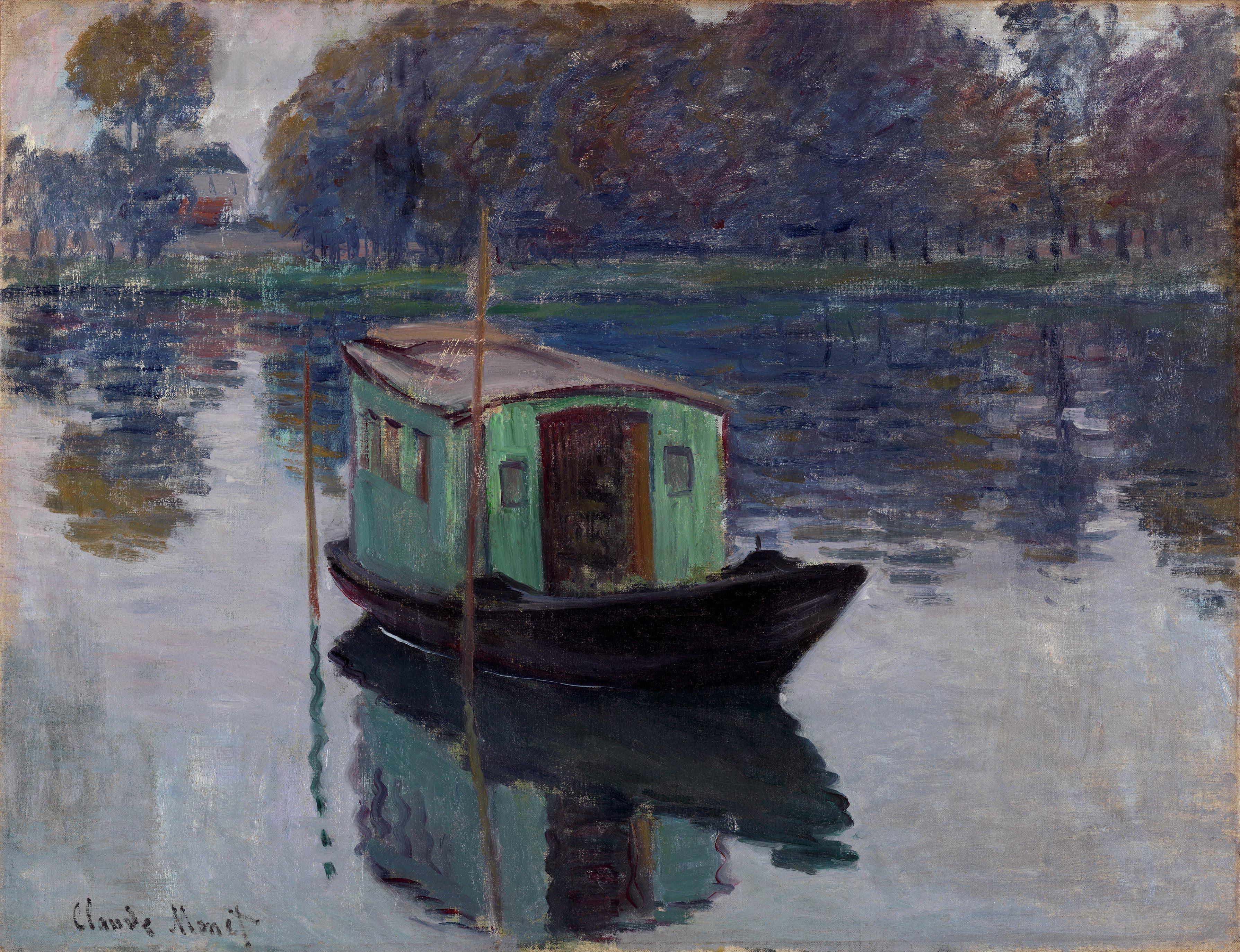
Claude Monet, The Studio-Boat, 1874

'Corot to Monet' includes two artists who worked from studio boats: Monet himself, who obtained one in 1872, and Daubigny, whose boat Le Botin had given Monet the idea.  Daubigny's View on the Oise (1873), showing the river with no foreshore, was probably painted from his floating studio (the successor to Le Botin - Daubigny had two boats).  A year later, in 1874, Manet famously painted Monet in his studio boat.  It would be nice to imagine other landscape painters in floating studios, but the idea seems very much of its time.  Artists before and since have sought inspiration on boats, but the notion of painting directly on the water was a rather poetic manifestation of nineteenth century naturalism.  Nowadays the boat itself would be very much part of the art work (indeed, we the public would probably be invited aboard).  Nevertheless, even in the 1870s the fact that a work like View on the Oise was painted on the Oise by M. Daubigny would have been something to distinguish it from the other plein air landscapes being produced at the time.

Saturday, August 22, 2009

Killeberg

Tate Modern's decision to devote a big exhibition to Per Kirkeby has been questioned but I was pleased to see a good spread of his yesterday - there are several reasons why he's an interesting artist for this blog:
  • Kirkeby's paintings may be abstract and neoexpressionist but they refer to natural forms and real landscapes 
  • Like other recent artists (Robert Smithson most obviously), he is fascinated by geology, but in Kirkeby's case this is based on his early training as a geologist
  • He continues to seek inspiration in nature, particular Greenland - the Tate show includes watercolour sketches made there
  • He engages with art history and has produced numerous books and short critical studies on painters like Munch and Gauguin - Tate Modern has a beautiful display of these
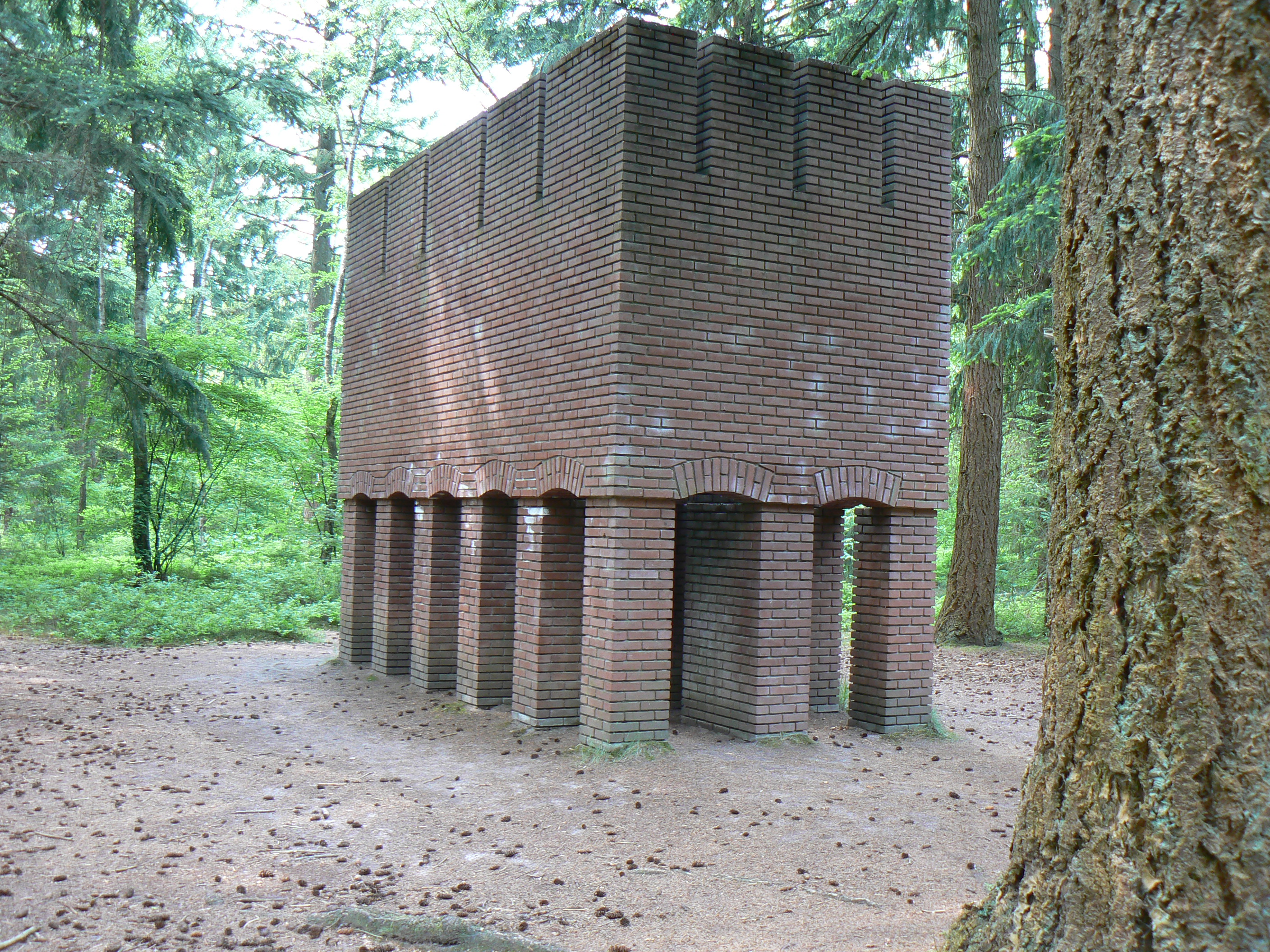
  • His brick sculptures have been placed in landscapes across Europe - there are no photographs of these in the exhibition, but see below for some examples 
Adrian Searle's review of the exhibition talks about the way landscape influences Kirkeby's painting: 'the colours are blackened army greens, earthy browns and ochres, greys from skies that don't move for days; there are snatches of white, dead blues, reds. The landscape is both there and not there. When the painter turns to the canvas, the weather outside disappears; but like history it insists on being felt anyway, like rain at the window or wind in the chimney. In the Danish painter's work there are rocks and sodden patches, waterfalls, huts, wood-grain, all sorts of geological fissures, strata and lumps.'

And here's Robert Storr discussing this element of Kirkeby's art: 'If northern light is to be taken as the hallmark of Scandinavian art, then Kirkeby is among the handful of Scandinavian artists who, although he himself rarely paints landscape as such, have captured that light in all hours of the day (such as those sudden changes in weather that can turn a radiant sky into a dense wall of clouds and back again). Presently, there seems to be little enthusiasm among people with advanced taste or ideas for such naturalism, even when translated into abstract terms as Kirkeby does. This, and the fact that he didn’t use painting to undertake a re-examination of history’s horrors as Anselm Kiefer, Jörg Immendorff, Richter and his German contemporaries did – being Danish spared him the daylight nightmares they suffered – leaves him odd man out of the group of painters that claimed the stage at the beginning the 1980s. Perhaps a “greening” of art will change things and put him back in the mix thematically. In any event, he holds his own simply as a painter, and ultimately it is the freshness of his work in that medium upon which his reputation will primarily – and securely – rest.'

Kirkeby's practice is obviously contemporary in many respects but it sometimes reminded me of the abstract, expressionistic landscape art painted in America and St Ives in the fifties: works inspired by nature and the spirit of place, sometimes titled with a location (e.g. Killeberg, 1983), but providing no means to visualise specific landscapes.  There are hints of forms in the swirls and patches of colour making up works like Twilight (Skumring) (1983-4) but they are ambiguous and, as with Howard Hodgkin, you feel that these are not paintings that the viewer should try to decipher.  Still, titles matter and I prefer Killeberg and Twilight to Kirkeby's paintings in a similar style with grand historical titles like The Flight Into Egypt.  

It seems quite possible that Kirkeby's brick sculptures will have a longer life than his paintings.  They seem well-suited to become ruins, although I think their uncanny quality derives now from the pristine perfection of their purposeless construction.  I've reproduced a few below but you can easily find others online.


Per Kirkeby, Backsteinskulptur, sculpture park KMM
Source: Wikimedia commons


Per Kirkeby, Backsteinskulptur, Gießen
Source: Wikimedia Commons


Per Kirkeby, Backsteinskulptur, Groningen

Wednesday, August 19, 2009

Garden and Cosmos

The British Museum are currently showing Garden and Cosmos: The Royal Paintings of Jodhpur, an exhibition previously at the Smithsonian.  The paintings have been loaned by the Mehrangarh Museum Trust and I should think images are copyright, but you can see some online here. The exhibition begins with a striking painting of Markandaya's ashram and the Ocean of Milk, its two halves prefiguring the predominant themes of later rooms - one shows activity in a lush landscape and the other a peaceful floating figure in a semi-abstract vision of the sea.  This makes it sound a bit like the Western equivalent of splicing together a Douanier Rousseau jungle and a Whistler seascape, which would look horrible... Laura Cumming has written a good description which will give you the idea:

'On the left, two distraught pilgrims have arrived at an ashram in a sylvan landscape of sage, peach, sherbet and every shade of green where the trees quiver with strange fruit and long-haired ascetics dream in leafy bowers - the dream of their leader, cross-legged in the middle consoling the pilgrims, being so vast it takes up the whole of the panel on the right.  And what a vision it is: the universe before consciousness and matter, the infinite nothingness before time. This is not portrayed as a void, or even the obliterating darkness William Blake imagined. The anonymous Indian master, also working in the late 18th century, has painted instead an expanse of deep indigo blue roiled by electric silver whorls: not quite water, not quite air, but some quasi-element between the two. The effect on the eye is stimulating yet faintly hypnotic - you might even call it cosmic.'

Unsurprisingly there are no independent landscapes or garden views in the exhibition - nature is a backdrop to scenes of court life and mythology.  But I think the curators rightly stress the importance of flowers, trees and running water in these scenes painted for the rulers of an arid land - Jodhpur is on the edge of the Thar desert.  Here is a description from the exhibition wall texts that I noted down, describing a series of paintings of sacred sites from 1827: 'Lush groves with starburst leaves, silver rivers and coloured peaks pervade these monumental paintings.  Jodhpur artists emphasised the otherworldly intensity of these sacred landscapes through colour, surface seen [do they mean sheen?] and the hypnotic repetition of motifs.'  Outside the British Museum there is small 'Indian landscape', which provided little respite today from the fierce city sun.  Relief from the heat came inside, where we were able to enjoy the paintings of Bakhat Singh (1725-1751) in his fort-palace at Nagaur (its lush gardens surrounded by flowering forest), bathing with beautiful women or savouring a moonlit evening.

Monday, August 17, 2009

Landscapes of melancholy emptiness


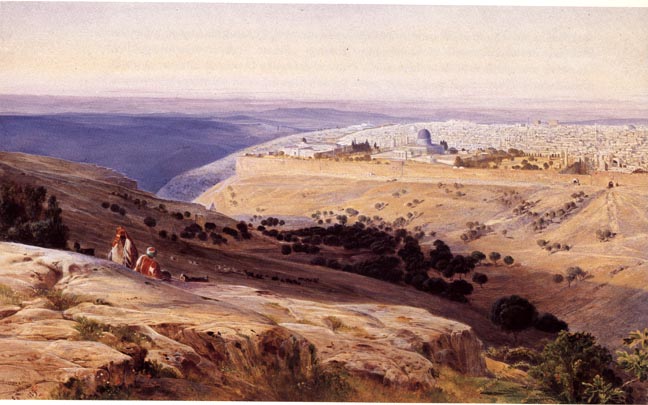
Edward Lear, Jerusalem from the Mount of Olives, Sunrise, 1859

I have mentioned Edward Lear briefly before - specifically the habit he developed of annotating his sketches.  In reading Robert Harbison recently I came upon an excellent description of Lear's landscape paintings with their 'droll notations'.  Lear's life was 

'spent mostly abroad simply because the English climate disagreed with him and he could find nothing to do at home.  So he became the sketcher and painter of exotic views, taking himself unhappily over big stretches of southern Europe and the middle East.  Much of his interest lies in his misplacement, a man who would be the truest homebody but for some flaw, who now converts preposterous places to clever mechanical tracery.  To someone familiar with his books of nonsense the landscapes are disappointingly uneccentric.  For an artist to confine himself to forms other than human is usually significant of something, and Lear provokes the suspicion that he is in these places because there are few Englishmen to meet or paint.  His earlier zoological and ornithological work is revealing because he invests every subject with personality, but the later, more refined landscapes leave out, as do all accounts of his life, the essential facts.  The most individual things about them are the droll notations in a springy script, which are painted out by the colors they describe; Lear erases the glimpse of himself he gives.  And the compositions are of such slender substance, the solidities of the picture often vacating to the back center, evading near-sighted eyes, echoing the flight from the self.  These landscapes of melancholy emptiness, faraway places seen from far away, are only a distinctive case of a Victorian genre - romantic topographical sketches of Near Eastern scenes.'

Harbison says here that 'for an artist to confine himself to forms other than human is usually significant of something.'  His suspicion that Lear was running away from people echoes a concern sometimes expressed that landscape art is an escape from the body - see the earlier post I did on this in connection with D. H. Lawrence. The paragraph on Lear forms part of his discussion of 'Dreaming Rooms: Sanctums', those spaces of safety in which the mind is free to travel.  Exotic topographical landscapes like Lear's 'exemplify a special nineteenth-century indecision between the literal and the imaginary, functioning like an invented imagery, but located on a particular page of the atlas.'

These observations form part of Harbison's Eccentric Spaces (1977), a consciously eccentric book that begins in the garden, moves inside to the sanctum (see above), then out into the world of machines and cities before spending a good deal of space discussing literature - topographical and architectural fictions - and concluding with the increasingly abstract spaces of maps, museums and catalogues. The book's preface describes the difficulty Harbison had in publishing this interdisciplinary, digressive book.  You can see why editors might have worried about sentences like this: 'A map seems the type of the conceptual object, yet the interesting thing is the grotesquely token foot it keeps in the world of the physical, having the unreality without the far-fetched appropriateness of the edibles in Communion, being a picture to the degree that that sacrament is a meal.'  But the book has several illuminating passages for those interested in landscape: much of the gardens chapter of course, descriptions of Ruskin in Venice, an argument for the important role of landscape in Mrs Radcliffe's Mysteries of Udolpho, and an appreciation of the detailed, almost cartographic paintings of Breugel in which significant and insignificant scenes are balanced and a spatial order replaces the moral.

Thursday, August 13, 2009

The Hebrides Overture


J. M. W. Turner, Staffa, Fingal's Cave, 1832 

Last night I watched the recent Charles Hazlewood documentary for the BBC on Felix Mendelssohn which included some discussion of the Hebrides Overture (completed in 1830).  There is an interview with biographer R. Larry Todd on the BBC's Mendelssohn site in which the composer's creation of the Hebrides Overture is discussed:

'From what I can tell, he was essentially a synaesthete, meaning that for him visual and musical imagery are interconnected. So when he goes to the Hebrides and he’s in Oban looking out at the coastline of Mull, it’s there he gets the idea for the opening of the Hebrides Overture and he writes a famous letter that sketches everything out in piano score. The fact that he puts it in a particular location means it’s clear that already in that composition there’s something about the particular combinations of colour that evolve and that what’s triggering it is the visual impression of looking out at the Isle of Mull. Well before he even got to Fingal’s Cave, he’s having the ideas for the Overture and it’s a visual impression that’s sparking the musical response. These things go hand in hand and particularly are tied in with the art of orchestration. That’s the romantic side of Mendelssohn.'

Sketch of a scene by Felix Mendelssohn 
found in his letter of August 1, 1829 to his sister Fanny

As you can see on the Birth of British Music site, Charles Hazlewood donned his woolly hat and headed north to Staffa (don't get me wrong - I like the hat - it could have been much worse).  The wind, waves and echoes of Fingal's Cave threatened to drown out Hazlewood as he stood there explaining the genesis of Mendelssohn's overture.  The programme included a clip of Andrew Motion comparing Mendelssohn to John Keats, who also visited Staffa in 1818 (Mendelssohn went in 1829).   Keats jotted down a poem, 'Staffa', in a letter to his brother Tom (rather dismissing it, saying "I am sorry I am so indolent as to write such stuff as this"). Here is part of the poem in which a spirit, Lycidas, describes the overwhelming power of the natural music to be heard at Fingal's Cave:

This was architectur'd thus
By the great Oceanus! -
Here his mighty waters play
Hollow organs all the day;
Here by turns his dolphins all,
Finny palmers great and small,
Come to pay devotion due -
Each a mouth of pearls must strew.
Many a mortal of these days,
Dares to pass our sacred ways,
Dares to touch audaciously
This Cathedral of the Sea!
I have been the pontiff-priest
Where the waters never rest,
Where a fledgy sea-bird choir
Soars for ever; holy fire
I have hid from mortal man;
Proteus is my Sacristan.

Monday, August 10, 2009

The Devil's Arse

Undoubtedly one of the best books I've ever read on landscape is Marjorie Hope Nicolson's Mountain Gloom and Mountain Glory (1959).  Here is a brief extract in which she cites Thomas Hobbes as an example of the tendency to denigrate mountain scenery, writing at a time when mountains were still viewed with distaste or fear.

'In 1636 the still unknown tutor of the youthful William Cavendish, later second Earl of Devonshire, set himself the task of celebrating the district in which his patron lived, and Thomas Hobbes - who considered himself at this time a man of letters rather than a philosopher - produced a poem, De Mirabilibus Pecci Carmen.  Hobbes was quite at home at Chatsworth.  He had also traveled abroad with his pupil.  He had experienced dangers of travel compared with which the Derbyshire Highlands were only child's play.  Certainly he could not really have felt the fear and distaste he expressed in his poem, but was obviously describing the scenery about Chatsworth as Latin tradition dictated.

Although the De Mirabilibus Pecci Carmen may offer some material to a reader interested in manifestations of semiscientific curiosity, the student of literature is likely to remember it rather because Hobbes, when he attempted to be a poet, left behind him one of the worst examples of "metaphysical" grotesquerie:

          Behind a ruin'd mountain does appear
          Swelling into two parts, which turgent are
          As when we bend our bodies to the ground,
          The buttocks amply sticking out are found.

Such was the mountain poetry of the philosopher who was to give new direction to aesthetics and literary criticism.'

Here is the title page from the 1678 edition, which included Hobbes' Latin and an English translation by 'a person of quality'.  Note the reference to 'the Devil's Arse'.

 
Source: British Library

Saturday, August 08, 2009

Vertigini

This is the last of my short series of posts about contemporary landscape drawing, based on Phaidon's Vitamin D survey.  Serse, in addition to being one of my wife's favourite operas, is the name of an Italian artist whose sea, forest and mountainscapes are all drawn by a process of erasure.  He works from photographs, covering a sheet of paper with base of graphite and then working on it with an eraser to reproduce the image.  Writing ten years ago in the New York Times, Grace Glueck concluded that 'at this point the artist's technical virtuosity is more impressive than his esthetic achievement.'  But in Vitamin D, Barbara MacAdam finds much to admire: 'the drawings end up having more depth and intensity than actual photographs.  The artist uses graphite not only to depict or imitate nature, but also to imitate a photograph.  In so doing he achieves a strange conceptual distance from his original source, which is often a color photo.' Whether or not copying photographs in this way can create a 'strange conceptual distance', it's true that some of his views have a strange feel to them, like Vertigini (Dizziness) (1999) which shows a mountain range with two separate vanishing points.

In her description of Serse's drawings, Barbara MacAdam draws links with quite a range of other artists - Hiroshi Sugimoto, Robert Longo, Robert Smithson, Jean Dubuffet and Edvard Munch. One could add to this list Caspar David Friedrich and Giorgio Morandi, mentioned in another short piece on Serse to accompany an exhibition at the Tim Van Laere gallery in Antwerp.  But Serse was a new name for me on reading Vitamin D and I can't see much about him online (at least not in English).  And if you google for images by Serse (or Serse Roma, to use his full name) you're actually most likely to hit upon these Freddo glasses which he has designed for Illy, with undulating waves of silver inspired by the sea at Trieste.

Thursday, August 06, 2009

The Mill on the Floss

In The Mill on the Floss (1860), George Eliot describes the landscape of childhood.  'Life did change for Tom and Maggie; and yet they were not wrong in believing that the thoughts and loves of these first years would always make part of their lives. We could never have loved the earth so well if we had had no childhood in it, - if it were not the earth where the same flowers come up again every spring that we used to gather with our tiny fingers as we sat lisping to ourselves on the grass - the same hips and haws on the autumn hedgerows - the same redbreasts that we used to call 'God's birds' because they did no harm to the precious crops. What novelty is worth that sweet monotony where everything is known and loved because it is known?'

'The wood I walk in on this mild May day, with the young yellow-brown foliage of the oaks between me and the blue sky, the white star-flowers and the blue-eyed speedwell and the ground ivy at my feet - what grove of tropic palms, what strange ferns or splendid broad-petalled blossoms, could ever thrill such deep and delicate fibres within me as this home-scene? These familiar flowers, these well-remembered bird-notes, this sky with its fitful brightness, these furrowed and grassy fields, each with a sort of personality given to it by the capricious hedgerows - such things as these are the mother tongue of our imagination, the language that is laden with all the subtle inextricable associations the fleeting hours of our childhood left behind them. Our delight in the sunshine on the deep bladed grass today, might be no more than the faint perception of wearied souls, if it were not for the sunshine and the grass in the far-off years, which still live in us and transform our perception into love' (Chapter 5).

And the theme is picked up again at the end of Chapter 14: 'There is no sense of ease like the ease we felt in those scenes where we were born, where objects became dear to us before we had known the labour of choice, and where the outer world seemed only an extension of our own personality: we accepted and loved it as we accepted our own sense of existence and our own limbs. ...  One's delight in an elderberry bush overhanging the confused leafage of a hedgerow bank as a more gladdening sight than the finest cistus or fuchsia spreading itself on the softest undulating turf, is an entirely unjustifiable preference to a landscape gardener, or to any of those severely regulated minds who are free from the weakness of any attachment that does not rest on a demonstrable superiority of qualities. And there is no better reason for preferring this elderberry bush than that it stirs an early memory - that it is no novelty in my life speaking to me merely through my present sensibilities to form and colour, but the long companion of my existence that wove itself into my joys when joys were vivid.'

Sunday, August 02, 2009

Wind Vane

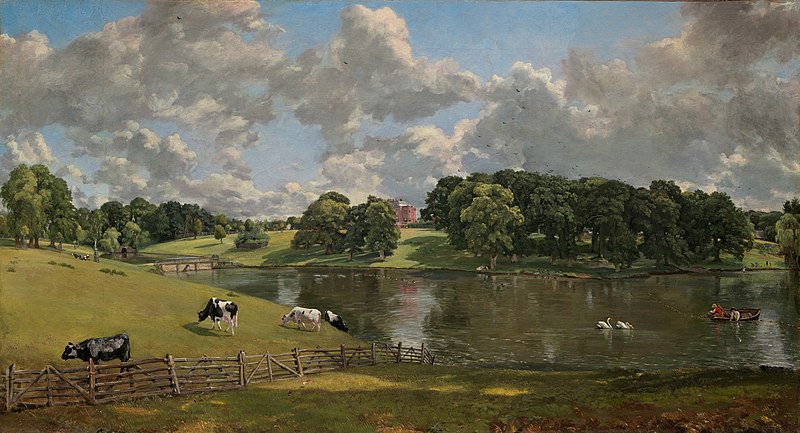
We know that naturalism is a style like any other - Gombrich's Art and Illusion goes to some lengths demonstrating this in the case of Constable's apparently simple, realistic painting of Wivenhoe Park.  For photographers and film makers the landscape imprints itself more directly, but they still decide where to point the camera.  Chris Welsby's 1972 film Wind Vane, however, partly dispenses with this artistic control by allowing the wind to decide the frame at any given moment, using a kind of sail device.  The photo below shows how this was done, suggesting that to get close to a landscape-generated landscape film requires quite an elaborate artistic set-up.

 
Chris Welsby with cameras for Wind Vane, 1972

The film is described on Chris Welsby's excellent website. 'The location for this film is the western end of Hampstead Heath in London. Two cameras mounted on tripods with wind vane attachments were positioned about 50 feet apart along an axis of 45 degrees to the direction of the wind. Both cameras were free to pan through 360 degrees in the horizontal plane. There are three continuous 100 foot takes for each screen. The movements of the two cameras, which were filming simultaneously, were controlled by the wind strength and direction. The sound was recorded synchronously with the picture track and consists mainly of wind noise. Each screen has its own soundtrack when projected.'

For me the most interesting thing about this film is the way the two cameras register the passing wind - both move in response to it but one follows slightly later than the other, giving a sense of the wind's movement across the Heath.  In an article called 'Blowin' in the Wind', Fred Camper describes another film in which the wind is integral to the filming process: Tree (1974): 'Welsby tied his camera to a tree branch during a strong wind; he'd planned an 11-minute film, but the camera malfunctioned and the usable portion was 4 minutes. The wobbles of the frame as the branch moves dominate the movements of grass and branches within the frame: the viewer becomes profoundly aware of how much the act of framing conveys dominance and control though here the agent is the wind.'


The BFI have released a DVD of Chris Welsby's films in the same series as the William Raban collection I described last month.  It includes his collaboration with Raban, River Yar (1972), Drift 'a study of winter light falling on the surface of water, metal and cloud', and (for me the most effective film) Sky Light - 'an idyllic river flows through a forest, flashes of light and colour threaten to erase the image, bursts of short wave radio and static invade the tranquillity of the natural sound.' The films should be viewed on bigger screens than our little TV, but I think the DVD is well worth watching to get a sense of Welsby's progress from early films like Wind Vane to recent installations like Lost Lake.  (I can't speak for the DVD's 20 page booklet which sounds good but was missing in the copy I borrowed from our local video shop.)


To conclude, here is how Chris Welsby views his work as a landscape artist, quoted from the introduction to his website: 'unlike the landscape painters and photographers of the nineteenth century, I have avoided the objective view point implicit in panoramic vistas or depictions of homogeneous pictorial space. I have instead concentrated on 'close up' detail and the more transient aspects of the landscape, using the flickering, luminous characteristics of the film and video mediums, and their respective technologies, to suggest both the beauty and fragility of the natural world. The process of re-presenting the landscape in either the single screen works or the installations is not seen to be separate from nature or in any way objective, but is viewed instead, as part of a more symbiotic model in which technology and nature are both viewed as inter-related parts of a larger gestalt.'

Friday, July 31, 2009

4 postcards from Venice

I heard designer Celia Birtwell on the radio the other day saying how her friend David Hockney often sends her drawings made on his iPhone.  This reminded me of Simon Faithfull, who has made a new kind of plein air landscape art using a personal digital assistant.  According to Mark Godfrey, writing in Vitamin D: New Perspectives in Drawing, the results have 'a stuttering, awkward quality; childlike, but divorced from from childlike themes.  The lines appear either black against a white ground, or vice versa, meaning that no twilight tones can be registered.  There is little shading, and when this does appear, it is not as cross-hatching or rubbing, but as one of a limited number of preset "fill-in" options.  Faithfull also sometimes uses basic animating devices.  He replicates a rippling canal surface with moving horizontal dashes (in the series "4 postcards from Venice," 2003, completed during the Biennale).  These animations aren't particularly dramatic.  Rather, Faithfull seems to emphasize the inadequacy of a new medium to render basic perception or to deliver the spectacular.'  This new take on the Venetian landscape may not sound too promising, but you can judge for yourself by looking at the work in question on his website.

Here is another description of Simon Faithfull's methods, from Donna Da Salvo's essay for an exhibition of sketches made at Dreamland, an old amusement park in Margate:  'Produced quickly using a Palm Pilot and finger, each of Faithfull’s drawings is made from life, and constitutes a map of his walk through Dreamland. Like the modern day flaneur roaming the park, Faithfull captures the momentary pleasure of looking. Some drawings are complex compositions, including views of the undulating landscape of the grade II listed Scenic Railway, or the frenetic movement of a car as it speeds along the rails of the Wild-Mouse, or even a solitary person and a gull on their respective perches by the sea. In others, he offers glimpses of life – a half-empty soda-fountain glass left behind, or the incomplete outline of two figures hidden behind sunglasses. These images can be read as pages from a sketchbook, albeit one that uses software to endlessly reproduce and then reintroduce them back into the world. He has said of them, ‘They are distillations of moments filtered through my head, but not my memory.’'

And finally, here is what he had to say to Sarah Kent at Time Out about the Antarctic landscape, which he visited in 2004-5 on an Arts Council fellowship, traveling with the British Antarctic Survey. 'I was afraid I’d come back with images looking like photographs from the National Geographic, but it’s the opposite of scenic. Antarctica is a huge glacier, which is absolutely flat and cloud-covered, but the light is almost supernatural in strength; its intensity is more than your eyes can deal with. The sun doesn’t set and there’s a weird phenomenon called ‘ice blink’; the underside of the clouds glows white with light reflected off the ice, so there’s complete white-out, which is utterly disorientating. Because there’s no moisture, the air is crystal clear and you can see further than ever before. But because there’s no horizon line, you lose all sense of scale and, instead of a landscape unfolding towards the horizon, there’s literally nothing to see. As you walk you can hear your feet making footsteps, but you can’t see them because there’s no definition or contrast, so it feels claustrophobic – as if everything were folding back on itself. I’d gone all that way to see the wilderness, but there was absolutely nothing to see, except the stuff brought there by people!'

Tuesday, July 28, 2009

Naught moves but clouds

Edward Thomas wrote all his poetry over a period of twenty-seven months, from November 1914 to January 1917.  Read in sequence they trace the progress of the seasons, often drawing on his memories of Kent, Hampshire, Somerset, Wales.  Sometimes they describe the landscape of the trenches, and sometimes they mingle past and present.  Here are extracts from different poems that refer to specific months, arranged as a kind of Edward Thomas calender:

February

The rock-like mud unfroze a little and rills / Ran and sparkled down each side of the road / Under the catkins wagging in the hedge

Black rocks with white gulls following the plough

... the sun on the celandines...

March

What did the thrushes know?  Rain, snow, sleet, hail, / had kept them quiet as the primroses.
 ad kept the
After a night of frost, before / The March sun brightened and the South-west blew, / Jackdaws began to shout and float and soar / Already, and one was racing straight and high / Alone, shouting like a black warrior / Challenges and menaces to the wider sky.

April

The April mist, the chill, the calm...

When mist has been forgiven / And the sun has stolen out, / Peered, and resolved to shine at seven / On dabbled lengthening grasses, / Thick primroses and early leaves uneven, / When earth’s breath, warm and humid, far surpasses / The richest oven’s...

May

Thrush, blackbird, all that sing in May...

The sedgewarblers that hung so light / On willow twigs, sang longer than any lark, / Quick, shrill or grating, a song to match the heat / Of the strong sun, nor less the water’s cool / Gushing through narrows, swirling in the pool.

The cherry trees bend over and are shedding / On the old road where all that passed are dead...

June

What I saw / Was Adlestrop – only the name / And willows, willow-herb, and grass, / And meadowsweet, and haycocks dry, /No whit less still and lonely fair / Than the high cloudlets in the sky.

The green roads that end in the forest / Are strewn with white goose feathers this June...

... in the little thickets where a sleeper / For ever might lie lost, the nettle-creeper / And garden warbler sang unceasingly; / While over them shrill shrieked in his fierce glee / The swift with wings and tail as sharp and narrow / As if the bow had flown off with the arrow.

July

Naught moves but clouds, and in the glassy lake / Their doubles and the shadow of my boat.

September

... September hides herself / In bracken and blackberry, harebell and dwarf gorse.

October

The green elm with one great bough of gold / Lets leaves into the grass slip, one by one

November

November has begun / Yet never shone the sun as fair as now / While the sweet last-left damsons from the bough / With spangles of the morning’s storm drop down / Because the starling shakes it, whistling what / Once swallows sang.

... of all the months when earth is greener / Not one has clean skies that are cleaner.   Clean and clear and sweet and cold...
Thursday, July 23, 2009

From the Mountains to the Lagoon

The first chapter of Peter Humfrey's 2007 monograph on Titian is called 'From the Mountains to the Lagoon'.  Titian was born in Pieve di Cadore, a small town in the Dolomites, and later 'acquired property there and invested in his family's timber business, which carried logs from the mountains and valleys of Cadore to the boatyards of Venice by way of the River Piave and the Adriatic Sea.  Titian's enduring affection for his homeland seems to be reflected in the jagged peaks, precipitous rocks, rushing torrents and dense forest that he added to the existing repertory of Venetian painting.'


Titian, background to Giovanni Bellini's Feast of the Gods, 1529

Humfrey's first example is actually a Giovanni Bellini painting, Feast of the Gods (1514), which had been the first commission for Alfonso d'Este's camerino in Ferrara.  Once Titian started producing paintings like Bacchus and Ariadne for Alfonso, Bellini's painting would have looked a bit old hat, so Titian was asked to re-work the landscape.  Another work that seems to draw on Titian's memories of the Dolomites is the mountainous background to the Presentation of the Virgin in the Temple (1534-8).  And a third example given by Peter Humfrey is the 'savage, fitfully illuminated landscape' of St Jerome in Penitence, painted just before Titian's death in 1575 (a far cry from the generalised Arcadian landscapes he had painted under the influence of Giorgione seventy years earlier).


Titian, background to Presentation of the Virgin in the Temple, 1534-8

The influence of Titian's birthplace is not discussed in A. Richard Turner's classic survey, The Vision of Landscape in Renaissance Italy.  Instead he shows the great range of landscapes Titian was able to paint, beginning his account by quoting Count Francesco Algarotti's view, expressed in 1756, that 'Titian, nature's greatest confidant, is among landscapists the Homer.'  For Algorotti, 'perhaps the most beautiful landscape ever painted is that of the Peter Martyr, where for the variety of trunks, of leaves, of the various bearings of the limbs one can discern the difference between one tree and another; where the land is so well partitioned and rolls on with such natural grace; where a botanist would go to gather plants.'


Titian, engraving after The Death of St Peter Martyr, 1530

Looking back to Kenneth Clark's Landscape into Art, I find the following: 'anyone who has visited Cadore will recognize that the impressions of Titian's native place remained with him all his life.  The rocky hills with their thick clusters of trees, the rushing streams and blue mountain distances are seized upon with Titian's sensual power, and crowded into the small background of a portrait.  Very occasionally they are given more space, and we recognise the origin of all Carracciesque landscape.  The great hunting landscapes by the Carracci in the Louvre are no more than freer and more crowded versions of the Venus of the Pardo which hangs opposite them; and from the lost St Peter Martyr, the most copied picture in the world, there flowed a series of landscape compositions which furnished the seventeenth century.  Titian's appetite for nature gives to his landscapes a magnificent fullness.  His trees, in particular, have a weight of leaf and roundness of trunk never surpassed, and it is not surprising that Poussin and Rubens, Constable and Turner all looked on him as a source of inspiration.'

Among all the many qualities that distinguish Titian, how wonderful to think that he painted a 'roundness of trunk never surpassed'...

Friday, July 17, 2009

The Overlook

Another short post on a contemporary artist drawing imaginary landscapes: Frank Magnotta.  According to Dominic Molon in Vitamin D, Magnotta's drawings reflect 'the staggeringly constant turnover of the contemporary American landscape in the past fifty years, resulting from the heightened cycles of real estate development and relentless urban gentrification' leading to 'a national sense of perpetual unsettledness'.  Many of these feature architectural fantasies set against an empty background, like Post (2007), which can be seen accompanying an interview in Fecal Face magazine, where Magnotta says 'in the U.S. I'm not sure that we really build monuments any more, but in a way popular culture is the great ephemeral American monument. I'm interested in giving form to that.'

Sometimes he'll draw in a surreal landscape background, as in the recent Grand Optimist. In The Overlook (2004) buildings are entierly absent.  This drawing 'features a vast snowy landscape with such phrases as as HERITAGE HILLS, CRYSTAL LAKE, and GOLDEN ROSE placed at various points within the image.  Divorced from the assumed villaages that the phrases herald, the names become empty signifiers, meaningless ascriptions of perceived exclusivity and privelege that speak more to our desire for the trappings of wealth and prestige than the actual ability of language or objects to provide such bounty' (Dominic Molon).

Sunday, July 12, 2009

Thames Film


I spent a happy evening with a friend yesterday eating Il Bacio pizzas and watching the BFI's DVD compilation of William Raban films.  It includes his 66 minute long documentary Thames Film (1986), which flows from the city of London to the mouth of the river and ends with the incredible science fiction landscape of the Thames estuary seaforts.  The film was partly inspired by T.S. Eliot and includes lines from Four Quartets read by the poet.  The inclusion of poetry like this is familiar from other landscape and city documentaries - Terence Davies' Of Time and the City (2008) is just one recent example.  More striking, I think, is Raban's clever use of Breughel's painting The Triumph of Death which the camera pans over (in a manner reminiscent of Tarkovsky in Solaris) at several points in the film, revealing a series of links between the river's dark past and Breughel's apocalyptic vision.

Pieter Breughel the Elder, The Triumph of Death, c1562

Peter Ackroyd (inevitably) is an admirer of Thames Film and you can read his essay at the Luxonline site for William Raban.  He says, for example, that it is 'in many respects it is a visionary film. There are moments of light and colour that lift the spirit with exaltation. There are giant shapes and structures that fill the mind with awe. There are passages of mist and turbulence that recall the primaeval Thames of swamps and marshes. The multifold images of the river run through this film like the currents and tides of the water itself. It is a film, in every sense, of great fluency. The sounds, as well as the images, of the river are of great importance. There is a continual clangour, a loud lament, with the sound of machinery fighting against the lap of the water and the cry of the seagulls.'

Thames estuary seaforts, from Thames Film

William Raban has been making landscape films since Sky (1970) and River Yar (1971-72 a collaboration with Chris Welsby).  He says 'the first films I made were extensions to my work as a painter. The paintings involved taking impressions from natural surfaces like waves and tree bark. For the 'Tree Print' series canvas was left installed on tree trunks for long periods to weather and discolour. The films made at this time had a similar naturalistic approach towards documenting changes, and were mostly static views of landscapes where various 'time-lapse' systems were used to make slow movements like the rise and drop of tide levels and development of cloud patterns clearly perceptible.'

In the wake of these early experimental works, he has, in addition to Thames Film, made a sequence of films that have charted the changing face of London and its river:
  • Thames Barrier (1977) - a synchronised three-screen time-lapse film of the river during the building of the Thames Barrier
  • Sundial (1992) - the tower of Canary Wharf filmed as a giant gnomon to mark the passing of a day
  • A13 (1994) - a Vertov-influenced commentary-free sequence showing the construction of Limehouse Road Link and its effects on the local landscape
  • Beating the Bridges (1998) - another river film in which thirty Thames bridges provide 'a range of acoustic space that is featured on the soundtrack by the ambient reverb and a live percussion score'
  • MM (2002) - like A13, another quietly polemical film about the changing cityscape, this time focusing on the creation of the Millenium Dome

The Millenium Dome, from MM

Friday, July 10, 2009

From Murano Grande

This is one of a few posts I'm going to do on contemporary drawn landscapes, based on Phaidon's excellent survey Vitamin D: New Perspectives in Drawing. Emma Dexter's introduction to the book examines the open possibilities of drawing today - in contrast to photography this archaic form is now 'an under-regarded and under-theorized backwater.' The definition of drawing can be stretched from pictures made with pencil and paper to inscribed landscapes (she reproduces Richard Long's A Line Made by Walking where the earth is revealed 'as a surface or ground to be marked, etched, and scarred by the body as the instrument of drawing, taking the role of pencil or pen.') However, the artists I'll mention here have been concerned with drawing in the traditional sense, depicting imaginary landscapes in a medium that can convey formal precision, satirical bite or childlike innocence.

The first of these is Cuban artist Glexis Novoa, who now lives in Miami. Here is an extract from Rubén Gallo's discussion of his work. 'Rem Koolhaas once wrote that in the future, all cities will be generic, as bland and nondescript as airports. Many of Novoa's drawn landscapes, including From Murano Grande (2002) depict the generic city of the future: unspecific urban spaces that could be located in Europe or America, in India or Africa. The cityscapes seem ostensibly prosperous - the buildings are tall, the streets are clean - but are entirely devoid of life. There is not a single soul on the streets. The cemetery-like coldness of these environments is further intensified by the artist's choice of slabs of marble as support for his drawings. Novoa provokes our thoughts: Are these dehumanized cities what the future holds in store? Or are they already a reality in many parts of the world?'

Looking around for an image of this work on the web, I see it is possible to buy a From Murano Grande scarf. Here are three more Glexis Novoa landscapes from the artist's website:
You can also get a feel for his work from a few videos on Youtube, e.g. "Cuba, Fidel & Obama" (SITE, YF-23, Kim Il, Samotracia, ONL & palmera Antiimperialista).

Tuesday, July 07, 2009

Landscape futures


Geoff Manaugh was in London today to launch the BLDGBLOG book, so I popped over to the Architectural Association this evening to hear him give an entertaining whistle-stop tour of its contents. It had been a day of strange weather with a massive downpour earlier, like something out of the book's 'Redesigning the Sky' chapter (aggressive cloud seeding during the Vietnam War). The book is fascinating and beautiful to look at, with a lot of on landscapes and soundscapes. Some of the people I've discussed here before crop up - Simon Norfolk, Christian Bök, W.G. Sebald, J. G. Ballard (of course). So here are Ten More Reasons to read the book (in addition to those given on the BLDGBLOG site) - examples of the book's 'architectural conjecture :: urban speculation :: landscape futures'.

The idea that...
  • the Mesolithic landscape of Doggerland, which lies under the North Sea, could be made to re-emerge behind massive ring cities in the form of hydrological projects, encircling the flooded landscape
  • John Milton anticipated the Manhattan Project in his description of the preparations for 'an insurrectionary terrorist invasion of Heaven' in Paradise Lost - a 'mineral activation of the Earth as a resource for high-tech weaponry'
  • the fountains of Rome could be turned into a sequence of liquid cinemas
  • a kind of Sir John Soane museum of historically important architectural fragments culd be established, exhibiting items like the window JFK was shot from, detached like a Gordon Matta-Clark building cut
  • a new set of sound mirrors should be built in the landscape to create specific sounds at specific times - 'a distant gully that moans every year in the second week of November'
  • bands should start doing cover versions of environmental sound recordings - Godspeed You! Black Emperor providing a perfect rendition of a Brian Eno recording of Bayswater Road
  • Rachel Whiteread should begin filling whole cave systems with plaster
  • with a version of the inflatable architecture designed by Swiss architecture firm Instant, you could inflate 'an entire borough that has never otherwise existed, sprawling across the marshy plains of east London. Call it Hackney 2, or Stoke Airington' (a reference to Stoke Newington, where I'm now sitting and writing this)
  • hurricanes could be averted by storing winds in an Aeolian Reef, inspired by the 'weather breeding isle' in Virgil's Aeneid: 'Here in a vast cavern King Aeolus /Rules the contending winds and moaning gales /As warden of their prison. Round the walls / They chafe and bluster underground. The din /Makes a great mountain murmer overhead...'
  • 'a distant heir of J. M. W. Turner returns sunburnt from the tropics to find London an archipelago of failed sea walls and waterlogged high-rises, the suburbs an intricate filigree of uninhabited canals, bonded warehousing forming atolls amidst sandbanks and deltas'

Saturday, July 04, 2009

So foul a sky clears not without a storm

'In the time of Spanish rule, and for many years afterwards, the town of Sulaco -the luxuriant beauty of the orange gardens bears witness to its antiquity-had never been commercially anything more important than a coasting port with a fairly large local trade in ox-hides and indigo.' This is the euphonious opening sentence to Joseph Conrad's Nostromo (its rhythm reminds me of the famous declaration at the start of The Adventures of Augie March “I am an American, Chicago born—Chicago, that somber city—and go about things as I have taught myself, free-style, and will make the record in my own way.”)
Conrad spends the whole of the first chapter describing the landscape of Sulaco and the Golfo Placido: scene setting, yes, but also a sign that this novel's ambition includes the creation of a completely believable South American country in all its details. Here, for example, is Conrad's first mention of the Cordillera - mountains which have isolated Sulaco from the effects of Civil War until the turbulent events of the novel:

'On crossing the imaginary line drawn from Punta Mala to Azuera the ships from Europe bound to Sulaco lose at once the strong breezes of the ocean. They become the prey of capricious airs that play with them for thirty hours at a stretch sometimes. Before them the head of the calm gulf is filled on most days of the year by a great body of motionless and opaque clouds. On the rare clear mornings another shadow is cast upon the sweep of the gulf. The dawn breaks high behind the towering and serrated wall of the Cordillera, a clear-cut vision of dark peaks rearing their steep slopes on a lofty pedestal of forest rising from the very edge of the shore. Amongst them the white head of Higuerota rises majestically upon the blue. Bare clusters of enormous rocks sprinkle with tiny black dots the smooth dome of snow.'

The landscape in this first chapter will impact on the narrative and, literally in the case of the Cordellera, cast a shadow on Nostromo's characters. Conrad describes the political struggle for this territory, the transformation brought about by foreign capital and the coming of the railway, and the exploitation of its natural resources in the form of the increasingly productive silver mine. But like a Turner history painting it also registers the fleeting effects of sunlight and atmosphere: clouds are often described and the novel begins with a quotation from Shakespeare, "So foul a sky clears not without a storm."

At one key point in the novel, the landscape disappears altogether, as Decoud and Nostromo try to spirit away the mine's silver in a small boat in the misty silence of night: 'A great recrudescence of obscurity embraced the boat. The sea in the gulf was as black as the clouds above. Nostromo, after striking a couple of matches to get a glimpse of the boat-compass he had with him in the lighter, steered by the feel of the wind on his cheek. It was a new experience for Decoud, this mysteriousness of the great waters spread out strangely smooth, as if their restlessness had been crushed by the weight of that dense night...'

The novel actually contains a landscape painting - a vision of the country before the mine was developed, captured by the wife of the mine administrator, Charles Gould. 'The waterfall existed no longer. The tree-ferns that had luxuriated in its spray had died around the dried-up pool, and the high ravine was only a big trench half filled up with the refuse of excavations and tailings. The torrent, dammed up above, sent its water rushing along the open flumes of scooped tree trunks striding on trestle-legs to the turbines working the stamps on the lower plateau--the mesa grande of the San Tome mountain. Only the memory of the waterfall, with its amazing fernery, like a hanging garden above the rocks of the gorge, was preserved in Mrs. Gould's water-colour sketch; she had made it hastily one day from a cleared patch in the bushes, sitting in the shade of a roof of straw erected for her on three rough poles under Don Pepe's direction.'

It is like a description of Eden - a comparison made explicit when Mrs Gould looks at the landscape visible now only in this watercolour:

"Ah, if we had left it alone, Charley!"

"No," Charles Gould said, moodily; "it was impossible to leave it alone."

"Perhaps it was impossible," Mrs. Gould admitted, slowly. Her lips quivered a little, but she smiled with an air of dainty bravado. "We have disturbed a good many snakes in that Paradise, Charley, haven't we?"

Monday, June 29, 2009

Straight Miles and Meandering Miles

The catalogue to the Richard Long exhibition Heaven and Earth, which I discussed here recently, draws attention to Long's early career at art school, when he first developed the ideas that have motivated his art ever since. Long has recalled one important influence at the time was John Cage. He saw Cage lecture at the Saville Theatre in November 1966: 'It was all about chance and eccentric lateral thinking and humour - all sorts of John Cage ideas which were new to me.' A year later he experienced a recorded lecture, Indeterminacy, in which Cage told sixty stories in sixty minutes, varying the pace according to the length of the story. As Clarrie Wallis points out, this procedure is similar to that used in Long's map work A Walk of Four Hours and Four Circles (1972), where concentric circles were each walked in one hour (the smallest circle slowest, the largest fastest).

Thinking of avant garde composers in this context, I was reminded of La Monte Young's Compositions 1960 - an early example of conceptual art as instructions, e.g.
#2: Build a fire in front of the audience…
or
#5: Turn a butterfly (or any number of butterflies) loose in the performance area. When the composition is over, be sure to allow the butterfly to fly away outside…
One of these compositions sounds like a Richard Long walk:
#10: Draw a straight line and follow it
You could imagine one of Long's early map works re-written in this way as instructions for an imaginary walker:

A Ten Mile Walk, England, 1968
1. Pick a starting point x
2. Pick a round number y
3. Draw a straight line from x of length y in a direction that it is possible to walk
4. Walk the line

Of course the fact that Long has done his walks is the whole point. It is his landscape experience that we are presented with, even though we can accompany him in our imagination (just as we can join Gary Snyder on the riprap trail, or Basho on the narrow road). His work is not participative in the style of contemporary relational aesthetics. Still, while I'm on this road not taken, here are four more Richard Long walks recast as instructions. They might come in useful if you are short of ideas this summer, and, adapted for cities, they could even be used as the basis for some Situationist dérives...

A Walk of Four Hours and Four Circles, England, 1972
1. Draw a circle a on the map of diameter x
2. Superimpose a second circle b centred on the same spot with diameter 3x
3. Superimpose 2 more circles c and d with diameters 5x and 7x
4. Spend exactly an hour walking each of the four circles

A Hundred Tors in a Hundred Hours, Devon, England, 1976
1. Pick a distinctive common land form
2. Locate a round number of them, x
3. Walk to all of them in exactly x hours

A Five Day Walk, England, 1980
1. Choose a route that is x miles
2. Walk 1/15 of this distance x on the first day
3. On the second and subsequent days walk 2/15, 3/15, 4/15 and 5/15 of the distance

Straight Miles and Meandering Miles, England, 1985
1. Choose a long distance walk
2. Map out a certain number of locations where it is possible to walk a straight mile
3. Walk the route by, alternatively, normal paths and straight lines

Friday, June 26, 2009

The horizon of Holland


Back in 1965 the ICA organised an exhibition called 'Between Poetry and Painting' which included work by Ian Hamilton Finlay. Forty-four years later the ICA now has a similar exhibition entitled 'Poor. Old. Tired. Horse.', named after Ian Hamilton Finlay's magazine of that title. In addition to Ian Hamilton Finlay, the new exhibition includes work by two other artists I've discussed here before, Robert Smithson and Carl Andre. I've just taken the photo above which shows the catalogue for the 1965 exhibition next to the catalogue for the current show (which takes the form of a magazine called 'Roland'). The earlier exhibition took place before I was born but I think my uncle must have been to it and so the catalogue has found its way into my library. At that time Ian Hamilton Finlay had not yet moved to Stonypath to start work on the garden that would become Little Sparta - the catalogue says simply that he 'has lived in Perthshire, Orkney and Edinburgh, and now lives in the north of Scotland.'

On Tuesday Stephen Bann came to the ICA to give a talk about Ian Hamilton Finlay. He focused on the pre-Stonypath period and included some never-published colour photographs that he had been unable to use in an Architectural Review article (it was only printed in black and white in those days). One of these photographs showed THE HORIZON OF HOLLAND IS ALL EARS, a concrete poem made into a wooden structure and placed in the garden of Finlay's home in Ross-shire. This is the first of Finlay's interventions in the landscape, the ancestor of the sculptures at Little Sparta.

There were several references in the talk to Finlay's poetic interests and links with contemporaries like Lorine Niedecker. Finlay wrote to Bann saying that the landscape of Orkney was equivalent to a Wallace Stevens poem. He also said that Orkney resembled concrete poetry, whilst Perthshire seemed more like the writing German poets like Trakl. The less particularised landscape of Ross-shire on the other hand required more effort to make a poem out of the place... the kind of effort Ian Hamilton Finlay put there into making his first artist garden and his first poem in the landscape.

Tuesday, June 23, 2009

Design for an artificial echo

In a previous post here I quoted an extract from Gilbert White's A Natural History of Selborne, which included a proposal: "Should any gentleman of fortune think an echo in his park or outlet a pleasing incident, he might build one at little or no expense. For whenever he had occasion for a new barn, stable, dog-kennel, or the like structure, it would be only needful to erect this building on the gentle declivity of an hill, with a like rising opposite to it, at a few hundred yards distance; and perhaps success might be the easier ensured could some canal, lake, or stream, intervene. From a seat at the centrum phonicum he and his friends might amuse themselves sometimes of an evening with the prattle of this loquacious nymph..."

Back in the late seventeenth century, John Evelyn had the same thought and provided a design in his unpublished Elysium Britannicum, "to instruct you how to produce an Artificial Echo and by an innocent magick & without superstition, to raise up & deprehend that vocal & fugitive Nymph." The illustration below is reproduced from John Dixon Hunt's Greater Perfections, in which it is used to illustrate the point that Evelyn, generally a proponent of natural gardens, was nevertheless happy to recommend artificial effects where nature had not provided them.


In John Evelyn's "Elysium Britannicum" and European Gardening Therese O'Malley describes this as a sketch of the artificial echo at the Tuileries in Paris. The excellent Gardenvisit.com includes an extract from Evelyn's diary from 4 February 1644: "I finished this day with a walk in the great garden of the Tuileries, marvelously contrived for privacy, shade, or company, by groves, plantations of tall trees, especially that in the middle, being of elms, the other of mulberries. It has a labyrinth of cypresses; not omitting the noble hedges of pomegranates, fountains, fish-ponds, and an aviary; but above all, the artificial echo, redoubling the words so distinctly; and, as it is never without some fair nymph singing to its grateful returns; standing at one of the focuses, which is under a tree, or little cabinet of hedges, the voice seems to descend from the clouds; at another, as if it was underground..."

Evelyn's experience in Paris is referred to in a 1995 survey of artificial soundscapes by Joseph Dillon Ford, 'From Vocal Memnon To The Stereophonic Garden, A Short History Of Sound And Technology In Landscape Design': He concludes: 'the creation of acoustically pleasant and appropriate landscapes represents a significant opportunity for those who recognize that a design which delights the eye but neglects the ear is likely to be as well-received as a handsomely costumed actor who mumbles, butchers or forgets his lines. An excerpt from Alexander Pope's An Essay on Criticism (part II, line 62) seems especially appropriate in this connection: "Tis not enough no harshness gives offence; / The sound must seem an echo to the sense." Those landscape architects who fully appreciate the historical role of sound as a design element essential to the creation of a strong sense of place and who accept the considerable technical, aesthetic, environmental, and legal challenges required to renew the soundscape, will have the distinct satisfaction of extending their art into new, ever-richer realms of poetic experience.'