Tuesday, July 31, 2007
A hot gust of wind blows across the colourless sea...
'The night had brought little relief from the heat, and at dawn a hot gust of wind blows across the colourless sea. The KNIGHT, Antonius Block, lies prostrate on some spruce branches spread over the fine sand....' So begins The Seventh Seal...
In his little BFI Film Classics book about the film Melvyn Bragg says how the opening of the film resembles a play. But in a theatre we would not see the landscape, and it is the setting of this scene that seems to me crucial. The screenplay describes the knight opening his eyes after a morning prayer: he 'stares directly into the morning sun which wallows up from the misty sea like some bloated, dying fish. The sky is grey and immobile, a dome of lead. A cloud hangs mute over the western horizon. High up, barely visible, a seagull floats on motionless wings. Its cry is weird and restless.' It is at this point that the knight turns round and sees Death.
Rugged coasts and islands are perhaps the most archetypal Bergman landscape. In addition to his use of Hovs Hallar in Skåne for The Seventh Seal, I think primarily of the way he used the Stockholm Archipelago in Summer with Monika and his repeated use of the island of Fårö, which first appeared in Through a Glass Darkly. Fårö is, according to, Geoffrey Macnab, a "a remote, windswept place with a landscape that appears flat and barren. There are countless pine trees, fields with ancient stone walls, a succession of sand and shingle beaches, and more sheep than humans." It was on Fårö that Bergman lived until the sad news of his death was announced yesterday.
Labels:
Ingmar Bergman,
scenery,
shores,
wind
Location:
Fårö, Sweden
Saturday, July 28, 2007
A Nocturnal Reverie
The verse anthology I’m clutching here, English Scottish and Welsh Landscape, edited by John Betjeman and Geoffrey Taylor, with lithographs by John Piper, was published, like Geoffrey Grigson’s The Poet’s Eye during the Second World War. It is a strange book, the product of a unique moment and a particular sensibility. What is so strange about it? Well the whole book begins with an apology rather than a preface in which the editors explain why they seem to have deliberately omitted the most exciting English nature poetry in favour of modest verse written about particular places. ‘You must visualize the earlier part of the book at any rate, as a series of views of this island rendered by oil, water-colour or engraving. Cunningham’s conventional landscapes have been well described by Mr. Grigson in The Romantics as ‘like a cast oil on a dining-room wall in an eighteenth-century mansion – the kind that goes with the house because it is too big for the auctioneer to sell’. The wooden passage from Dodsley is like an inn signboard : Bampfylde is a Morland : Goldsmith is some not very good picture, but so famous that it could not be omitted : Crabbe has the freshness of a Cotman water-colour : many of the lesser-known writers round the turn of the [19th] century are like the copper-engravings or Bewick cuts which, no doubt, adorned some of their works...’
So rather than stick to poems that retain a ‘freshness’, like Crabbe’s, the editors have deliberately chosen a ‘not very good’ Oliver Goldsmith (an extract from ‘The Deserted Village’), a ‘wooden passage’ from Robert Dodsley, and so on. The reason for this approach becomes clear when they describe as ‘the reason for the book’ the chance to include ‘quiet Georgian rectors, village schoolmasters, peers in their libraries looking across the park, Victorian drunks and reformers and escapists’. ‘They were recording landscape from the distant view to the cascade in a wet cart rut, with a love and observation men are just beginning again to appreciate. Theirs may be ‘pedestrian’ verse, but it is written by pedestrians or, at the fastest, travellers on a cob, for pedestrians.’ Even without this explanation, it is clear from a glance at the index of authors that there are a disproportionate number of Reverends: Rev. Henry Alford, Rev. William Barnes, Rev. Robert Blair, Rev. William Lisle Bowles, Rev. Moses Browne etc. And of course George Crabbe was among their number: he was the Rector of Trowbridge.
I was looking for a brief example to include here, but a lot of this poetry is not available on the web (although it was out of copyright when the book was published back in 1944). However, here are a few lines from the book’s opening poem, dating from the start of the eighteenth century. It describes a night scene in Wiltshire viewed (or imagined?!) by Anne Finch, Countess of Winchelsea, in her poem ‘A Nocturnal Reverie’:
...Whilst Salisb'ry stands the Test of every Light,
In perfect Charms, and perfect Virtue bright:
When Odours, which declin'd repelling Day,
Thro' temp'rate Air uninterrupted stray;
When darken'd Groves their softest Shadows wear,
And falling Waters we distinctly hear;
When thro' the Gloom more venerable shows
Some ancient Fabrick, awful in Repose,
While Sunburnt Hills their swarthy Looks conceal,
And swelling Haycocks thicken up the Vale...
Sunday, July 22, 2007
Landscapes at Kalumpiwarra, Yalmanta and Ngulalintji
Among Australian Aboriginal artists, the work of Rover Thomas (1926-98) particularly appeals to me, perhaps because there are some superficial similarities with Mark Rothko, as noted here. However, in an article on Thomas, Wally Caruana remarks on their differences: ‘if Rothko's paintings mirror the human form, then Thomas' are firmly embedded in the landscape.’
Postage stamp from 1993: Kalumpiwarra-Ngulalintji by Rover Thomas
Rover Thomas’s Landscapes at Kalumpiwarra, Yalmanta and Ngulalintji (1984), in the National Gallery at Canberra, commemorates an old woman killed by a car accident at Turkey Creek airstrip. It shows, according to Howard Morphy in his book Aboriginal Art, a place on the woman’s spirit journey with identifiable locations: Blackfellow Creek, the rock at Ngarkalin, grass at Yalmanta, a wooded area, Ashburton Hill, Bow River. ‘Although Thomas’s landscapes echo some contemporary Euro-American paintings in style, they come directly out of the art of the Kimberleys... the underlying theme is the spiritual value of the land and the connections between places.’
I couldn’t see Landscapes at Kalumpiwarra, Yalmanta and Ngulalintji on-line but here are some links to other Rover Thomas paintings: Yari Country (1989), Cyclone Tracy (1991), Paruku (Lake Gregory) (1991), Kankamkankami, (1998). And there’s a Rover Thomas painting, All that big rain coming from top side, on Les Murray’s site accompanying Murray’s poem ‘Two Rains’. This work was bought by the Australian National Gallery in 2001 with the record sum for an indigenous Australian painting: $778,750.
Saturday, July 21, 2007
Above the frenzied sea
Some years ago we visited the Cinque Terra, a group of five villages on the Ligurian coast of Italy. One day we did the coast walk between them, starting at Riomaggiore and ending at Monterosso (see photo below). I remember the curves of the landscape, the glittering sea, the wind blowing in the pine trees... but I also remember a harsher side to the place: the crumbling, dusty path, a relentless sun overhead and dense brambles hiding the view. Soon afterwards I read Eugenio Montale’s first book Ossi di Seppia (Cuttlefish Bones) and found all these elements in poems set in the Liguria of his childhood and youth. In 1900 Montale’s family had built a villa at Fegina, near Monterosso. As Jonathan Galassi says in his notes to Collected Poems 1920-1954, ‘here Montale will spend long summer holidays until he is nearly thirty, and absorb the elemental landscape – hallucinatory sun, agitated sea, barren cliffs and shoals – that is the primary material of his first poetry.’ The Ossi di Seppia poems were first published in 1925, when Montale was 29.
The path to Monterosso
To get a sense of the Ligurian landscape in Ossi di Seppia you need to read the poems. What I’ve attempted to do below is give a flavour by extracting some phrases from Galassi’s translations, starting with the orchard of ‘In limine’ and ending with the flight of swifts in ‘Riviere’.
the wind inside the orchard ... among the lemon trees ... whispering of friendly branches ... the fragrance of lemons ... the golden horns of sunlight ... the copper horizon ... the livid sea ... swallowed by the haze ... the rock that shimmers with salt ... old-silver shimmer on the walls ... the bitter scent of the sea ... fired reflections ... the plain of the sea ... a blistering garden wall ... among the thorns and brambles ... throb of sea scales ... cicadas’ wavering screaks ... the shade of that green thicket ... wavering mother-of-pearl haze ... the stillness of the country ... my field parched by the salt sea wind ... the sunflower crazed with light ... the statue in the drowsiness of noon ... the trees give up no shade ... walking in dry, glassy air ... butterflies danced fleetingly ... among thin reeds and brush ... the well’s pulley creaks ... the owl darts ... wet smoke hangs heavy on roofs ... the arc of the sky ... slanting shadows of cluster pines ... the sight of the sea ... foam raining back on the rocks ... the sun bakes ... mosquitoes cloud the air ... cork and seaweed and starfish ... the dry cliffs ... the rocks that edged the road ... shaking tufts of thirsty cane ... briny gusts ... rivers of rainwater ... the sea’s lashing ... the wind’s erratic gales ... air so blue it goes dark ... the sun in darkened courtyards ... a throbbing sea hatched with furrows ... tangled seaweed and drifting tree trunks ... scarlet houses built of ancient brick ... the thin hair of tamarisks ... vines and pine groves ... the bald, hunched backs of hillocks ... steep embankments ... bramble thickets ... a wisp of breeze ... the house by the sea ... shivering tamarisks ... false calm over carved waters ... sirocco gale that burns ... the sky alive with pale lights ... the choppy sea talks in the rocks ... a few seabirds are flying ... clouds pressed between the branches ... among the silver blades of tender leaves ... a patch of sky burns overhead ... the rumble of a train ... the solemn cicadas ... the dusty streets ... tops of elders shiver ... the sea that shudders ... the windy gorge ... the branches of dwarf pines ... a lead stormcloud high above the riptide ... a salty, roiling maelstrom ... thunder rolls with a struck-metal clang ... the apprehensive sky starts spattering ... among the stones ... the sun hides in the clouds ... hazy afternoon ... the gentle breakers ... copper water riffled by a breeze ... the swarm of bats that sunset scatters ... a fisherman lets down his line ... tranquil afternoon ... the excess of light stuns ... edges go abstract ... tendrils of the low vines ... an eddy of deepening blue ... assiduous, slow waves ... sluggish mists ... the sigh of the breaker ... someone hangs out nets ... a curve of flayed horizon ... the whistle of the tugboat ... the offshore wind’s hot eddies ... a cormorant’s wing beats up above ... the rivermouth, waterless, but alive with rocks and lime ... a roadway of dried mud ... a dense fog ... glancing light ... a few blades of agave ... above the frenzied sea ... a pair of pale camellias ... shuddering olive trees and staring sunflowers ... the cuttlefish bone ... a stone smoothed by the sea ... the arcs of shifting branches ... rocks brown in the foam ... arrows of roving swifts.
The 'copper horizon', Riomaggiore
Labels:
Eugenio Montale,
light,
orchards,
seas,
shores
Location:
Monterosso Al Mare
Monday, July 16, 2007
Drosscape
The latest Frieze, a ‘summer ecology special’, is a hefty 265 pages, so I was glad to see the editorial reflecting on the carbon footprint of magazine production. In a review of the Sharjah Biennial (‘Still Life: Art, Ecology, and the Politics of Change’), Christy Lange writes that ‘a number of works only superficially grazed the subject of the fate of our environment (confusing it instead with the genre of landscape or the literal act of recycling).’ With this in mind, as we’re concerned here with the ‘genre of landscape’, I’m not going to discuss the interesting work of environmental artists like Tue Greenfort, who feature in this special edition of Frieze, but I’d recommend looking at the Frieze website, now expanded to include more content, thus ‘saving more trees’. It includes a survey of the field by Max Andrews, author of LAND, ART: A Cultural Ecology Handbook.
A couple of interesting landscape-related things on this site worth drawing particular attention to:
- There is a review of Alan Berger’s new book, Drosscape. In this book ‘Berger classifies drosscape sites into landscapes of dwelling (LODs – voids of land in housing developments), landscapes of transition (LOTs – temporary storage facilities), landscapes of infrastructure (LINs – transportation rights of way), landscapes of obsolescence (LOOs – junkyards and landfills), landscapes of exchange (LEXs – abandoned malls) and landscapes of contamination (LOCOs – military bases and other brown fields).’ There are various other reviews on-line, e.g. at Terrain.org.
- A review of a new Mike Marshall exhibition mentions an interesting new work. ‘In Spoil (2007) Marshall retouched a black and white image of a mountain of debris in a way that both restored original colour to the monochrome image and mimicked, in deliberately debased form, a landscape painting of the Sublime. It’s Caspar David Friedrich crossed with Peter Fischli & David Weiss: by turns meditating on the transcendent qualities of art’s capacity to represent nature, expressing shyness towards art as representation and a love, instead, for the beauties of the commonplace. There are things that are consistently wonderful – flowers, the sun breaking through clouds, the roll of thunder – yet which lose all their power in mediation. Marshall considers how to tackle this problem.’
Wednesday, July 11, 2007
Coalbrookdale by Night
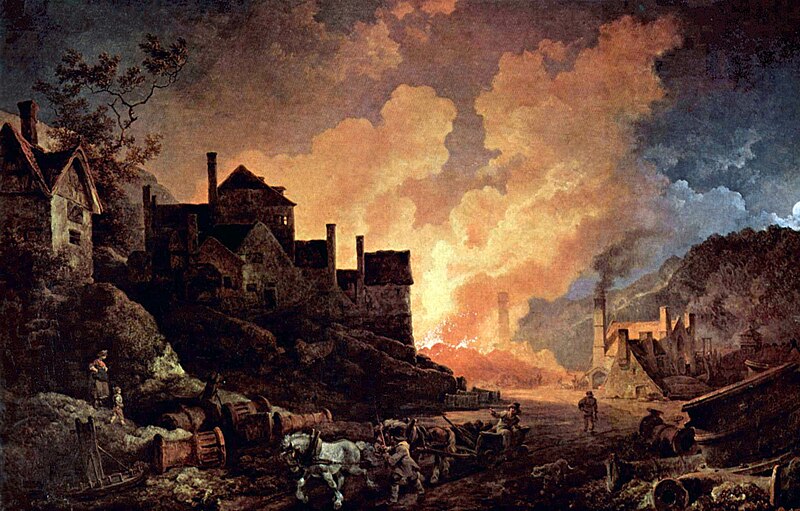
The last posting got me thinking about the idea of the industrial sublime, and the painting below which is often used to illustrate it. The Royal Academy has a Loutherbourg etching of the Ironworks, Coalbrook Dale which is much less menacing, and, going further back to 1777, there is a painting, Morning View of Coalbrook Dale by William Williams, where the industrial smoke is just a baleful presence in the distance... But with Coalbrookdale by Night the delightful horror of the new industry is evident in a fiery drama, set, according to this article, at a place called Bedlam Furnaces.
Philip James de Loutherbourg, Coalbrookdale by Night, 1801
Source: Wikimedia Commons
In his book Beauty and the Contemporary Sublime Jeremy Gilbert-Rolfe describes the way the industrial revolution changed the nature of the sublime. ‘The limitlessness once found in nature gives way, in technology, to a limitlessness produced out of an idea which is not interested in being an idea of nature, but one which replaces the idea of nature.’ The Coalbrookdale furnace is a new force in the world, but for ‘the industrial subject’ this kind of sight will henceforth be ‘part of the landscape. The landscape potentially now has in it forces comparable in power with nature, but products of reason rather than forces that just are...’
Monday, July 09, 2007
St Louis zinc smelting establishments
I can't resist including another piece from The Poet's Eye. Geoffrey Grigson includes the whole of Walt Whitman's 'Plate Glass Notes', a diary entry for November 1879, published in November Boughs. In the extract I've reproduced here, Whitman returns from the plate glass works where he had seen 'vast, rude halls, with immense play of shifting shade, and slow-moving currents of smoke and steam, and shafts of light, sometimes sun, striking in from above with effects that would have fill’d Michel Angelo with rapture'. These sights prepare him for another sublime scene when he arrives at St Louis: the zinc smelting establishments...
'Coming back to St. Louis this evening, at sundown, and for over an hour afterward, we follow’d the Mississippi, close by its western bank, giving me an ampler view of the river, and with effects a little different from any yet. In the eastern sky hung the planet Mars, just up, and of a very clear and vivid yellow. It was a soothing and pensive hour—the spread of the river off there in the half-light—the glints of the down-bound steamboats plodding along—and that yellow orb (apparently twice as large and significant as usual) above the Illinois shore. (All along, these nights, nothing can exceed the calm, fierce, golden, glistening domination of Mars over all the stars in the sky.)
As we came nearer St. Louis, the night having well set in, I saw some (to me) novel effects in the zinc smelting establishments, the tall chimneys belching flames at the top, while inside through the openings at the facades of the great tanks burst forth (in regular position) hundreds of fierce tufts of a peculiar blue (or green) flame, of a purity and intensity, like electric lights—illuminating not only the great buildings themselves, but far and near outside, like hues of the aurora borealis, only more vivid...'
Labels:
Geoffrey Grigson,
industry,
sunsets,
Walt Whitman
Location:
Saint Louis
Saturday, July 07, 2007
Sandy Flora
As you can see, I have borrowed a copy of The Poet's Eye (1944), Geoffrey Grigson's anthology which I mentioned a few weeks ago. Of course it is John Craxton's lithographs that strike the reader immediately, ranging from small black and white images of shells, stones and trees to full page landscapes in colour, like the illustration below. But the writings themselves are also fascinating, bringing together 'visionary' poems and prose and covering 'generalised vision, descriptive vision cut from its application, vision conceived simply for its own sake, and vision of the intense kind...’ It is full of surprising choices, from its opening version of Rabelais’ ‘Inscription Above the Entrance to the Abbey of Theleme’ by Sir Thomas Urquhart, to the short extract from Moby Dick which closes the book. In between there are many landscape poems and descriptions. The writers who feature most often are William Barnes, John Clare, George Crabbe, R.W. Dixon, John Dryden, Coventry Patmore and Walt Whitman. It is an eclectic and very individual selection, although clearly in sympathy with the period’s Neo-Romantic sensibilities: poems and prose by both William Blake and Samuel Palmer are included.
Of course it’s quite impossible to convey the pleasures of such an anthology with just one example, but I’ll try anyway. At one point there is a little cluster of George Crabbe ‘visions’, starting with part of his poem, ‘The Ancient Mansion’. Then, after an extract from William Barnes, Grigson moves to some more of Crabbe’s verse, a description of ‘Sandy Flora’ taken from ‘The Village’ (1783) which I’ve reproduced below. And then he moves immediately to a third piece, prose this time, headed ‘Seaside Fen’ and apparently a footnote to ‘The Lover’s Journey’ (from Crabbe’s Tales). There are various other Crabbe selections dotted through the book (I like, for example, ‘Moonlight and Jelly-Fish or Sea Nettles’, which describes them: ‘Soft brilliant, tender, through the Wave they glow, / And make the Moon-beam brighter where they flow...’) Grigson says in the introduction that ‘all the truest and deepest poets, if they do not always remain there, go, at least, through a stage of vision in the very straightforwardness of the word: they have good eyes.’ George Crabbe, it is safe to say, never lost his ‘good eyes’.
Lo! where the heath, with withering brake grown o'er,
Lends the light turf that warms the neighbouring poor;
From thence a length of burning sand appears,
Where the thin harvest waves its wither'd ears;
Rank weeds, that every art and care defy,
Reign o'er the land, and rob the blighted rye.
There thistles stretch their prickly arms afar,
And to the ragged infant threaten war;
There poppies nodding, mock the hope of toil,
There the blue bugloss paints the sterile soil;
Hardy and high, above the slender sheaf,
The slimy mallow waves her silky leaf;
O'er the young shoot the charlock throws a shade,
And clasping tares cling round the sickly blade.
With mingled tints the rocky coasts abound,
And a sad splendour vainly shines around.
Friday, July 06, 2007
San José Canyon: A Quality of Dancing
I stumbled upon a little online exhibition of Thomas Joshua Cooper photographs at the Ingleby Gallery site: ‘rock, water, tree’. It covers ‘the places and subjects that have been most present in his work for the past 30 years.’ Elsewhere, in an interview with David Bellingham, Cooper talks of his early approach, choosing sites like the San José Canyon in accordance with “ongoing concerns which included how both physical and emotional aspects of place, that were highly interiorised in their physical surround and emotionally charged in the gestural conditions of their object matter (grass, rocks, leafless-branches, etc.), helped me to recognise and then picture the 'symbolic field' that was and still is important to me.” In the photographs, he was “consciously removing the traditional elements that allow for a recognition of place” so as to “intensify what is now an abstracted 'symbolic field' for visual reference and location.”
In general terms it could be said that Cooper’s photographs forestall a rapid perception of landscape so as to embroil the viewer in more complex processes of thought and feeling. In his 1992 essay, ‘Poetry and the Space Beyond’, Thomas A. Clark discusses the way a Thomas Joshua Cooper photograph operates in three stages. First we admire its scale and intensity, the 'deep blacks and velvety whites' of its surface. Secondly we penetrate to the place itself - not some famous site, just an assemblage of trees, foliage, water. Finally the viewer starts to feel the spirit of the place, which ‘will always be alien, unhuman, beyond our preconceptions.’ In this way Clark looks at the photograph ‘San José Canyon: A Quality of Dancing’ and sees not just morning light on a hillside, but an evocation of first light and first things, ‘a world cleansed of history’.
Saturday, June 30, 2007
First light, Moscow, 1812
I’ve been reading the new Milan Kundera book on the novel, The Curtain: An Essay in Seven Parts, which talks among many other things about Henry Fielding’s idea that the novelist should probe human nature with ‘a quick and sagacious penetration into the true essence of all the objects of our contemplation.’ Thus, rather than framing and contemplating a landscape, the novelist actively moves in and explores it. Indeed, some of the great novelists hardly stop to describe a particular view. I read somewhere recently that War and Peace has memorable descriptions of Russia in winter, but does it? There are soldiers suffering frostbite and, in earlier happier times, young people sledging through the snow, but in these cases it is people’s actions and perceptions that are being described. War and Peace is like a series of history, genre and portrait paintings, but I don’t recall much that could be described as landscape. On the other hand, Tolstoy, ‘quick and sagacious’, writes with such economy that he didn’t really need to stop the action to dwell on a particular vista. If you look, for example, at that sledging scene (Vol 2, Part 4, Chapter 10) you find fleeting but evocative sentences like these: ‘As they drove down past the garden, the leafless trees, sometimes cast their shadows right across the road and hid the bright moonlight. But once they were out of the gates, the snowy plain, glittering with diamonds on a wash of midnight-blue, opened out on all sides, quiescent and bathed in moonlight.’ (Anthony Briggs translation, p576)
Here is one rare moment when a character in War and Peace does stop to look at the view. The prose reads like topographical poetry (or a cinematic panning shot), but appears naturally in the narrative to symbolise a turning point for Russia and a re-birth for Tolstoy’s character, Pierre.
‘On that first morning, when he had got up at first light, come out of the shed and seen the dark domes and crosses on the Novodevichy Convent, then the grass with its dustings of hoar-frost, then the slopes of the Sparrow hills and the wooded river-banks meandering away into the purple distance, when he had felt the chill touch of the morning air and heard the cawing of jackdaws flying across the fields away from Moscow, and then seen a sudden glint of light in the east followed by the sun’s rim rising majestically from behind a cloud, and the domes and crosses, the hoar-frost, the horizon and river all merrily sparkling in the new light – Pierre had felt a new surge of strength and vitality, the like of which he had never known before.’ (p1126)
Labels:
snow,
war landscapes
Location:
Vorob'yevy Gory, Moscow
Thursday, June 28, 2007
A Vista, Furness Abbey
I was looking at ‘A Vista, Furness Abbey’ (1860) by Roger Fenton in Tate Britain’s How We Are exhibition today. The abbey itself looks rather as I imagine it looks today - what’s interesting are the three figures, backlit and semi-posed, creating a Romantic atmosphere that doesn’t really emerge from the stones themselves. They look, and were no doubt meant to look, like characters in a story, and now the passage of time has turned the ‘actors’ themselves into characters.
I made a note of some of the landscapes in the exhibition, listed here with links to earlier posts where I’ve talked before about some of the photographers. In the first room, apart from Fenton, there are early photographs by William Henry Fox Talbot, picturesque countryside scenes by Benjamin Brecknell Turner (1815-94), photographs to accompany the Ordnance Survey by Sir Henry James (1803-77), and commercial landscape photographs by Francis Frith (1822-98) – Frith established a family firm that lasted until 1971 and whose images are viewable online at the Francis Frith site.
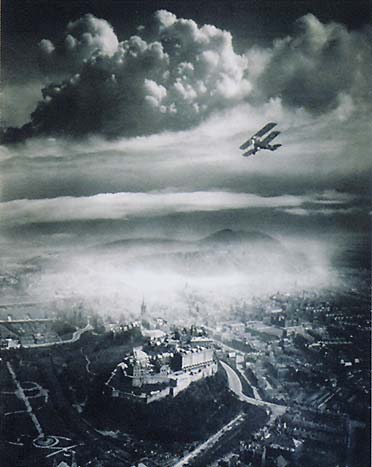
Moving into the twentieth century there are two striking aerial photographs of London and Edinburgh by Alfred George Buckham (complete with superimposed images of an aeroplane). In a room on the ‘new Britain’ covering the post-war period, the curators include more aerial views, from geographer J.A. Steers’ book The Coast of England and Wales (1946), along with some Country Life Picture Books, colour guide book photographs by Walter Arthur Poucher and W.G. Hoskins’ The Making of the English Landscape (although I’m not sure why this last book was particularly relevant to a photography exhibition). Geoffrey Grigson always crops up in anything to do with mid-century British landscape, and he makes an appearance here as editor of An English Farmhouse and its Neighbourhood (1948), with photographs by Percy Hennell.
Among more recent photographers, the exhibition includes some post-industrial scenes by John Davies - he has a homepage with various landscape photographs and images of Rachel Whiteread’s House. There is a neat (too neat?) juxtaposition of ghastly modern suburban houses photographed by Fergus Heron and David Spero’s shots of hopeful but rather fragile looking eco-houses from his Settlements project (which were discussed in a Guardian article here). There are some of Jonathan Olley’s sea wall pictures and two of Jem Southam’s intriguing large format photographs of The Pond at Upton Pyne – a fuller set of these can be seen at the V&A site. Finally there is one of Dan Holdsworth’s ‘Machine for Living’ non-spaces and a rather stunning photograph of a ‘slight disturbance of the sea’ by Simon Norfolk (the first image reproduced in this BLDGBLOG post).
I made a note of some of the landscapes in the exhibition, listed here with links to earlier posts where I’ve talked before about some of the photographers. In the first room, apart from Fenton, there are early photographs by William Henry Fox Talbot, picturesque countryside scenes by Benjamin Brecknell Turner (1815-94), photographs to accompany the Ordnance Survey by Sir Henry James (1803-77), and commercial landscape photographs by Francis Frith (1822-98) – Frith established a family firm that lasted until 1971 and whose images are viewable online at the Francis Frith site.
Moving into the twentieth century there are two striking aerial photographs of London and Edinburgh by Alfred George Buckham (complete with superimposed images of an aeroplane). In a room on the ‘new Britain’ covering the post-war period, the curators include more aerial views, from geographer J.A. Steers’ book The Coast of England and Wales (1946), along with some Country Life Picture Books, colour guide book photographs by Walter Arthur Poucher and W.G. Hoskins’ The Making of the English Landscape (although I’m not sure why this last book was particularly relevant to a photography exhibition). Geoffrey Grigson always crops up in anything to do with mid-century British landscape, and he makes an appearance here as editor of An English Farmhouse and its Neighbourhood (1948), with photographs by Percy Hennell.
Among more recent photographers, the exhibition includes some post-industrial scenes by John Davies - he has a homepage with various landscape photographs and images of Rachel Whiteread’s House. There is a neat (too neat?) juxtaposition of ghastly modern suburban houses photographed by Fergus Heron and David Spero’s shots of hopeful but rather fragile looking eco-houses from his Settlements project (which were discussed in a Guardian article here). There are some of Jonathan Olley’s sea wall pictures and two of Jem Southam’s intriguing large format photographs of The Pond at Upton Pyne – a fuller set of these can be seen at the V&A site. Finally there is one of Dan Holdsworth’s ‘Machine for Living’ non-spaces and a rather stunning photograph of a ‘slight disturbance of the sea’ by Simon Norfolk (the first image reproduced in this BLDGBLOG post).
Labels:
aerial landscapes,
Geoffrey Grigson
Location:
Furness Abbey
Sunday, June 24, 2007
Lightning Field
Looking at the archives of the excellent Cabinet Magazine today I came upon some artists’ impressions of Walter De Maria’s Lightning Field (1977), under the title ‘Please Draw That Famous Photograph of The Lightning Field From Memory’. The 'photograph' they are trying to remember is one of the most iconic in recent art, and certainly one of the images that defines ‘land art’, although the resulting pictures suggest they are not all remembering one specific photograph. Nobody is allowed to photograph the site - restrictions placed long before circulation of images on the internet could be imagined. [Update 2014: It would be interesting if Lightning Field came increasingly to be appreciated through artist's impressions, imprecise enough to avoid copyright restrictions. I just commissioned my young son to provide his own version, below].
The Lightning Field site itself, like Smithson’s Spiral Jetty, is now a place of pilgrimage, as described for example on Todd Gibson’s blog: 'As the sun drops in the sky when evening approaches, the field becomes different. A shadow grows from the base of each pole, giving it additional definition. The more veiled, angled light of evening begins to reflect off the poles, bringing into view the whole mile-long by kilometer-wide field. Watching this happen, it’s as if your vision suddenly sharpens. The field emerges from the landscape in its totality. If you happen to be there on a night that is not overcast and you get a brilliant orange sunset, the effect is stunning. The poles reflect that light, flashing orange, setting the field ablaze with color.'
I’ve always been intrigued by De Maria for his connection to the New York avant garde music scene - he was briefly in an early version of the Velvet Underground, as he recalls in an old interview at the Archives of American Art. Ubuweb has two sound recordings by De Maria: ‘Cricket Music’ (1964) and ‘Ocean Music’ (1968). [Update 2014: De Maria sadly died last year and The Independent's obituary emphasises the music link, 'Walter De Maria: Artist who forsook a career with The Velvet Underground to create electric, enigmatic installations'. Other obituaries appeared in the New York Times, and Los Angeles Times.]
The Lightning Field site itself, like Smithson’s Spiral Jetty, is now a place of pilgrimage, as described for example on Todd Gibson’s blog: 'As the sun drops in the sky when evening approaches, the field becomes different. A shadow grows from the base of each pole, giving it additional definition. The more veiled, angled light of evening begins to reflect off the poles, bringing into view the whole mile-long by kilometer-wide field. Watching this happen, it’s as if your vision suddenly sharpens. The field emerges from the landscape in its totality. If you happen to be there on a night that is not overcast and you get a brilliant orange sunset, the effect is stunning. The poles reflect that light, flashing orange, setting the field ablaze with color.'
I’ve always been intrigued by De Maria for his connection to the New York avant garde music scene - he was briefly in an early version of the Velvet Underground, as he recalls in an old interview at the Archives of American Art. Ubuweb has two sound recordings by De Maria: ‘Cricket Music’ (1964) and ‘Ocean Music’ (1968). [Update 2014: De Maria sadly died last year and The Independent's obituary emphasises the music link, 'Walter De Maria: Artist who forsook a career with The Velvet Underground to create electric, enigmatic installations'. Other obituaries appeared in the New York Times, and Los Angeles Times.]
Saturday, June 23, 2007
A yew on the chalk downs
'In England the light presses from above. It is not the clear white light of warmer countries, but it is dominant; there is a glitter at midday on glabrous leaves and lustrous glimmering flowers which drain the life from the colour so that only under a leaden sky or at twilight can a planned effect achieve its fullest value... Take for example, the nebulous shape of a yew on the chalk downs, where it appears sporadically and grows to greater perfection than many evergreens. Against rolling light green grassland it has no connection, no vital link of similarity or even of contrast to weld it to the surrounds. The grass lifts up, the yew tree weighs it down; there is a lack of balance in colours and forms. See the same tree against the jagged whiteness of a chalk-pit, and the aesthetic effect is at once satisfactory.'
This is Christopher Tunnard, writing with an appealing old-fashioned self-confidence about the aesthetics of landscape in his book Gardens in the Modern Landscape (1938). He concludes with recommendations that 'the yew tree on a lawn is less powerful emotionally than one placed in relationship to buildings; from the grey stones of a churchyard it draws the necessary illumination to enhance its form.' Soon after writing this Tunnard left the English light behind to take up a post at Harvard, and then after the war he rather drifted away from landscape design, concentrating instead on urban planning.
Thursday, June 21, 2007
Unfamiliar Wind (Leeks Hills)
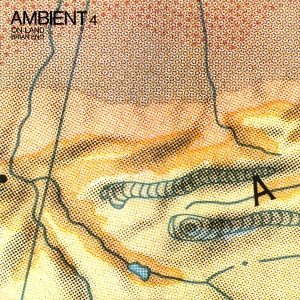
There's often precious little useful information on the internet about poets and artists who have involved themselves in landscape, but one thing the web is usually good for is popular music. Brian Eno, for instance, is unsurprisingly well served by various sites - most obviously Enoweb, which contains, for example, these comments from the sleeve notes to a reissue of On Land (1982).

Eno writes that "from Another Green World [1975] onwards I became interested in exaggerating and inventing rather than replicating spaces, experimenting in particular with various techniques of time distortion. This record represents one culmination of that development and in it the landscape has ceased to be a backdrop for something else to happen in front of; instead, everything that happens is a part of the landscape. There is no longer a sharp distinction between foreground and background.
In using the term landscape I am thinking of places, times, climates and the moods that they evoke. And of expanded moments of memory too... One of the inspirations for this record was Fellini's Amarcord (I Remember), a presumably unfaithful reconstruction of childhood moments. Watching that film, I imagined an aural counterpart to it, and that became one of the threads woven into the fabric of the music.
What qualified a piece for inclusion on the record was that it took me somewhere, but this might be somewhere that I'd never been before, or somewhere I'd only imagined going to. Lantern Marsh, for example, is a place only a few miles from where I grew up in East Anglia, but my experience of it derives not from having visited it (although I almost certainly did) but from having subsequently seen it on a map and imagining where and what it might be. We feel affinities not only with the past, but also with the futures that didn't materialize, and with the other variations of the present that we suspect run parallel to the one we have agreed to live in."
In a subsequent interview he explained the need to avoid New Age pastoral landscape music by providing a texture of more dissonant sounds. "Texture is information. Texture is only form looked at from a distance. If you look at this carpet, you perceive it as texture, but if you looked closer, you would see that it's actually a whole lot of forms. If you take birdsong -which is one of the aural textures of being in the country - the fact of it is that much of it is the sound of alarms and distress and attack.
"Landscape is a funny word for me, because it does conjure up pictures of nice little paintings with little paths going down them, but landscape really is and always has been a depiction of a psychological space, often of psychological cataclysm. it doesn't imply peacefulness, not to me.
"On the whole On Land is quite a disturbed landscape: some of the undertones deliberately threaten the overtones, so you get the pastoral prettiness on top, but underneath there's a dissonance that's like an impending earthquake."
As I write this entry I'm listening to a particularly effective track from the album, 'Unfamiliar Wind (Leeks Hills)'. According to the Wikipedia entry on the album, Eno explained that "Leeks Hills is a little wood (much smaller now than when I was young, and this not merely the effect of age and memory) which stands between Woodbridge and Melton. There isn't a whole lot left of it now, but it used to be quite extensive. To find it you travel down the main road connecting Woodbridge and it lies to your left as you go down the hill"
Location:
Leeks Hill
Sunday, June 17, 2007
Somewhere near Allonville
Paul Nash, Spring in the Trenches, Ridge Wood, 1917
An interesting article in the LRB a few weeks ago by Brian Dillon included a quote from Paul Nash describing the strange beauty of no-man's land: 'The mud is dried to a pinky colour and and upon the parapet, and through sandbags even, the green grass pushes up and waves in the breeze, while clots of bright dandelions, clover, thistles and twenty other plants flourish luxuriantly, brilliant growths of bright green against the pink earth.' Dillon was reviewing Defiant Gardens: Making Gardens in Wartime, by Kenneth Helphand, which discusses the attempts of soldiers and prisoners to find ways of cultivating small patches of beauty, or catching a glimpse of a better world, like the 'pair of Australians lounging in a meadow picking wildflowers, somewhere near Allonville. The image is purest pastoral: an aesthetic that flourished in soldiers' presentations of themselves to the camera, or to their own journals.'
There is more on this book at the National Public Radio site, including a photograph of a Japanese stone garden made at the Manzanar Internment Camp in California.
Photographs are now on Wikimedia Commons, this by Davefoc.
Towards the end of his life, during the Second World War, Paul Nash again saw flowers, this time in the air. In his posthumously published essay Aerial Flowers he wrote
'When the war came, suddenly the sky was upon us all like a huge hawk, hovering, threatening. Everyone was searching the sky, expecting the terror to fall: I among them scanned the low clouds … hunting the sky for what I most dreaded in my imagining. It was a white flower. Ever since the Spanish Civil War the idea of the Rose of Death, the name the Spaniards gave to the parachute, had haunted my mind, so that when the war overtook us I strained my eyes always to see that dreadful miracle of the sky blossoming with these floating flowers.'
Paul Nash, Flight of the Magnolia, 1944
Source: Tate Gallery - public domain (image added 2017)
Labels:
gardens,
Paul Nash,
war landscapes
Location:
Allonville, France
Sunday, June 10, 2007
Ocean Surface
Still thinking about John Cheever’s the Swimmer... if I were to curate an art exhibition on the theme of this story I would certainly want to include Ed Ruscha’s Nine Swimming Pools. I was looking at this last week in an exhibition at Tate St Ives inspired by Brian Wilson, where it is included along with Ruscha’s Thirty-Four Parking Lots (which I wrote about here). The exhibition has the poetic title If Everybody Had an Ocean, which is the first line of ‘Surfing USA’ (I now realise I always heard this as ‘everybody had a notion’ – which sounds pretty lame in comparison!) Of course Brian Wilson didn’t write the Beach Boys’ lyrics so the exhibition’s quotations from their songs are themselves the work of people inspired by Wilson’s music – Tony Asher, Van Dyke Parks etc. Anyway, it’s a nice exhibition which we saw on a beautiful sunny day when the sea was as blue as a Californian swimming pool.
One of the other artists featured in the exhibition is Vija Celmins, a favourite artist of Mrs Plinius, who enjoyed the exhibition of Celmins prints like Ocean Surface Wood Engraving (2000) at the Met a few years back. Celmins’ seascapes remind me of the Roni Horn river water images mentioned last week, as well as the seas photographed by Hiroshi Sugimoto (which I discussed briefly here). The PBS site explains that ‘Celmins received international attention early on for her renditions of natural scenes—often copied from photographs that lack a point of reference, horizon, or discernable depth of field. Armed with a nuanced palette of blacks and grays, Celmins renders these limitless space—seascapes, night skies, and the barren desert floor—with an uncanny accuracy, working for months on a single image.’ I was interested to read in the PBS interview how Celmins relates herself to Cézanne, whom she sees as having had ‘a really gutsy relationship between the image and the plain flat object. He has such a wonderful way of pointing that out to you in every stroke. And also the fact—which I think was a great part of the twentieth century—that this is an invented thing, you know? That it’s not like a copy of nature, or a copy of photograph. It’s an invented thing that you have in front of you, you know? So I think I kind of have that in me somewhere, this relationship.’
Location:
The Ocean
Saturday, June 02, 2007
Hot Pot at Strútur
The new issue of Tate etc. includes a piece by Roni Horn. Few artists write as well and I think we can assume she didn't come up with the silly title for the article! She discusses her footnoted photographs of the River Thames, which I've mentioned here before and which I think must be one of the best contemporary art works about London. She also talks about Iceland and relates her experiences to The Swimmer, played by Burt Lancaster in the film of John Cheever's story. On a simple level, the way the character experiences his environment is bound to be inspiring for landscape artists, and was the basis for the Roger Deakin book Waterlog. But Roni Horn also talks about the vulnerability of the swimmer and the way the Icelandic landscape offers a mixture of bleak emptiness and sheltering protection.
"I first went to Iceland in 1975. I travelled with a tent, hitchhiking and walking, then on a motorcycle, but still with a tent. So I was outside most of the time, and I often found myself heading for the hot springs. They became a kind of shelter. They took the form of hot pots or swimming pools. Sometimes they are located in remote places, so I found myself pool-hopping to these exquisite faraway places and spending a lot of time in the middle of nowhere, outside, in hot water. It struck me at the time as a great combination. When I look back, I am reminded of Burt Lancaster in the film called The Swimmer. He is divorced and having had the time of his life for years, he now wants to go home; he's alone. And so he is swimming home, pool-hopping home, and home is somewhere in suburban Connecticut. And you watch him going from one backyard to the next. He was in a swimsuit throughout the whole film and you felt his sensitivity to everything, and his vulnerability. So here I am, looking for shelter. and those pools were a great form of shelter. I was in these amazing settings, way out there in the thick of it, so to speak, alone but protected. Sometimes in the middle of a desert. For me, a desert is confrontational in a way, because it's so dogmatic. But here it was a totally sensual experience. And that happened a lot in Iceland, where you were in places that you would normally associate with difficult, aggressive things and they became alluring and attractive, comforting really."

"I first went to Iceland in 1975. I travelled with a tent, hitchhiking and walking, then on a motorcycle, but still with a tent. So I was outside most of the time, and I often found myself heading for the hot springs. They became a kind of shelter. They took the form of hot pots or swimming pools. Sometimes they are located in remote places, so I found myself pool-hopping to these exquisite faraway places and spending a lot of time in the middle of nowhere, outside, in hot water. It struck me at the time as a great combination. When I look back, I am reminded of Burt Lancaster in the film called The Swimmer. He is divorced and having had the time of his life for years, he now wants to go home; he's alone. And so he is swimming home, pool-hopping home, and home is somewhere in suburban Connecticut. And you watch him going from one backyard to the next. He was in a swimsuit throughout the whole film and you felt his sensitivity to everything, and his vulnerability. So here I am, looking for shelter. and those pools were a great form of shelter. I was in these amazing settings, way out there in the thick of it, so to speak, alone but protected. Sometimes in the middle of a desert. For me, a desert is confrontational in a way, because it's so dogmatic. But here it was a totally sensual experience. And that happened a lot in Iceland, where you were in places that you would normally associate with difficult, aggressive things and they became alluring and attractive, comforting really."

The cover of the excellent Phaidon book on Roni Horn, showing the Hot Pot at Strútur (1991)
Sunday, May 27, 2007
Landscape near Felpham
I have already mentioned here the exhibition in Chichester, ‘Poets in the Landscape’, and I have now been to see it. It is like three little exhibitions in one.
The first room focuses on the local poet William Hayley (1745-1820) who was a friend of artists such as Blake, Romney and Joseph Wright of Derby. Hayley is not well known now and the catalogue quotes a letter from Southey to Coleridge in 1802 – ‘everything about that man is good, except his poetry.’ He does however provide an interesting figure from which to view the links between poetry and painting at the end of the eighteenth century. The highlight in this room is an unusual watercolour by Blake that I don’t recall seeing before (although it is in the Tate) – a pale, unfinished sketch with a hint of Turner about it: Landscape near Felpham (c1800).
The second room is a fascinating display of engravings and etchings, encompassing the familiar pastoral poetry of Blake, Palmer and the Ancients, and their followers in the 1920s: Goldsmiths students Graham Sutherland, Robin Tanner, Paul Drury, their teacher F.L. Griggs, and contemporary Joseph Webb. Sutherland saw his first Palmer etching when a fellow student bought one in a shop on the Charing Cross Road (those were the days!) He, Tanner and Drury made a pilgrimage to Shoreham and ‘even wore cloaks in imitation of the Ancients’.
The third room includes Neo-Romantic artists like Sutherland, John Piper and Paul Nash, with particular reference again to their links with poetry, through book illustration and work for Horizon, Penguin New Writing and Poetry London. There is Geoffrey Grigson’s The Poet’s Eye, for example, with illustrations by John Craxton: the first in a series of seven anthologies, New Excursions into English Poetry, whose general editors were Sheila Shannon and Walter James Turner. Other volumes included English, Scottish and Welsh Landscape, illustrated by Piper with verse chosen by John Betjeman and Geoffrey Taylor, and Sea Poems chosen by Myfanwy Piper and illustrated by Mona Moore. Walter James Turner was the general editor of Britain in Pictures, a series covering various aspects of Britishness, including Romanticism: John Piper’s British Romantic Art traced the tradition from Wilson, Blake and Constable through to Nash and Sutherland. Other volumes included Grigson’s English Landscape, Betjeman’s English Churches, Vita Sackville-West’s English Country houses, Lord David Cecil’s English Poets and Stephen Bone’s British Weather.
Labels:
Geoffrey Grigson,
John Piper,
William Blake
Location:
Felpham
Saturday, May 26, 2007
Floating Island at Hawkshead
In 1188 Gerald of Wales and Archbishop Baldwin went on a preaching tour to gain support for the Third Crusade. Their travels were written up in Gerald's The Journey Through Wales, which includes a good example of pre-Romantic description of mountains. When Gerald reached Snowdonia his interest centred not on the snowy peaks and cataracts, but on their usefulness as extensive grazing-grounds (illustrated with a quotation from Virgil) and some of the marvels you could apparently see there:
- A lake with a floating island, blown around by the winds
- Another lake in which the eels, perch and trout all had only one eye
- An eagle that waited to feed on men killed in battle, perched on a particular stone with a hole pierced through it where the eagle would clean and sharpens its beak.
Once did I see a slip of earth
By throbbing waves long undermined,
Loosed from its hold--how no one knew,
But all might see it float, obedient to the wind;Might see it from the verdant shore
Dissevered float upon the lake,
Float with its crest of trees adorned
On which the warbling birds their pastime take...
Location:
Hawkshead, Cumbria
Sunday, May 20, 2007
Dover Beach
‘Dover Beach’ is one of the most famous poems in English, not for the landscape, ‘where the sea meets the moon-blanched land’, nor even the soundscape, ‘the grating roar / of pebbles which the waves draw back, and fling, / At their return, up the high strand...’, but for the metaphor prompted by the poet’s impression of the tide receding:
The Sea of Faith
Was once, too, at the full, and round earth's shore
Lay like the folds of a bright girdle furled.
But now I only hear
Its melancholy, long, withdrawing roar,
Retreating, to the breath
Of the night-wind, down the vast edges drear
And naked shingles of the world.
Was once, too, at the full, and round earth's shore
Lay like the folds of a bright girdle furled.
But now I only hear
Its melancholy, long, withdrawing roar,
Retreating, to the breath
Of the night-wind, down the vast edges drear
And naked shingles of the world.
Matthew Arnold’s poem was the starting point for an interesting edition of In Our Time on ‘Victorian Pessimism’. (I have spent the last week doing little but listen to old programmes in this series following an eye injury on Tuesday – today I feel just about able to look at the screen again.) The In Our Time survey of pessimism in nineteenth century culture also included Thomas Hardy’s poem ‘In A Wood’ where landscape clearly lacks the redemptive qualities it had for the Romantics. ‘Dreaming that sylvan peace / Offered the harrowed ease— / Nature a soft release / From men’s unrest’, Hardy finds in the wood only ‘great growths and small... to men akin— / Combatants all!’
Subscribe to:
Posts (Atom)